Ultra Zionists Take Manhattan, and Demand the Holy Land

Indepedent journalist Max Blumenthal has just released his latest video.  This one deals Jewish extremists at a New York city rally that closely resemble members of the American Tea Party movement.

Blumenthal writes the following.

On April 25, over 1000 New York-area Jewish extremists gathered in midtown Manhattan to rally against the Barack Obama administration’s call for a freeze on construction in occupied East Jerusalem and to demand unlimited rights to colonize the West Bank. With Obama and top White House officials engaged in a charm offensive to repair their relationship with mainstream American Jewish organizations, speakers at the rally lashed out at the Jewish groups and Democratic politicians, warning that cozying up to Obama would endanger Israel and imperil their cherished settlement enterprise.

I’ll let Blumenthal’s video tell the rest.

Last year, Blumenthal, along with Joseph Dana, produced the famous “Feeling the Love in Jerusalem” video that was banned on YouTube and Huffington Post. He also produced “Bomb a Ghetto, Raise a Cheer,” a video documenting pro-Israeli teabaggers rallying in support of Operation Cast Lead. For more of Blumenthal’s works click here.

The Price of Translating a Narrative and its Context (The King is Out: Part V)

Karan Johar falteringly attempts to fashion a cinematic alliance of sorts between African-Americans and South Asians — very unusual in the Bollywood context and more so for Karan Johar, himself — but fails to seize the radical politics embedded. One wishes that the spirit of this song was continuously re-thought, re-energized, re-contextualized, re-translated. A revolution that stops moving, stops “revolving,” is nothing but an aborted one.

by Huma Dar

[read Part I Part II Part III Part IV]


In an interesting twist, Karan Johar’s My Name is Khan displaces or translates (one original meaning of “translate” is to bear or carry across from one place to another) the convoluted and complex, determining context from India, with a specific genealogy, on to the US.  The post-9/11 circumstances provide some unfortunate resonances, yet much of the untranslated/untranslatable context results in the particular aporias of the filmic text.  Even beyond Mandira’s furious and irrational directive to Rizwan Khan, he has to go around saying his name is Khan and “he is not a terrorist” because in that originary terrain of imposed defensiveness there is not much space for a “Muslim name” (besides certain limited spheres), leave alone for “My Name is Khan, and I am an American.”  This latter, more “affirmative” alternative to the “apologetic” cinematic version, is proposed by Suad Abdul-Khabeer in her excellent critique of the film.

Continue reading “The Price of Translating a Narrative and its Context (The King is Out: Part V)”

A Suitable Boy, “Decent” People, and Names that Pass (The King is Out: Part IV)

by Huma Dar

[read Part I Part II Part III]

Ripping Apart the King, Separating Him from Kajol

In the second half of the film, My Name is Khan (2010), Karan Johar shows that Rizwan Khan’s wife, Mandira (played by Kajol) is on a personal journey to obtain justice for her son and accountability from the perpetrators of a hate crime.  It is thus ironic that Mandira’s own negligence towards Rizwan Khan (played by SRK) and the lack of accountability for making him set off on an ostensibly unfeasible mission, albeit in a fit of grief and anger, is not problematized at all in the film.  A mission that might very well have remained unfulfilled but for Rizwan Khan’s Herculean efforts, his unusual talents and disabilities, and a string of exceptional circumstances.  Rizwan Khan, given his Asperger’s syndrome, “fear of new places,” and his Muslimness (actively practiced), would have been equally, if not more, susceptible to the kind of hate crime that victimized Mandira’s son.  After the initial outburst at the place of death, Mandira had had enough time to re-think  the consequences of her angry directive to Khan, yet she never apologizes to Khan.  Here too, the immediate context of Bollywood, the multiple Hindu-Muslim marriages amongst the stars of Bombay, and the general lack of acceptance of such marriages in mainstream India are crucial to keep in mind.

Continue reading “A Suitable Boy, “Decent” People, and Names that Pass (The King is Out: Part IV)”

Placating the gods of Citizenship: the Ritual Sacrifice (The King is Out: Part III)

The obligatory declaration of cinematic patriotism for Indian Muslims necessitates a continuous performance of “loyal citizenship” invariably through offering the sacrifice of a “disloyal” one. This leaves little space for critical engagement with the nation and the state.

by Huma Dar

[read Part I Part II]


King Khan and his divinity

The obligatory declaration of cinematic patriotism for Indian Muslims (discussed in Parts I and II earlier) necessitates a continuous performance of “loyal citizenship” invariably through offering the sacrifice of a “disloyal” one. This leaves little space for critical engagement with the nation, the state, and the unending wars.  An example of this ritual performance is the sequence in My Name is Khan where Rizwan Khan, played by Shahrukh Khan (SRK), reports the “doctor” in the Los Angeles Masjid to the FBI.  How do we know the “bad” doctor is an al-Qaeda member or a terrorist?  Dr. Faisal Rahman does indeed talk about his “blood boiling” at the oppression of the Muslim Ummah in Iraq, Afghanistan, Palestine, Chechnya, Kashmir et al and even exhorts the handful of audience in a completely open space inside the Masjid to “join him and do something.”  The details of that “something” are never revealed.

Continue reading “Placating the gods of Citizenship: the Ritual Sacrifice (The King is Out: Part III)”

Shahrukh Khan and the Pound of Flesh: the Cost of Stardom (The King is Out: Part II)

by Huma Dar

[read Part I]

Shahrukh Khan (SRK) has a long history of playing the fraught field (of the Indian context) with flawless diplomacy, perhaps even overplaying the field.  In early 2002, precisely during the days of the state-sponsored anti-Muslim pogroms in Indian Gujarat, the then Indian Prime Minister Atal Bihari Vajpayee, from BJP (a Hindu Nationalist party), released an MTV-esque album,Samvedna [Sensitivity]. Widely broadcast on Doordarshan, the State-owned television channel, as well as on Indian-American programs (at least in the San Francisco Bay Area), the video features Vajpayee reciting his Hindi poetry while Jagjit Singh, the ghazal singer, sings in tune.  The album is prefaced by the rhapsodizing words of Javed Akhtar — another famous Muslim from Bollywood, narrated by Amitabh Bachhan.

Continue reading “Shahrukh Khan and the Pound of Flesh: the Cost of Stardom (The King is Out: Part II)”

“Veil in the Time of War” or “Veilin’ the Time of War”

In the context of the current multiple arenas of war and occupation in Muslim-majority regions, the issues of gender and sexuality are vitally linked to the casus belli, both within and without academia. Such linkages, with a long and complicated genealogy thoroughly imbricated in the politics of colonization, decolonization, and neo-colonization, also indicate an obsessive desire to re-enact the “discovery narrative” or the “rescue narrative.” Examining current contestations in popular media – including recent articles written by Maureen Dowd, Naomi Wolf and Phyllis Chesler et al and the poster designed by Alexander Segert, which was integral to the success of the anti-minaret Swiss referendum – this essay investigates whether, how, and where the neoconservative, neoliberal, and the mainstream feminist discourses converge, diverge, and intersect.

Segert's Anti-Minaret Poster

by Huma Dar

In the context of the current multiple arenas of war and occupation in Muslim-majority regions, the issues of gender and sexuality are vitally linked to the casus belli, both within and without academia.  Such linkages, with a long and complicated genealogy thoroughly imbricated in the politics of colonization, decolonization, and neo-colonization, theorized by Inderpal Grewal, Gayatri Spivak, Lata Mani, Leila Ahmed, Sherene Razack, Saba Mahmood, Sunera Thobani amongst others, also indicate an obsessive desire to re-enact the “discovery narrative” or the “rescue narrative.”  Examining current contestations in popular media – including recent articles written by Maureen Dowd, Naomi Wolf and Phyllis Chesler et al and the poster designed by Alexander Segert, which was integral to the success of the anti-minaret Swiss referendum – I investigate whether, how, and where the neoconservative, neoliberal, and the mainstream feminist discourses converge, diverge, and intersect.  I undertake to deconstruct the ongoing debates that obsessively revolve around the veil or the sexuality that is variously professed to be suppressed, annihilated, or even “discovered” beneath the veil by some liberal explorers.

Continue reading ““Veil in the Time of War” or “Veilin’ the Time of War””

The King is Out, His Name is Khan: Long Live the King (Part I)

My Name is Khan, although narratively based mostly in the USA, has to be theorized within and around the framework of Bollywood; the Urdu-Hindi film history, and its transnational circuits of production, distribution, and consumption; Shahrukh Khan’s star narrative, and the determining context of the Indian political scene along with that in the US and its “war on/of terror.”

by Huma Dar


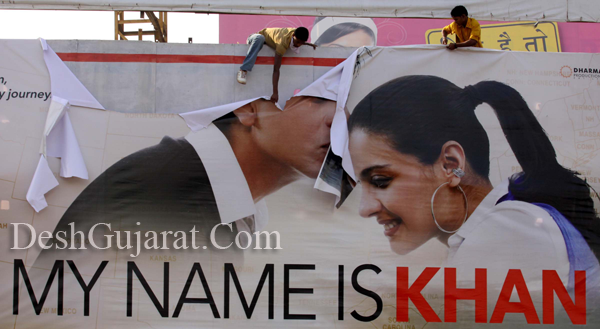
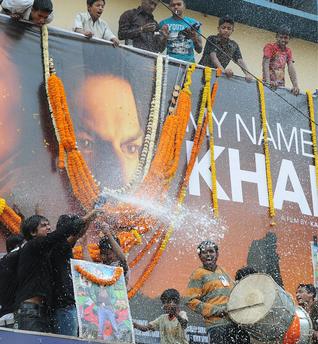
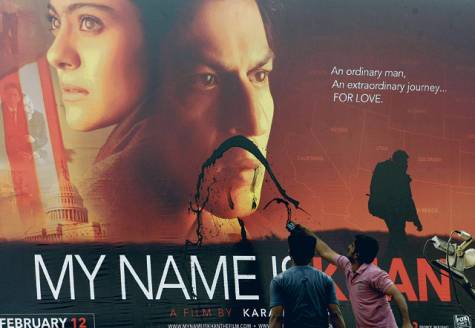
The Defacing of Khan: It's Not Easy Being Muslim in Mumbai or in Newark

My Name is Khan, although narratively based mostly in the USA, has to be understood and theorized within and around the framework of Bollywood; the Urdu-Hindi film history and its transnational circuits of production, distribution, and consumption; Shahrukh Khan’s star narrative, and the determining context of the Indian political scene along with that in the US and its “War on/of Terror.”  Even prior to the Indian Partition in 1947, most Muslim artists had what Sa’adat Hasan Manto (1912-1955) mockingly called “shuddified” or Hinduized names – Dilip Kumar for Yusuf Khan, Madhubala for Mumtaz Begum Jahan Dehlavi (1933-1969), Meena Kumari for Mahjabeen Bano (1932-1972), or the more ambivalent (non-halal) Johnny Walker for Badruddin Jamaluddin Qazi (1923-2003) and Nargis for Fatima Rashid (1929-1981).  At the contemporary moment, the biggest stars of the Urdu-Hindi film industry in India are Khans: Shahrukh, Salman, Aamir, Saif Ali et al.  It might therefore be tempting to conclude that the Bombay film industry is indeed a level playing field.  The Khans are all Muslims, at least nominally.  Cinematically, they enact, with a few notable exceptions, Hindu characters.  Culturally, the vigorous fanzines of Bollywood idolize them as comfortably suave denizens of metropolitan Bombay[Mumbai] with understated or unexpressed Muslimness — their Hindu wives, girlfriends, or mothers facilitating this imagined assimilation or passing.  Of course, for regular, non-filmi (“film-related” in Urdu-Hindi) Muslim men, this assimilation through marriage to Hindu women is generally frowned upon and can have potentially fatal consequences.

My ruminations on My Name is Khan, like a typical Urdu-Hindi film, lengthy and replete with intermissions, are an entryway into not just the film as cinematic text, but also its complex and rich transnational contexts that must be read in tandem.  In a series of six thematic posts, with this as the first, I will expand on:

(i) The (B)Onus of Muslimness in Bollywood

(ii) Shahrukh Khan and the Pound of Flesh: the Cost of Stardom

(iii) Placating the gods of Citizenship: the Ritual Sacrifice

(iv) A Suitable Boy, “Decent” People, and Names that Pass

(v) The Price of Translating a Narrative and its Context

(vi) Outing the Muslimness, Finally: Some Viewing (and Hearing) Pleasures

Continue reading “The King is Out, His Name is Khan: Long Live the King (Part I)”

ESRC, Islamophobia, and the British sense of humour

A couple of years back a leading Scots philosopher, a friend, applied for funding to the Economic and Social Research Council (ESRC), the main public research-funding body in the UK, to study the tradition of non-violence in Islam. After much delay, he received a letter from the ESRC in which an anonymous reviewer informed him that his bid had been rejected because ‘there is no tradition of non-violence in Islam’.

On 23 March 2010, the British Home Office’s counter-terrorism communications unit RICU announced its top 20 most influential “pro-Islamic” political bloggers. Topping the list are Ali Eteraz and the Angry Arab News Service. Eteraz is a US-based writer, an aggressive self-promoter, who is known less for his ‘pro-Islamic’ views than for his self-conscious cultivation of a ‘moderate’ image which has included forging friendly ties with the notoriously Islamophobic hate site Harry’s Place. Angry Arab News Service is run by As’ad AbuKhalil, a California-based Lebanese anarchist, and atheist. AbuKhalil’s daily output includes ritual denunciations of clerics and Islamists from North Africa to Saudi Arabia. He is an all opportunities offender (sometimes indiscriminately so).

The list was compiled based on research conducted by one David Stevens of Nottingham University whose work, according to his website, is focued ‘within the area of contemporary normative political philosophy’. The man obviously gazes from such Olympian heights that he can’t distinguish between the Pope and a pagan. And to his funders, it appears not to matter.

So who commissioned this exercise in fatuity? Why the ESRC of course.

Continue reading “ESRC, Islamophobia, and the British sense of humour”

(Neo)Orientalism with an Attitude: In the Footsteps (and Beyond) of Richard Burton

Getting one’s picture taken with the Dalai Lama or the Pope will guarantee neither Buddhist enlightenment nor beatification: my apologies for shattering the hopes of some New Agers. Similarly, entering the Ka’aba in Burtonesque disguise — specially minus his arguably relevant though shifty linguistic skills and textual knowledge — will not and cannot necessarily guarantee much “learning” about Islam.

by Huma Dar

The March 10, 2010, page A27 of the New York edition of New York Times carries an Op-Ed piece by Maureen Dowd titled, “Pilgrim Non Grata in Mecca.” Dowd writes about her desire to “learn about the religion that smashed into the American consciousness on 9/11” via “sneaking” into Mecca in “a black masquerade cloak.”  Her self-proclaimed inspiration is Richard Burton’s “illicit pilgrim[age] to the sacred black granite cube…in Arab garb” thereby “infiltrat[ing] the holiest place in Islam, the Kaaba [sic].”

Dowd, however, decides to “learn about Islam” in a way “less sneaky,” “disrespectful,” or “dangerous” and yet more entitled and privileged than Richard Burton could ever have dreamed of.   She herself describes Burton as “the 19th-century British adventurer, translator of “The Arabian Nights” and the “Kama Sutra” and self-described ‘amateur barbarian.'”  The words “illicit,” “Kama Sutra,” and “infiltration” and Dowd’s voyeuristic desires resonate with the Orientalism of yore.  Moreover Dowd’s valuable US passport and USA’s special relationship with Saudi Arabia (read: enabling of the oppressive monarchy) entitle her to meet Prince Saud al-Faisal, the Saudi foreign minister — of the “sometimes sly demeanor” — on her “odyssey” to that country.  “Infiltration” in disguise is no longer required, and yet this ease of access also disguises and makes more difficult the complexity of any real learning.

Dowd “presses” al-Faisal for the privilege to watch in Mecca, the “deeply private rituals” and “gawk at the parade of religious costumes fashioned from loose white sheets” although she knows in advance that “Saudis understandably have zero interest in outraging the rest of the Muslim world.”  While talking to this high-ranking minister, Dowd bristles at al-Faisal’s reassuring suggestion that if she desired to see any mosque in a place other than in Mecca or Medina, and was prevented from doing so, all she had to do was to contact the “emir of the region” who would comply and enable the fulfillment of her desires.  (Anyone else reminded of Aladdin’s djinn/genie?)  Without conceding the irony of the situation that she, after all, is speaking to Prince al-Faisal, the Saudi foreign minister, Dowd quips, “Sure. Just call the emir. I bet he’s listed.”   Imagine what Richard Burton would have done with the special privileges of this particular magic lamp provided by the New World Order!

Finally Dowd does indeed witness the Hajj — in an IMAX theatre watching Journey to Mecca: In the Footsteps of Ibn Battuta. Dowd, much to her surprise, makes the belated discovery that “the Kaaba [sic] was built by “Abraham, the father of the Jews” [why Jews only?]— a reminder that the faiths have a lot to learn from each other.”  It is also a reminder that journalists like Ms. Maureen Dowd have a lot of homework to do before they set out on their surely expensive travels — and I am not even including the much recommended language lessons.  Any commonly available text on Islam, for example by Karen Armstrong, Jamal Elias, Michael Sells, or Ziauddin Sardar, might have served the purpose.  Dowd could thus have avoided relying solely on the “amateur barbarian” Richard Burton or Newsweek’s own Fareed Zakaria.  The former’s scholarly credentials are hardly beyond doubt — see his problematic remarks on “Jewish human sacrifice” in The Jew, the Gipsy and el Islam (1898).  The latter’s forte is not his knowledge of Islam — or at least no more than Zakaria’s mentor, Samuel Huntington’s forte is Christianity.  Dowd might thus have disabused herself of the notion of “the sacred black granite cube.”  The “sacred black” stone is not a “cube” and neither is the “sacred cube” — the Ka’aba — all granite!

Getting one’s picture taken with the Dalai Lama or the Pope will guarantee neither Buddhist enlightenment nor beatification: my apologies for shattering the hopes of some New Agers.  Similarly, entering the Ka’aba in Burtonesque disguise — specially minus his arguably relevant though shifty linguistic skills and textual knowledge (See Parama Roy’s excellent essay for more on Burton) — will not and cannot necessarily guarantee much “learning” about Islam.  On the other hand, a trip to any local library with a willingness to read and learn, and engagement with an open mind in meaningful conversations with the (gasp!) American Muslims, might be better starting points for undertaking this particular journey.

Did the Editor of The New York Times not know the price difference between the ticket to the IMAX theatre plus membership to a local library and the cost of Dowd’s lavish travels to the Kingdom of Saudi Arabia?  The Neo-Orientalist fantasy to tread in the footsteps of Sir Richard Burton is accelerated with privilege and precisely because of this privilege skips and misses its target even more widely.

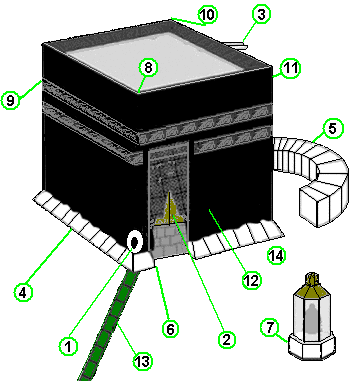
It is in the spirit of a gift that I offer Ms. Dowd this image:
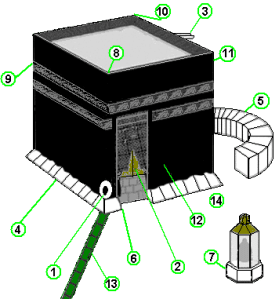
Labeled elements are as follows: 1 – The Black Stone; 2 – Door of the Kaaba; 3. Gutter to remove rainwater; 4 – Base of the Kaaba; 5 – Al-Hatim; 6 – Al-Multazam (the wall between the door of the Kaaba and black stone); 7 – The Station of Ibrahim; 8 – Angle of the Black Stone; 9 – Angle of Yemen; 10 – Angle of Syria; 11 – Angle of Iraq; 12 – Kiswa (veil covering the Kaaba); 13 – Band of marble marking the beginning and end of rounds; 14 – The Station of Gabriel.

How Western anti-Muslim bigotry became respectable

The Real News on the historic roots of the resilient ideology of Islamophobia.