Stephen Zunes and the Zionist Tinderbox

By Michael Barker

“[A]nti Zionism may be a ‘fool’s anti-imperialism,’ where Jewish nationalism itself is erroneously seen as the problem rather than the alliance its leaders have made with exploitative Western interests.”
Stephen Zunes, 2006.1

Who is Stephen Zunes? Well according to his web-site, he is a Professor of Politics and International Studies at the University of San Francisco, who in 2002 won recognition from the Peace and Justice Studies Association as Peace Scholar of the Year. Although Zunes describes himself as a committed peace loving, anti-imperialist activist, by reviewing just one of his books this article will demonstrate that in actual fact his scholarly actions belie such intent. The book in question is Tinderbox: U.S. Middle East Policy and the Roots of Terrorism (Zed Books, 2003), a popular text that received glowing accolades  from Noam Chomsky, Howard Zinn, Richard Falk, and Saul Landau (amongst others). This essay will illustrate how Zunes’ proclivity for defending Zionism ultimately leads hims to promote a “fool’s anti-imperialism.”

That is not to say that Zunes is uncritical of U.S. foreign policy, far from it, just that his work serves as a smokescreen for understanding the real drivers of U.S. foreign policy vis-a-vis the Middle East.

Continue reading “Stephen Zunes and the Zionist Tinderbox”

Hey, Elton!

Great video medley from filmmaker John Greyson, who writes: “Palestinian civil society has called on Elton John to respect its boycott call and cancel his June 17th concert in Tel Aviv. If he does so, he’ll be joining Santana and Gil-Scott Heron, who recently canceled their spring concerts in Israel. This video suggests six reasons why Elton should join the BDS (boycott, divestment, sanctions) movement.”


Continue reading “Hey, Elton!”

Jerusalem Day

by Ruth Tenne

Jerusalem Day was declared a national  holiday by the State of Israel on the 12th May 1968 in celebration of  the “liberation” of East Jerusalem and the  unification of the city in the aftermath of the 1967  Six-Day War. The medieval Maghrabi Quarter near the Jewish Wailing  Wall was demolished soon after, and its Palestinian  inhabitants were evicted in order to make way for an open space  for Jewish worshipers  [1]. To celebrate this occasion the victorious hymn  “Jerusalem of Gold” was written in glorification of the annexation of East Jerusalem and the reclaiming of the Western Wailing Wall .

In 1980 the Israeli Knesset passed the Basic Law: Jerusalem, Capital of Israel, confirming Jerusalem’s status as the nation’s “eternal and indivisible capital”.  UN Security Council Resolution 478 stated thereafter that the Jerusalem Law was “null and void and must be rescinded forthwith”. [2].   The Resolution instructed UN member-states to withdraw their diplomatic representation from the city – refusing to confer official status on Israel’s illegal act of annexation.

The UN position, however, did not deter Israel from its continued attempts to cleanse East Jerusalem of its Palestinian inhabitants by the use of force and military orders.  The so-called “City of Gold”  turned into a ghettoised place with  rubble from demolished Palestinian houses, razed Palestinian neighbourhoods , desecrated Muslim graveyards, and  dispossessed homeless  families serving as testimony to Israel’s  underlying  aim of  “purifying”  the city of  its indigenous Palestinian population. According to the Head  of the Israeli Committee Against House Demolitions – Jeff Halper –  only 11 percent of East Jerusalem land is available for Palestinian housing as result of Israel’s discriminatory policies which means  that  Jerusalemite Palestinians are virtually barred from 93 percent of the  municipality of  Jerusalem. The overall goal is to confine Palestinians to small enclaves in East Jerusalem, or to remove them from the city altogether – an action referred to by Israel as the “quiet transfer”.

Continue reading “Jerusalem Day”

Boycott Israel? Amitav Ghosh & the Dan David Prize

The call for academic and cultural boycott is clearly a way to encourage civil society to play a broader political role—that is why it has the support of wide sections of Palestinian civil society. One of the most significant questions that call poses to us is simply this: How could those of us who oppose apartheid, occupation, and colonialism not support such a call?

Dear Amitav Ghosh,

We wish to express our deep disappointment in your decision to accept the Dan David prize, administered by Tel Aviv University and to be awarded by the President of Israel. As a writer whose work has dwelled consistently on histories of colonialism and displacement, your refusal to take stance on the colonial question in the case of Israel and the occupation of Palestine has provoked deep dismay, frustration, and puzzlement among readers and fans of your work around the world. Many admired your principled stand, and respected your decision not to accept the Commonwealth Writers Prize in rejection of the colonialist framework it represented.

Continue reading “Boycott Israel? Amitav Ghosh & the Dan David Prize”

Can Obama make “peace” in the Middle East

Our dear friend Phil Weiss makes the most impressive interventions in this debate. He is also the first we have seen who knows how to handle Tim Sebastien well.

Doha Debates takes on the potential for a US brokered deal in the Middle East.

The Future of Palestine: Righteous Jews vs. the New Afrikaners

John J. Mearsheimer

This is the transcript of the Hisham B. Sharabi Memorial Lecture delivered by John J. Mearsheimer at the The Palestine Center today.

It is a great honor to be here at the Palestine Center to give the Sharabi Memorial Lecture.  I would like to thank Yousef Munnayer, the executive director of the Jerusalem Fund, for inviting me, and all of you for coming out to hear me speak this afternoon.

My topic is the future of Palestine, and by that I mean the future of the land between the Jordan River and the Mediterranean Sea, or what was long ago called Mandatory Palestine.  As you all know, that land is now broken into two parts: Israel proper or what is sometime called “Green Line” Israel and the Occupied Territories, which include the West Bank and Gaza.  In essence, my talk is about the future relationship between Israel and the Occupied Territories.

Of course, I am not just talking about the fate of those lands; I am also talking about the future of the people who live there.  I am talking about the future of the Jews and the Palestinians who are Israeli citizens, as well as the Palestinians who live in the Occupied Territories.

Continue reading “The Future of Palestine: Righteous Jews vs. the New Afrikaners”

Ultra Zionists Take Manhattan, and Demand the Holy Land

Indepedent journalist Max Blumenthal has just released his latest video.  This one deals Jewish extremists at a New York city rally that closely resemble members of the American Tea Party movement.

Blumenthal writes the following.

On April 25, over 1000 New York-area Jewish extremists gathered in midtown Manhattan to rally against the Barack Obama administration’s call for a freeze on construction in occupied East Jerusalem and to demand unlimited rights to colonize the West Bank. With Obama and top White House officials engaged in a charm offensive to repair their relationship with mainstream American Jewish organizations, speakers at the rally lashed out at the Jewish groups and Democratic politicians, warning that cozying up to Obama would endanger Israel and imperil their cherished settlement enterprise.

I’ll let Blumenthal’s video tell the rest.

Last year, Blumenthal, along with Joseph Dana, produced the famous “Feeling the Love in Jerusalem” video that was banned on YouTube and Huffington Post. He also produced “Bomb a Ghetto, Raise a Cheer,” a video documenting pro-Israeli teabaggers rallying in support of Operation Cast Lead. For more of Blumenthal’s works click here.

A Suitable Boy, “Decent” People, and Names that Pass (The King is Out: Part IV)

by Huma Dar

[read Part I Part II Part III]

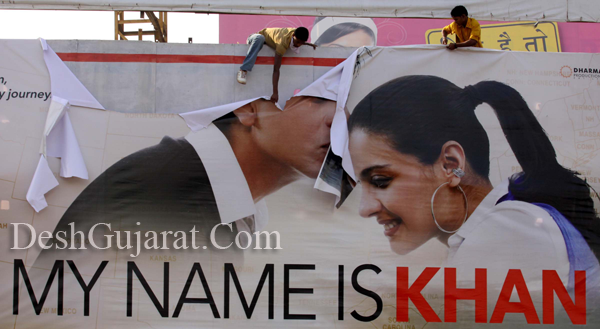
Ripping Apart the King, Separating Him from Kajol

In the second half of the film, My Name is Khan (2010), Karan Johar shows that Rizwan Khan’s wife, Mandira (played by Kajol) is on a personal journey to obtain justice for her son and accountability from the perpetrators of a hate crime.  It is thus ironic that Mandira’s own negligence towards Rizwan Khan (played by SRK) and the lack of accountability for making him set off on an ostensibly unfeasible mission, albeit in a fit of grief and anger, is not problematized at all in the film.  A mission that might very well have remained unfulfilled but for Rizwan Khan’s Herculean efforts, his unusual talents and disabilities, and a string of exceptional circumstances.  Rizwan Khan, given his Asperger’s syndrome, “fear of new places,” and his Muslimness (actively practiced), would have been equally, if not more, susceptible to the kind of hate crime that victimized Mandira’s son.  After the initial outburst at the place of death, Mandira had had enough time to re-think  the consequences of her angry directive to Khan, yet she never apologizes to Khan.  Here too, the immediate context of Bollywood, the multiple Hindu-Muslim marriages amongst the stars of Bombay, and the general lack of acceptance of such marriages in mainstream India are crucial to keep in mind.

Continue reading “A Suitable Boy, “Decent” People, and Names that Pass (The King is Out: Part IV)”

With Brothers Like This

This Memorial eve, culture in Israel took a turn to the right. Highly respected artist, Amir Bennayun, has written a song that can only described as messianic hateful state incitement and propaganda. Here it is in all its disgusting glory [lyrics below limited by my translation]:

I Am Your Brother

Continue reading “With Brothers Like This”