Drones and Democracy

by Kathy Kelly and Josh Brollier

Islamabad: On May 12th, the day after a U.S. drone strike killed 24 people in Pakistan’s North Waziristan, two men from the area agreed to tell us their perspective as eyewitnesses of previous drone strikes.

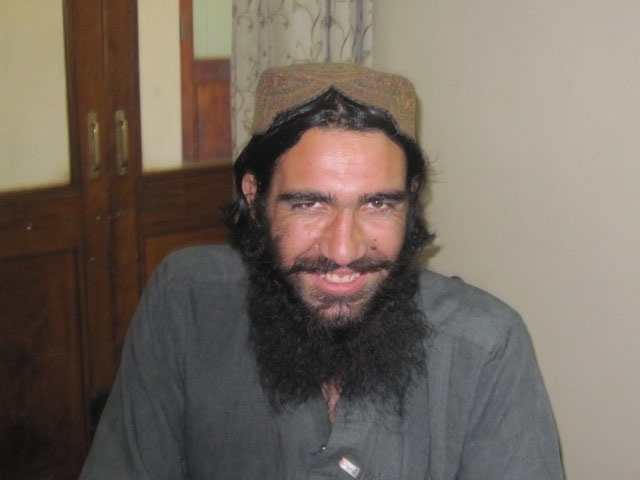
One is a journalist, Safdar Dawar, General Secretary of the Tribal Union of Journalists. Journalists are operating under very difficult circumstances in the area, pressured by both militant groups and the Pakistani government.  Six of his colleagues have been killed while reporting in North and South Waziristan. The other man, who asked us not to disclose his name, is from Miranshah city, the epicenter of North Waziristan.  He works with the locally based Waziristan Relief Agency, a group of people committed to helping the victims of drone attacks and military actions.  “If people need blood or medicine or have to go to Peshawar or some other hospital,” said the social worker, “I’m known for helping them. I also try to arrange funds and contributions.”
Continue reading “Drones and Democracy”

From Prayer to Paralysis

by Joshua Brollier 

Zainullah at a Paraplegic Center near Peshawar (Photo: G. Simon Harak)

May 17, 2010, Islamabad — Through the Soviet invasion and occupation, the Afghan civil war and now the United States war and occupation, a young man named Zainullah, around 25 years of age, has seen war his whole life. But you’d never know it by his engaging smile and his relaxed countenance. Zainullah currently lives at a paraplegic center in Hayatabad, Pakistan, a suburb of Peshawar, the capital city of the North-West Frontier Province. He is originally from the Helmand province of Afghanistan, which has been one of the most intense battlegrounds during the “war on terror” launched by the United States in 2001. 

Zainullah was paralyzed about nine months ago after being struck with shrapnel from a U.S. cruise missile. On the day of the attack, Zainullah was getting ready to start his prayers. He heard a bomb blast, and before he had a chance to realize that he was the target, Zainullah was laying prostrate on the ground with a piece of metal lodged in his spinal cord. Two men from his village carried him to the nearest clinic. There he was given an injection and then taken to the International Commission of the Red Cross (ICRC) facility in Helmand. Now paralyzed from the waist down, Zainullah spent one month at the ICRC , and then decided to seek more extensive rehabilitation treatment in Pakistan. 

Continue reading “From Prayer to Paralysis”

Pressured from all sides in Pakistan’s Swat Valley

by Kathy Kelly and Joshua Brollier

May 14th, 2010

Hindu Kush foothills on the road to the Swat Valley. (Photo: G. Simon Harak)

In May of 2009, under tremendous pressure from the United States, the Pakistani military began a large-scale military operation in the Swat District of Pakistan to confront militants in the region. The UNHCR said the operation led to one of the largest and fastest displacements it had ever seen. Within ten days, more than two million people fled their homes.

Now, a year later, our small delegation visited the Swat District. After a breathtaking ride through the Hindu Kush mountains, traveling in a pick-up truck from Shah Mansour in the Swabi district, we arrived in Swat’s capital, Saidu Sharif.

Saidu Sharif is a small town, ringed by mountains. The Swat River, a few hundred yards in width, runs through it. It’s easy to imagine a former time when tourists would flock to visit this scenic treasure. While we were there, the town seemed tranquil. Stores were open and the streets were bustling. Merchants, children, shoppers, bicyclists, goats, cars, donkey carts, rickshaws, and tractors jostled for space in the narrow roadways. But, we also saw dozens of uniformed men, carrying weapons, suggesting that tensions still prevail in Swat.

Continue reading “Pressured from all sides in Pakistan’s Swat Valley”

Boycott Israel? Amitav Ghosh & the Dan David Prize

The call for academic and cultural boycott is clearly a way to encourage civil society to play a broader political role—that is why it has the support of wide sections of Palestinian civil society. One of the most significant questions that call poses to us is simply this: How could those of us who oppose apartheid, occupation, and colonialism not support such a call?

Dear Amitav Ghosh,

We wish to express our deep disappointment in your decision to accept the Dan David prize, administered by Tel Aviv University and to be awarded by the President of Israel. As a writer whose work has dwelled consistently on histories of colonialism and displacement, your refusal to take stance on the colonial question in the case of Israel and the occupation of Palestine has provoked deep dismay, frustration, and puzzlement among readers and fans of your work around the world. Many admired your principled stand, and respected your decision not to accept the Commonwealth Writers Prize in rejection of the colonialist framework it represented.

Continue reading “Boycott Israel? Amitav Ghosh & the Dan David Prize”

Rahimullah Yusufzai on Faisal Shahzad and breaking news from the tribal region

Rahimullah Yusufzai, who is one of PULSE’s 20 Top Global Media Figures of 2009, interviewed by Dori Smith of the excellent Talk Nation Radio.

Pakistan’s tribal border regions and North Waziristan are dangerous, veteran journalist and editor Rahimullah Yusufzai sheds light on regional militant groups, and local reaction to Faisal Shazhad case. Was it a conspiracy, people ask?

The family of Faisal Shazhad are shocked and wondering what happened. Faisal Shazhad’s Father is a liberal, explains Yusufzai, and the family is not particularly religious. Mysteries will surely surround this case for some time to come.

Suicide Bombers

The Riz Khan show asks what motivates a person to sacrifice their own life in order to kill others. There are sensible answers from the venerable Robert Pape, Director of the Chicago Project on Security and Terrorism and author of Dying to Win: The Strategic Logic of Suicide Terrorism, and much twaddle from Farhana Ali, a particularly clueless terrorologist. If this stupid woman is serving as a ‘senior instructor for the US Afpak team’, then God help America and God help the people of ‘Afpak’. (I suspect Pape was thinking the same. His laughter at the end of the interview was eloquent).

Placating the gods of Citizenship: the Ritual Sacrifice (The King is Out: Part III)

The obligatory declaration of cinematic patriotism for Indian Muslims necessitates a continuous performance of “loyal citizenship” invariably through offering the sacrifice of a “disloyal” one. This leaves little space for critical engagement with the nation and the state.

by Huma Dar

[read Part I Part II]


King Khan and his divinity

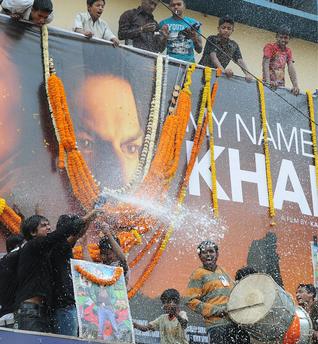
The obligatory declaration of cinematic patriotism for Indian Muslims (discussed in Parts I and II earlier) necessitates a continuous performance of “loyal citizenship” invariably through offering the sacrifice of a “disloyal” one. This leaves little space for critical engagement with the nation, the state, and the unending wars.  An example of this ritual performance is the sequence in My Name is Khan where Rizwan Khan, played by Shahrukh Khan (SRK), reports the “doctor” in the Los Angeles Masjid to the FBI.  How do we know the “bad” doctor is an al-Qaeda member or a terrorist?  Dr. Faisal Rahman does indeed talk about his “blood boiling” at the oppression of the Muslim Ummah in Iraq, Afghanistan, Palestine, Chechnya, Kashmir et al and even exhorts the handful of audience in a completely open space inside the Masjid to “join him and do something.”  The details of that “something” are never revealed.

Continue reading “Placating the gods of Citizenship: the Ritual Sacrifice (The King is Out: Part III)”

Shahrukh Khan and the Pound of Flesh: the Cost of Stardom (The King is Out: Part II)

by Huma Dar

[read Part I]

Shahrukh Khan (SRK) has a long history of playing the fraught field (of the Indian context) with flawless diplomacy, perhaps even overplaying the field.  In early 2002, precisely during the days of the state-sponsored anti-Muslim pogroms in Indian Gujarat, the then Indian Prime Minister Atal Bihari Vajpayee, from BJP (a Hindu Nationalist party), released an MTV-esque album,Samvedna [Sensitivity]. Widely broadcast on Doordarshan, the State-owned television channel, as well as on Indian-American programs (at least in the San Francisco Bay Area), the video features Vajpayee reciting his Hindi poetry while Jagjit Singh, the ghazal singer, sings in tune.  The album is prefaced by the rhapsodizing words of Javed Akhtar — another famous Muslim from Bollywood, narrated by Amitabh Bachhan.

Continue reading “Shahrukh Khan and the Pound of Flesh: the Cost of Stardom (The King is Out: Part II)”

Pakistan: A new wave of attacks?

This is a video of my appearance on Al Jazeera’s Inside Story. For context, I’d encourage viewers to read my articles in Political Insight and Le Monde Diplomatique.

The Pakistani Taliban have claimed responsibility for an attack on the US consulate in Peshawar on Monday. Is Pakistan paying the price for battles waged by the United States in the region?

From the Front Line: Insurgent Pakistan

This article appeared in the Political Studies Association‘s excellent new publication Political Insight.

by Muhammad Idrees Ahmad

No nation has ever made a frank avowal of its real imperial motives. It always claims to be primarily concerned with the peace and prosperity of the people whom it subjugates. — Reinhold Niebuhr

The ironies of US President Barack Obama’s Nobel acceptance speech in Oslo were widely noted. Not since Theodore Roosevelt had a Nobel laureate used the acceptance ceremony to make a case for war. Both men appealed to St Augustine’s authority to support the justness of their cause. However, when Roosevelt spoke he had already concluded the peace for which he was honoured; Obama’s lies distant in the purgatory of  ‘hope’. In the present he remains at war — as Henry Kissinger was, when he picked up his prize — having recently ordered the second major escalation of his brief presidency. Kissinger’s war simmered on for two more years; Obama’s will likely last longer.

Afghanistan may well become Obama’s Vietnam, but his diversion is not Cambodia, or Laos, it is nuclear-armed Pakistan. History sometimes repeats itself both as tragedy and farce.

Weeks before Obama described al-Qaeda as a threat on a par with Nazi Germany, national security adviser, General James Jones, told CNN that the organisation had fewer than a hundred men in Afghanistan. Driven by institutional inertia and vulnerable to the charge of weakness, Obama appears unable to disengage. Instead he has borrowed Bush’s rhetoric of good and evil and joined the fear factory. He has subsumed al-Qaeda and the Taliban into a singular threat of global proportions whose defeat he pronounced ‘fundamental to the defense of our people’. Afghanistan, he argued,will not be pacified until the Taliban’s allies in Pakistan are vanquished. Precipitate withdrawal will restore the Taliban to power, and create a safe haven for al-Qaeda to plan more terrorist attacks on the west.

Continue reading “From the Front Line: Insurgent Pakistan”