Can I tell how much I love peaches?
Not ordinary ones
But those plucked from
The orchards along Jhelum
The ones in the basket before me
Are nebrim for sure
But they blush like a home-grown innocence
And hold as many juicy promises
I wonder what tree bore them
I wonder if it’s wise to ignore them
The tree of life
Has many buried roots
It is said that my only son
Was killed under the canopy
Of the branches of one such tree
By the army
Also known as the security forces
An old joke
What do they secure
These so-called security forces?
Not the people, not our lives, not our liberty
Not our sentiments, nor our emotions, not our sanity
Not our sons who are shot
Nor our daughters who are raped
Not the truth, not the facts, not humanity
In the wake of Benazir Bhutto’s assassination as violent attacks ripple throughout Pakistan and tensions escalate with the West, WITHOUT SHEPHERDS offers a rare glimpse into real life in the shadow of the war on terror. From the streets of Karachi to the Afghan border, the film crosscuts between six people wrestling with a country in turmoil and defiantly standing for change: a cricket star building a new political party, a trucker crossing dangerous territory to feed his family, a supermodel pushing feminism through fashion, a subversive Sufi rocker using music to heal, a female journalist working behind Taliban lines, and an ex-mujahid seeking redemption. Together their stories give context to a crisis that has dangerous consequences for the region and the world and unveil the progressive face of this misunderstood country.
Karen Armstrong is the author of the classic The History of God.
UCtelevision — 17 June 2010 — One of the world’s leading commentators on religious affairs, Karen Armstrong discusses the intersection of religion and secularism in contemporary life. She explores the ideas that Islam, Judaism and Christianity have in common and their effect on world events. Series: Walter H. Capps Center Series
The call for academic and cultural boycott is clearly a way to encourage civil society to play a broader political role—that is why it has the support of wide sections of Palestinian civil society. One of the most significant questions that call poses to us is simply this: How could those of us who oppose apartheid, occupation, and colonialism not support such a call?
Dear Amitav Ghosh,
We wish to express our deep disappointment in your decision to accept the Dan David prize, administered by Tel Aviv University and to be awarded by the President of Israel. As a writer whose work has dwelled consistently on histories of colonialism and displacement, your refusal to take stance on the colonial question in the case of Israel and the occupation of Palestine has provoked deep dismay, frustration, and puzzlement among readers and fans of your work around the world. Many admired your principled stand, and respected your decision not to accept the Commonwealth Writers Prize in rejection of the colonialist framework it represented.
The police, in the northern Italian town of Novara, fined a 26-year-old Tunisian woman for wearing a black niqab; she was going to a mosque for the Friday prayers. According to the New York Times she was fined about $650 under a regulation introduced in January 2010. Apparently, Novara — a bastion of the xenophobic Northern League — “bans clothing in public that prevents identification by the police.”
Karan Johar falteringly attempts to fashion a cinematic alliance of sorts between African-Americans and South Asians — very unusual in the Bollywood context and more so for Karan Johar, himself — but fails to seize the radical politics embedded. One wishes that the spirit of this song was continuously re-thought, re-energized, re-contextualized, re-translated. A revolution that stops moving, stops “revolving,” is nothing but an aborted one.
In an interesting twist, Karan Johar’s My Name is Khan displaces or translates (one original meaning of “translate” is to bear or carry across from one place to another) the convoluted and complex, determining context from India, with a specific genealogy, on to the US. The post-9/11 circumstances provide some unfortunate resonances, yet much of the untranslated/untranslatable context results in the particular aporias of the filmic text. Even beyond Mandira’s furious and irrational directive to Rizwan Khan, he has to go around saying his name is Khan and “he is not a terrorist” because in that originary terrain of imposed defensiveness there is not much space for a “Muslim name” (besides certain limited spheres), leave alone for “My Name is Khan, and I am an American.” This latter, more “affirmative” alternative to the “apologetic” cinematic version, is proposed by Suad Abdul-Khabeer in her excellent critique of the film.
The obligatory declaration of cinematic patriotism for Indian Muslims necessitates a continuous performance of “loyal citizenship” invariably through offering the sacrifice of a “disloyal” one. This leaves little space for critical engagement with the nation and the state.
The obligatory declaration of cinematic patriotism for Indian Muslims (discussed in Parts I and II earlier) necessitates a continuous performance of “loyal citizenship” invariably through offering the sacrifice of a “disloyal” one. This leaves little space for critical engagement with the nation, the state, and the unending wars. An example of this ritual performance is the sequence in My Name is Khan where Rizwan Khan, played by Shahrukh Khan (SRK), reports the “doctor” in the Los Angeles Masjid to the FBI. How do we know the “bad” doctor is an al-Qaeda member or a terrorist? Dr. Faisal Rahman does indeed talk about his “blood boiling” at the oppression of the Muslim Ummah in Iraq, Afghanistan, Palestine, Chechnya, Kashmir et al and even exhorts the handful of audience in a completely open space inside the Masjid to “join him and do something.” The details of that “something” are never revealed.
Shahrukh Khan (SRK) has a long history of playing the fraught field (of the Indian context) with flawless diplomacy, perhaps even overplaying the field. In early 2002, precisely during the days of the state-sponsored anti-Muslim pogroms in Indian Gujarat, the then Indian Prime Minister Atal Bihari Vajpayee, from BJP (a Hindu Nationalist party), released an MTV-esque album,Samvedna [Sensitivity]. Widely broadcast on Doordarshan, the State-owned television channel, as well as on Indian-American programs (at least in the San Francisco Bay Area), the video features Vajpayee reciting his Hindi poetry while Jagjit Singh, the ghazal singer, sings in tune. The album is prefaced by the rhapsodizing words of Javed Akhtar — another famous Muslim from Bollywood, narrated by Amitabh Bachhan.
Conversations host Harry Kreisler welcomes historian, critic, and Pulitzer Prize-winning author Garry Wills for a discussion his new book, Bomb Power. Wills recalls his formative influences including his Catholic faith and education; William Buckley and the editors of The National Review; the Vietnam War protests; and the Civil Rights movement. He compares Obama to past presidents and explains why his support turned to criticism. He analyzes the impact of the atomic bomb on the U.S. constitutional system arguing that its development created a national security state characterized by an enlargement of Presidential power at the expense of other branches of government.
My Name is Khan, although narratively based mostly in the USA, has to be theorized within and around the framework of Bollywood; the Urdu-Hindi film history, and its transnational circuits of production, distribution, and consumption; Shahrukh Khan’s star narrative, and the determining context of the Indian political scene along with that in the US and its “war on/of terror.”
by Huma Dar
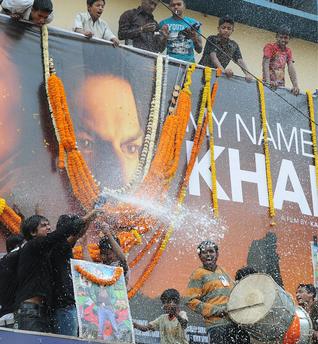
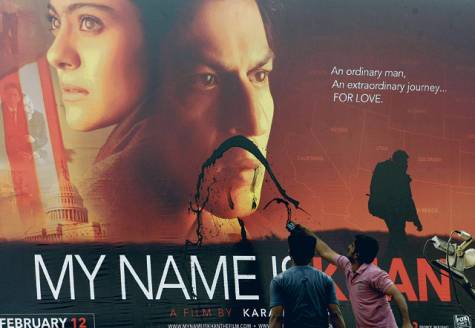
The Defacing of Khan: It's Not Easy Being Muslim in Mumbai or in Newark
My Name is Khan, although narratively based mostly in the USA, has to be understood and theorized within and around the framework of Bollywood; the Urdu-Hindi film history and its transnational circuits of production, distribution, and consumption; Shahrukh Khan’s star narrative, and the determining context of the Indian political scene along with that in the US and its “War on/of Terror.” Even prior to the Indian Partition in 1947, most Muslim artists had what Sa’adat Hasan Manto (1912-1955) mockingly called “shuddified” or Hinduized names – Dilip Kumar for Yusuf Khan, Madhubala for Mumtaz Begum Jahan Dehlavi (1933-1969), Meena Kumari for Mahjabeen Bano (1932-1972), or the more ambivalent (non-halal) Johnny Walker for Badruddin Jamaluddin Qazi (1923-2003) and Nargis for Fatima Rashid (1929-1981). At the contemporary moment, the biggest stars of the Urdu-Hindi film industry in India are Khans: Shahrukh, Salman, Aamir, Saif Ali et al. It might therefore be tempting to conclude that the Bombay film industry is indeed a level playing field. The Khans are all Muslims, at least nominally. Cinematically, they enact, with a few notable exceptions, Hindu characters. Culturally, the vigorous fanzines of Bollywood idolize them as comfortably suave denizens of metropolitan Bombay[Mumbai] with understated or unexpressed Muslimness — their Hindu wives, girlfriends, or mothers facilitating this imagined assimilation or passing. Of course, for regular, non-filmi (“film-related” in Urdu-Hindi) Muslim men, this assimilation through marriage to Hindu women is generally frowned upon and can have potentially fatal consequences.
My ruminations on My Name is Khan, like a typical Urdu-Hindi film, lengthy and replete with intermissions, are an entryway into not just the film as cinematic text, but also its complex and rich transnational contexts that must be read in tandem. In a series of six thematic posts, with this as the first, I will expand on:
 P U L S E
