Tariq Ali, Fazwaz Gerges and Vali Nasr discuss Usama bin Laden’s assassination on Al Jazeera’s Empire with Marwan Bishara.
Osama bin Laden is dead. The world’s most wanted man has finally been killed after a hunt that lasted more than a decade, triggered global wars, and cost the lives of tens of thousands of people. What does it mean for US wars in the Muslim world? And will the US actions unleash a new wave of attacks around the world?
Rahimullah Yusufzai on the assassination of Usama bin Laden, the man who led all of 100 men in Afghanistan according to former National Security Advisor Gen. James Jones.
In this TomDispatch.com interview Civil rights attorney and PULSE contributor Chase Madar outlines the case against––and the defense on behalf of––the soldier who allegedly provided the documents for the latest WikiLeaks release as well as the now infamous “Collateral Murder” video, Private First Class Bradley Manning. Also, don’t miss Chase’s brilliant piece on Bradley Manning.
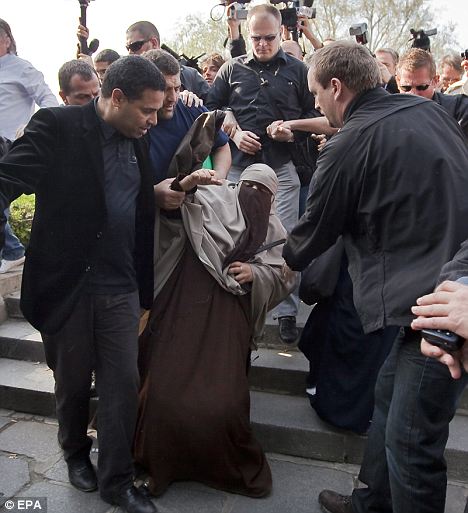
A woman in niqab being arrested in Paris, April 12, 2011, copyright EPA
Of Civilities and Dignities
On 22 June 2009, Nicolas Sarkozy, the French President, asserted that burqas (or the burqa-clad?) are “not welcome” in France, adding that “[i]n our country, we cannot accept that women be prisoners behind a screen, cut off from all social life, deprived of all identity” and that “the veils reduced dignity.”France’s Muslim minority is Western Europe’s largest Muslim minority, estimated at six-million-strong. And this is just an approximation, as the French Republic implicitly claims to be post-race and post-religion via a prohibition on any census that would take into account the race or religion of its citizens. (This anxiety mirrors the brouhaha in Indian media àpropos the much-contested enumeration of OBCs or Other Backward Castes in the Indian census surveys of 2011, or the urgency to declare some spaces post-caste, post-feminist, and post-racist while casteism, patriarchy and racism continue unabated.)
Billy Crudup and Margaret Colin enact a scene from Tom Stoppard’s new play ‘The Laws of War‘, which focuses on the abuses of the so-called ‘war on terror.’
Recent polls suggest that while a majority of U.S. people disapprove of the war in Afghanistan, many on grounds of its horrible economic cost, only 3% took the war into account when voting in the 2010 midterm elections. The issue of the economy weighed heavily on voters, but the war and its cost, though clear to them and clearly related to the economy in their thinking, was a far less pressing concern.
U.S. people, if they do read or hear of it, may be shocked at the apparent unconcern of the crews of two U.S. helicopter gunships, which attacked and killed nine children on a mountainside in Afghanistan’s Kunar province, shooting them “one after another” this past Tuesday March 1st. (“The helicopters hovered over us, scanned us and we saw a green flash from the helicopters. Then they flew back high up, and in a second round they hovered over us and started shooting.” (NYT 3/2/11)).
Four of the boys were seven years old; three were eight, one was nine and the oldest was twelve. “The children were gathering wood under a tree in the mountains near a village in the district,” said Noorullah Noori, a member of the local development council in Manogai district. “I myself was involved in the burial,” Noori said. “Yesterday we buried them.” (AP, March 2, 2011) General Petraeus has acknowledged, and apologized for, the tragedy.
PULSE is proud to present this excerpt from Brain-Dead or Alive, the new novel created by Tom Clancy’s Op-Center, written in collaboration with Gen. Tony Zinni (Ret.), Gen. Charles Horner (Ret.), Gen. Fred Franks (Ret.), and Chase Madar.
Neocon Poet Laureate Tom Clancy
It was a dark and stormy night in McLean, Virginia.
Former CIA director and ex-president Vernon Manley Babbitt sat at his dining-room table flanked by his most trusted compadres, who in many adventures past had defended the American way of life against nuclear terrorists, Islamic fanatics, and unarmed folk singers. Their next mission might be the most dangerous yet.
V. Manley Babbitt and his secret team called themselves the BFD, and their existence was so classified no one knew what the initials stood for. The BFD was licensed to do anything, from waterboarding the president’s mother to parking in handicapped spots, and with the safety of millions at stake, they often did. Babbitt surveyed his companions, tried and true, around the table.
First there was X, a man without an identity. Nobody knew X’s real name. Was it maybe just X? That kind of head-fake would have been vintage X! No one even knew what X looked like, not even X’s wife, because he always wore a brown paper bag on his head. He had ex-Special Ops written all over him, but not on the paper bag, which usually bore the logo of the retail chain where his wife had done the previous day’s shopping.
triple murders, a suicide, and the unraveling of a spy and a covert war…
by Huma Dar
On Thursday, 27th of January, 2011, while the world was busy watching — or ignoring, as the case might be — the inspiring Egyptian Revolution, in broad daylight, in a very busy part of Lahore (Pakistan), in front of hundreds of eye-witnesses, American contractor, Raymond Davis, murders two or by some accounts even three people: Muhammad Faheem (aka Faheem Shamshad?) (age 26), Faizan Haider (age 22), and Ibad-ur-Rehman. Davis shoots the former two, who had allegedly threatened to rob him, from within his locked car, with seven bullets — each bullet expertly and fatally finding its mark. The windshield shows the piercing trajectory of the fatal bullets, but otherwise remains miraculously unshattered. Davis, then, emerges calmly from his well-equipped car (see descriptions below), shoots Faizan from the back while Faizan was running away (how “dangerous” is that?! does the excuse of “self-defence” hold when one of the victims was running away?), takes photographs and videos of both his victims with his cellphone, gets back into his car, and drives off unruffled, to flee the scene. Faizan Haider was still alive — he expired later in the hospital. What an act of “responsibility” from a “diplomat” of the self-ascribed global policeman!
On December 24 2004, I wrote an essay, “America and Islam,” for which I received much heat from Zionist and right-wing bloggers in the United States.
The article made the point that the leaders of al-Qaida believe that they have to carry their war to the home ground of the ‘far enemy’ – the United States, Israel and Western powers – in order to free the Muslim world from foreign domination. This anyone can verify from the numerous communiqués of al-Qaida.
To say this is not to endorse the terrorist methods that al-Qaida employs. This was my moral position then: and it is my moral position now. At the same time, we should not shrink from recognizing that the total wars waged by many states, including the United States, since WWII differ from the methods of al-Qaida only in the infinitely greater scale of the destruction they wreak upon civilians.
The article made another critical point. It argued that al-Qaida, in some measure, reflects the political and moral failings of Muslim societies. If Muslims had shown more spine in resisting local tyrannies through non-violent means, their courage would have scotched the violent extremism of groups like al-Qaida.
The revolutions in Tunisia and Egypt have forced Obama into an uncomfortable but familar posture: On the one hand, in order to preserve at least the appearance of credibility, the candidate of hope and change has to feign solidarity with the people who expressed their hope by flooding into the streets of Tunisia and Cairo demanding change in leadership of their US-sponsored tyrannies. On the other, as the man charged with the responsibility of prolonging the death-gasp of a doomed Empire, Obama had to work overtime behind the scenes to make sure that any political changes forced upon America’s satraps in the Middle East remain cosmetic and trivial. This dilemma accounts for the mixed messages being issued from the White House throughout the crisis as each mangled response contradicts an earlier stance.
More recent developments on Mubarak’s “dignified” exit reveal even more cynical contempt for Egypt’s long suffering people on the part of the Obama administration as Egypt’s recently appointed VP Omar Suleiman, the CIA’s ‘go to guy’ for its offshore torture enterprises has reportedly been installed as Mubarak’s puppet successor.
What better illustrates Obama’s flailing and ineffectual leadership style than a comparison of his rhetoric in Cairo shortly after taking office with his current posture regarding developments in Egypt? In his 2009 Cairo speech, Obama affirmed his “unyielding belief” in the universality of democratic struggle, and the “yearning” of all people to live “under the rule of law and the equal administration of justice, towards government that is transparent and doesn’t steal from the people”. Words that in retrospect reveal the insincerity behind them as his administration attempts to downplay the “government by the people, of the people . . . ” stuff as it applies to the Arab world, and push forward a more moderate and “realistic” solution to what they consider an unfolding ”crisis” in Egypt and beyond: Millions of people peacefully united in a struggle to break free from a brutal, authoritarian regime headed by a corrupt tyrant.


 On Thursday, 27th of January, 2011, while the world was busy watching — or ignoring, as the case might be — the inspiring Egyptian Revolution, in broad daylight, in a very busy part of Lahore (Pakistan), in front of hundreds of eye-witnesses, American contractor, Raymond Davis, murders two or by some accounts even three people: Muhammad Faheem (aka Faheem Shamshad?) (age 26), Faizan Haider (age 22), and Ibad-ur-Rehman. Davis shoots the former two, who had allegedly threatened to rob him, from within his locked car, with seven bullets — each bullet expertly and fatally finding its mark. The windshield shows the piercing trajectory of the fatal bullets, but otherwise remains miraculously unshattered. Davis, then, emerges calmly from his
 The revolutions in Tunisia and Egypt have forced Obama into an uncomfortable but familar posture: On the one hand, in order to preserve at least the appearance of credibility, the candidate of hope and change has to feign solidarity with the people who expressed their hope by flooding into the streets of Tunisia and Cairo demanding change in leadership of their US-sponsored tyrannies. On the other, as the man charged with the responsibility of prolonging the death-gasp of a doomed Empire, Obama had to work overtime behind the scenes to make sure that any political changes forced upon America’s satraps in the Middle East remain cosmetic and trivial. This dilemma accounts for the mixed messages being issued from the White House throughout the crisis as each mangled response contradicts an earlier stance.
 P U L S E