Rahimullah Yusufzai, who is one of PULSE’s 20 Top Global Media Figures of 2009, interviewed by Dori Smith of the excellent Talk Nation Radio.
Pakistan’s tribal border regions and North Waziristan are dangerous, veteran journalist and editor Rahimullah Yusufzai sheds light on regional militant groups, and local reaction to Faisal Shazhad case. Was it a conspiracy, people ask?
The family of Faisal Shazhad are shocked and wondering what happened. Faisal Shazhad’s Father is a liberal, explains Yusufzai, and the family is not particularly religious. Mysteries will surely surround this case for some time to come.
Four people arrested in Bil’in. As you can tell by the video’s last few minutes, as friend and journalist, Tommy Donnellan, is being carried off, the army knows that he is of the press. What do you call it when the authorities arrest the press, again?
Peace activists can hasten an end to the U.S. war in Afghanistan by demanding a timetable for U.S. military withdrawal. [A bill in the U.S. Congress] introduced by Representatives McGovern and Jones, requires such a timetable. In the Senate, a similar bill has been introduced by Senator Feingold. Arguments in favor of a timetable for withdrawal of U.S. forces from Afghanistan should include readiness to examine disturbing patterns of misinformation regarding U.S./NATO attacks against Afghan civilians.
It is worth noting that even General McChrystal acknowledges that U.S. forces have killed civilians who meant them no harm. During a biweekly videoconference with US soldiers in Afghanistan, he was quite candid. “We’ve shot an amazing number of people and killed a number and, to my knowledge, none has proven to have been a real threat to the force,” said General McChrystal. “To my knowledge, in the nine-plus months I’ve been here, not a single case where we have engaged in an escalation of force incident and hurt someone has it turned out that the vehicle had a suicide bomb or weapons in it and, in many cases, had families in it.”
Those families and individuals that General McChrystal refers to should be our primary concern. We should try to imagine the sorrow and horror afflicting each individual whose tragic story is told in the “timetable” of atrocities committed against innocent people. How can we compensate people who have endured three decades of warfare, whose land has been so ravaged that, according to noted researcher Alfred McCoy, it would cost $34 billion dollars to restore their agricultural infrastructure. We should notify our elected representatives that the $33 billion dollar supplemental funding bill sought by the Obama administration to pay for U.S. wars in Afghanistan and Iraq could be directed toward helping Afghanistan replant its orchards, replenish its flocks, and rebuild its irrigation systems. We should insist on an end to atrocities like those which follow.
[I]n one scene I wanted to have just a half open door and I wanted to be shown saying namaz once. We couldn’t take that shot. Then we put that bit where I say the prayer: Nasrun minal lahe wah fatahun kareeb (God give me strength to win) [sic] [Victory is Allah’s, and the opening/victory is close] which is my own prayer too. I don’t think we should intellectualise entertainment. See the fun of it.
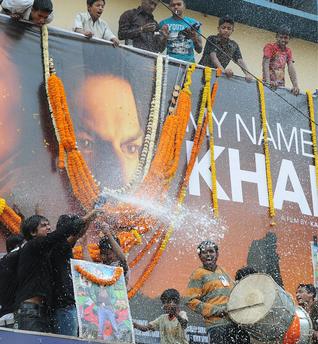
This is how Shahrukh Khan describes his experience working in the filmChak De! India(Dir: Shimit Amin, 2007). With apologies to King Khan for discarding his proposal to not “intellectualize” films, yet taking due “fun” in it, I argue that it is only in My Name is Khan(Dir: Karan Johar, 2010) that the King finally comes “out” as a Muslim. No “half open door” is needed. This coming out affords particular visceral pleasures to an audience (or at least a large section of it spread across the globe) long resigned to seeing SRK endlessly and persistently marked by the specifically filmic variety of Hinduness practiced in Bollywood: doing various pujas and aartis at different Hindu temples, or adorning his spouses’ hair-parting with sindhoor and smearing his own forehead with tilaks. This performative Hinduization of Shahrukh Khan in Urdu-Hindi cinema is unrelenting precisely due to the dogged presumption of SRK’s Muslimness that is not easily obscured. “In my films I have been going to temples and singing bhajans; no one has questioned that,” (my emphasis) SRK exclaims in the same interview. No one “questions” the diegetic (filmic) Hinduness of SRK; it is expected and mandatory. With the increasing and explicit polarization in India since 1990s, the anxiety around Muslimness is such that it requires perpetual masking: an iterative performance of Hinduness, secular or otherwise. When the mask slips off, the performance is momentarily paused – as when SRK plays a Muslim character in a film and critiqued the anti-Pakistani politics of Indian Premier League (IPL) – Hindutva activists target SRK’s suburban Bombay home, Mannat, with massive demonstrations (See the earlier Part II for more).[1]
Emad Rezqaafter being shot with an aluminium canister. Photograph by Hamde Abu Rahmeh
Friday in Bil’in, friend and fellow activist, Emad Rezqa was hit in the forehead by an aluminum tear gas projectile shot directly at him by Israeli soldiers during the weekly anti-Wall demonstration. He suffered a fractured skull and brain hemorrhage, and is currently hospitalized at the Hadassa Ein Karem hospital in Jerusalem. The demonstration Rezqa was injured in concluded the three-day International Bil’in Conference on Popular Struggle, and was attended by hundreds of people. Several other demonstrators were injured from gas inhalation, direct hits by gas canisters, and falling
This is the man who fired the canisters:
I was later arrested along with Palestinian journalist Moheb Barghouti, two fellow Israelis and a Mexican activist, after staging a sit-in. (more details soon)
The obligatory declaration of cinematic patriotism for Indian Muslims necessitates a continuous performance of “loyal citizenship” invariably through offering the sacrifice of a “disloyal” one. This leaves little space for critical engagement with the nation and the state.
The obligatory declaration of cinematic patriotism for Indian Muslims (discussed in Parts I and II earlier) necessitates a continuous performance of “loyal citizenship” invariably through offering the sacrifice of a “disloyal” one. This leaves little space for critical engagement with the nation, the state, and the unending wars. An example of this ritual performance is the sequence in My Name is Khan where Rizwan Khan, played by Shahrukh Khan (SRK), reports the “doctor” in the Los Angeles Masjid to the FBI. How do we know the “bad” doctor is an al-Qaeda member or a terrorist? Dr. Faisal Rahman does indeed talk about his “blood boiling” at the oppression of the Muslim Ummah in Iraq, Afghanistan, Palestine, Chechnya, Kashmir et al and even exhorts the handful of audience in a completely open space inside the Masjid to “join him and do something.” The details of that “something” are never revealed.
In Bil’in, the army remembers Bassem Abu Rahmeh by escalating to rubber bullets and live ammunition. A big ceremony was held with Fatah and the Fatah Youth marching band:
Today is the first year’s anniversary of Bassem Abu Rahmeh’s Death. I didn’t know Bassem, but I watched him die. It was only a few months after the Gaza massacre. Nobody cared for a dead Palestinian. Two weeks later I started going to Bil’in. I’ve been going every week ever since. I’ve met people I’ve come to care about. I’ve met Bassem’s friends, who welcome me in their home with a smile and embrace. His family, who have been shot and jailed. His fiance- a beautiful Israeli activist- whom I’ve come to love like a sister. I care about their life and I see them hurt.
Namir Noor-Eldeen, the photographer murdered by the American helicopter crew (Khalid Mohammed/AP)
I know the area where this massacre was committed. It is a crowded working-class area, a place where it is safe for children to play outdoors. It is near where my two aunts and their extended families lived, where I played as a child with my cousins Ali, Khalid, Ferial and Mohammed. Their offspring still live there.
The Reuters photographer we see being killed so casually in the film, Namir Noor-Eldeen, did not live there, but went to cover a story, risking his life at a time when most western journalists were imbedded with the military. Noor-Eldeen was 22 (he must have felt extremely proud to be working for Reuters) and single. His driver Saeed Chmagh, who is also seen being killed, was 40 and married. He left behind a widow and four children, adding to the millions of Iraqi widows and orphans.
Witnesses to the slaughter reported the harrowing details in 2007, but they had to wait for a western whistleblower to hand over a video before anyone listened. Watching the video, my first impression was, I have no impression. But the total numbness gradually grows into a now familiar anger. I listen to the excited voices of death coming from the sky, enjoying the chase and killing. I whisper: do they think they are God?
The US military says it has no reason to doubt the authenticity of a video leaked through the whistleblower website WikiLeaks showing a US military attack on a group of civilians in Iraq.
In the 2007 attack, a US military helicopter fired on a group of Iraqis, killing 12 civilians, according to the website, including two employees of the Reuters news agency.
The footage from a helicopter cockpit also shows a man stopping to help the injured, but he too is shot dead.
In an Al Jazeera exclusive, Omar al-Saleh reports on the man’s children, who were injured but survived the attack. (Apr 07, 2010)



 P U L S E