Continue reading “Joseph Stiglitz: Creating a Learning Society”
Betrayal & Ambivalence: Syrian Activists Wrestle with ISIS, Intervention & the Fate of Their Country
When Dissent magazine recently invited me to write an article on ISIS and intervention, I thought to pick the brains of various Syrian activists, writers and intellectuals. The correspondence that ensued became the article, which appeared on the Dissent blog yesterday. Here’s my introduction:
Conspicuously absent from the debate about ISIS and U.S. intervention—both in the mainstream and in the leftosphere—are Syrian voices. ISIS and U.S. officialdom occupy center stage, leaving the perspectives of Syrian civil society activists and writers out of the equation. While hardly surprising, this omission is troubling.
In an attempt to remedy this imbalance, I asked several Syrians—longtime activists and intellectuals from a range of backgrounds, including Kurdish, Palestinian, and Assyrian Christian—what they think about the ISIS crisis and Western intervention.
David Harvey and Gar Alperovitz on Cooperation and Capitalism
David Harvey and Gar Alperovitz dig into the failure of capitalism, the hope presented by worker co-ops, and what activists fighting for a just economy must do to get there.
The Best of Tony Judt
The following is a sample of the best videos featuring Tony Judt on Youtube, and a small selection of noteworthy articles.
Disturbing the Peace: Intellectuals and Universities in an Illiberal Age
Let’s Talk About Genocide: The UN Special Adviser on the Prevention of Genocide Standard and Israel
For other articles in this series 1, 2, 3, 4, 5, 6, 7, 8, 9, 10, 11
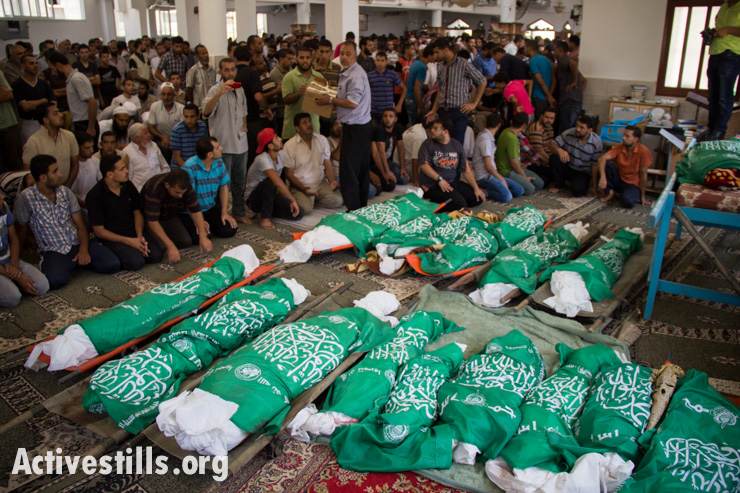
On the 24th of July 2014, when Israel had already massacred 697 Palestinians in Gaza, of whom at least 170 are children, Adama Dieng and Jennifer Welsh of the UN Office of the Special Adviser on the Prevention of Genocide published a statement, which I would characterize as aiding and abating genocide.
The Responsibility to Protect
While acknowledging the incomprehensible numbers of the dead, and the staggering destruction to civilian infrastructure to the besieged Gaza strip, which the UN itself has described as “uninhabitable” even before Israel’s latest onslaught, the Office of the Special Adviser on the Prevention of Genocide seems to see fit to equate the meagre damage inflicted by the resistance of the victims of genocide, to that of the perpetrators of this genocide, as they execute massacres alongside a campaign of mass destruction.
The word Genocide is fast becoming yet another synonym for Israel’s crimes against the Palestinian people, alongside Apartheid and Ethnic Cleansing. I’ve already began to scratch the surface of the applicability of the Crime of Genocide to Israel, by examining the definition provided in the Convention on the Prevention and Punishment of the Crime of Genocide, adopted by the UN General Assembly on December 9th 1948. My conclusion prompted me to create a call to action, calling for concerned citizens of the world to contact the UN Special Adviser on the Prevention of Genocide and demand an enquiry and publish its findings and recommendations as to the possibility that Israel is committing the Crime of Genocide.
Janine Wedel: Shadow Elites
Janine R. Wedel writes about power, influence, and governing through the unique lens of a social anthropologist. A professor in the School of Public Policy at George Mason University and senior research fellow at the New America Foundation, Wedel is the first anthropologist to win the Grawemeyer Award for Ideas Improving World Order.
Her book Shadow Elite: How the World’s New Power Brokers Undermine Democracy, Government, and the Free Market (Basic Books 2009) was named Book of the Month by The Huffington Post in January 2010.
The Best of Eric Hobsbawm
The following films are the best of Eric Hobsbawm on Youtube. Hobsbawn is one of the greatest British historians of te 20th Century, his Age of Revolution, from the ‘Age of’ series, is listed as one of the 100 Best History Books of All Time.
Hobsbawm on 9-11, Marxism, Brazil, and Neoliberalism
The Islamic State
VICE News reporter Medyan Dairieh spent three weeks embedded with the Islamic State, gaining unprecedented access to the group in Iraq and Syria as the first and only journalist to document its inner workings. Once you watch the film you’ll understand why my friend Faisal al Yafai calls them “a cancer of the Middle East politics and society“.
The Islamic State, a hardline Sunni jihadist group that formerly had ties to al Qaeda, has conquered large swathes of Iraq and Syria. Previously known as the Islamic State of Iraq and Syria (ISIS), the group has announced its intention to reestablish the caliphate and has declared its leader, the shadowy Abu Bakr al-Baghdadi, as the caliph.
The lightning advances the Islamic State made across Syria and Iraq in June shocked the world. But it’s not just the group’s military victories that have garnered attention — it’s also the pace with which its members have begun to carve out a viable state.
Flush with cash and US weapons seized during its advances in Iraq, the Islamic State’s expansion shows no sign of slowing down. In the first week of August alone, Islamic State fighters have taken over new areas in northern Iraq, encroaching on Kurdish territory and sending Christians and other minorities fleeing as reports of massacres emerged.
Almost 200 Hollywood Celebrities Sign on to Israel’s Genocide of the Palestinian People
Today, [Creative Community for Peace] say, there is not a single musical act, from Justin Timberlake to the Rolling Stones to Alicia Keys, that they have not approached and coached in advance of their performance in Israel. ~Times of Israel
It’s no surprise that the genocidal Times of Israel is so eager to push anti-BDS initiatives. It’s also no surprise that one of Israel’s most well connected, elite whitewashing team, Creative Community for Peace [CCfP], is doing exactly what it vowed to do- whitewash genocide. However one might wonder about some of the names on the below statement that CCfP has published: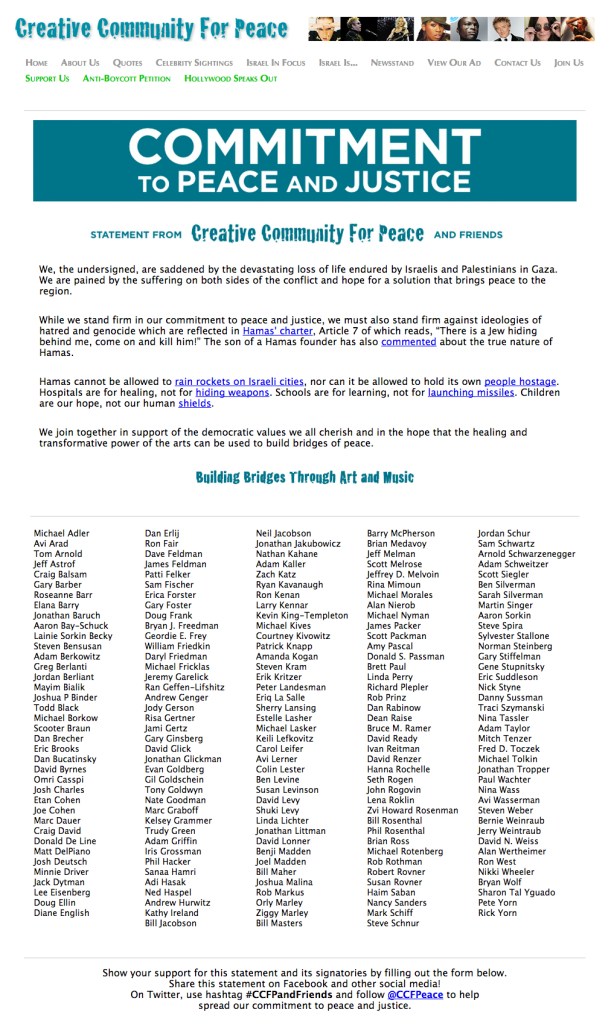
Fathers of ISIS
There’s no need to stoop to conspiracy theories to understand the ISIS phenomenon. In this brilliant summary, first published here, Ziad Majed explains the organisation’s origins.
The organization abbreviated as ISIS (Islamic State in Iraq and Syria) is not new in the region, nor is it a newfound expression of the crises afflicting Arab societies at a moment of profound transformations, initiated by 2011 revolutions.
To the contrary, ISIS is the offspring of more than one father, and the product of more than one longstanding and widespread sickness. The organization’s explosive growth today is in fact the result of previously existing, worsening conflicts that were caused by the different fathers.
ISIS is first the child of despotism in the most heinous form that has plagued the region.
Therefore, it is no coincidence that we see its base, its source of strength concentrated in Iraq and Syria, where Saddam Hussein and Hafez and Bashar Al-Assad reigned for decades, killing hundreds of thousands of people, destroying political life, and deepening sectarianism by transforming it into a mechanism of exclusion and polarization, to the point that injustices and crimes against humanity became commonplace.
ISIS is second the progeny of the American invasion of Iraq in 2003, both the way in which it was initially conducted and the catastrophic mismanagement that followed. Specifically, it was the exclusion of a wide swath of Iraqis from post invasion political processes and the formation of a new authority that discriminated against them and held them collectively at fault for the guilt of Saddam and his party, which together enabled groups (such as those first established by Abu Musab al-Zarqawi) whose activities have been resumed by ISIS to get in touch with some parts of Iraqi society and to establish itself among them.
ISIS is third the son of Iranian aggressive regional policies that have worsened in recent years — taking Iraq, Lebanon, and Syria as its backyard, feeding (directly or indirectly) confessional divisions and making these divides the backbone of ideological mobilization and a policy of revenge and retaliation that has constructed a destructive feedback loop.
ISIS is fourth the child of some of the Salafist networks in the Gulf (in Saudi Arabia and other states), which emerged and developed throughout the 1980s, following the oil boom and the “Afghan jihad”. These networks have continued to operate and expand throughout the last two decades under various names, all in the interest of extremism and obscurantism.
ISIS is fifth the offspring of a profound crisis, deeply rooted in the thinking of some Islamist groups seeking to escape from their terrible failure to confront the challenges of the present toward a delusional model ostensibly taken from the seventh century, believing that they have found within its imaginary folds the answer to all contemporary or future questions.
ISIS is sixth the progeny of violence, or of an environment that has been subjected to striking brutality, which has allowed the growth of this disease and facilitated the emergence of what could be called “ISISism”. Like Iraq previously, Syria today has been abandoned beneath explosive barrels to become a laboratory, a testing ground for violence, daily massacres and their outcomes.
ISIS, an abominable, savage creature, is thus the product of at least these six fathers. Its persistency depends on the continuation of these aforementioned elements, particularly the element of violence embodied by the Assad regime in Syria. Those who think that they should be impartial toward or even support tyrants like Assad in the fight against ISISism fail to realize that his regime is in fact at the root of the problem.
Until this fact is recognized — that despotism is the disease and not the cure — we can only expect more deadly repercussions, from the Middle East to the distant corners of the globe…
 P U L S E