A Response to Jacky Terrasson’s Agent, Christophe Deghelt, about the Red Sea Jazz Festival

Note: I don’t speak French, I’m responding to a Google Translate version of the original post, so I’ll refrain from my usual special attention to semantics, in order not to dwell on what may be a technical mistake in translation.

Jacky terrasson with manneger Christophe Deghelt

Last Wednesday, Jacky Terrasson’s agent, Christophe Deghelt, responded to the massive campaign to boycott the Israel state sponsored Red Sea Jazz Festival (more details on the government and corporate connections of the festival in this article). Since thought did actually go into this post, I think we in the BDS movement should respond. So here it is, point-by-point. I hope this furthers public discussion, as BDS so often does, because just like Christophe Deghelt, this is a “debate that I hold dear”.

On Notions of  War, Peace, and Popular Struggle

Continue reading “A Response to Jacky Terrasson’s Agent, Christophe Deghelt, about the Red Sea Jazz Festival”

The global food waste scandal

A new report by the Institution of Mechanical Engineers estimates that globally 30-50% of food is wasted. (Download the report.). In the following video Trstram Stuart, author of the 2009 book, Waste: Uncovering the Global Food Scandal, tackles the subject. Writing in the Financial Times Tristram quoted Lord Haskins, then one of the chief advisers to the government on food and farming, as estimating that 70% of food produced in Britain is wasted. This is obviously a striking example of market efficiency.

Discussing Assad’s Speech at the Opera House

“It was operatic in its otherworldly fantasy, unrelated to realities outside the building,” wrote Rami Khouri of Bashaar al-Assad’s latest speech, delivered as the bombs fell on southern Damascus. I was a guest on the BBC World Service to discuss the speech alongside Patrick Seale (Hafez al-Assad’s biographer), Syria Comment’s Joshua Landis, Faisal Yafai of the National, and Dr Yazan Abdullah. You can listen to the conversation here. (I fear it may not be accessible beyond the UK).

Spirituality, Stanley Jordan, and BDS

Update: On January 6, Stanley Jordan has cancelled his collaboration with the Red Sea Jazz Festival, joining a long line of artists combining their ethics, politics, and spirituality. Joy Harjo, still has not made a public statement rethinking her stance on the issue.

Note: Stanley Jordan is scheduled to perform in the Red Sea Jazz Festival between 17-19 of January. Although, after much deep soul searching, he has written a statement that he intends to continue as scheduled (below), in our political reality, we don’t give up until the Jazzist plucks the first guitar string in front of a segregated audience.
For your convenience, the rest of the international artists performing in the festival are listed at the end of this article.

Stanley Jordan

I’m a Spiritual Atheist. I never knew you could capitalize that phrase, but thank DOG, the internet is a wondrous place:

SPIRITUAL ATHEISTS are people who are:
1) ATHEISTS
Spiritual Atheists do not believe in the existence of an entity external to the universe that supposedly created and rules the universe… Spiritual Atheists generally recognize the word “God” as a personal name that has been given to the collective personality of the infinite and eternal universe… Even so, many Spiritual Atheists are extremely reluctant to make use of the word “God”, due to the extreme desecration it has suffered by traditional Theists and Atheists alike.

2) SPIRITUAL
Spiritual Atheists believe that the entire universe is, in some way, connected; even if only by the mysterious flow of cause and effect at every scale. Therefore, Spiritual Atheists generally feel that as they go about their lives striving to be personally healthy and happy, they should also be striving to help the world around them be healthy and happy! (“Wholistic Ethics”)

There are many people in the world like me. Some are atheists, some are theists. I respect all’s choices and love me a good theological debate, but to me, the most important piece of information in the above quote is “generally feel that as they go about their lives striving to be personally healthy and happy, they should also be striving to help the world around them be healthy and happy!”. This is also the first time I’ve heard the phrase “Wholistic Ethics”, I have my critique of it (and also have a critique of trying to unite atheists who define themselves as spiritual), but that would derail the conversation from what I really want to talk about: What does spirituality have to do with politics? Continue reading “Spirituality, Stanley Jordan, and BDS”

Woman in the Crossfire

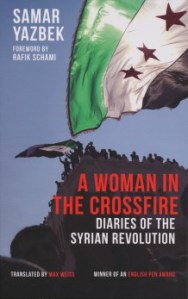
womaninthecrossfire_72A Woman in the Crossfire: Diaries of the Syrian Revolution’ by novelist Samar Yazbek is part journalism, part personal memoir, and all literature. It’s literature of the instantaneous sort, a staggered snapshot of the first four months of the revolution, a public history of  “a country succumbing to the forces of death,” and an interior history too. Yazbek tells us about her headaches, her insomnia and Xanax addiction, her crying fits, her fears for her daughter and herself, her constant panic. How sometimes in the speeded-up context the rush of information precedes all feeling: “The daily news of killing,” she writes, “was more present inside of me than any emotion.”

Samar Yazbek has always been problematic. Having consecrated herself “to the promise of a mysterious freedom in life,” she left home (in Jableh, on the coast) at sixteen, later divorced her husband and lived in Damascus, a single mother, working in journalism and writing sexually controversial novels. When Syria rose up against the Asad regime she publically supported the victims and their cries for freedom. And she’s an Alawi, a member of the president’s largely loyalist sect, of a well-known family. As an unveiled and obviously independent woman, a secularist and daughter of a minority community, her support for the revolution proved the lie of regime propaganda, which characterised the uprising as Salafist from the start.

So leaflets slandering her were distributed in the mountains. She was called a traitor, made  recipient of death threats, publically disowned by family and hometown. Naturally she was visited by the mukhabarat and made to experience, vicariously at least, the domestic wing of regime propaganda – for the theatre of blood is as important inside Syria as the projection of civilised moderation used to be abroad – by being walked through a display of meat-hooked and flayed torturees.

Continue reading “Woman in the Crossfire”

Israel 2012, The Question of a Nation: What Does Culture Have to Do with Politics? (Part 2)

Earlier this week, I found a message in my inbox by an Israeli, who’s a Jazz musician, who’s paying gig was canceled because of a successful BDS movement campaign to get Swedish Jazzist, Andreas Öberg, to cancel his gig in the Eilat Red Sea Jazz Festival. Usually, the extent of my response, when I get unsolicited mail from angry Israelis, is to take a screenshot and add it to my “Love Letters” albums on my Facebook profile. Call it an artistic form of exhibiting political repression, racism and sexism, if you will (but what does culture have to do with politics, I wonder…). This time, however, since we’re not talking about your typical angry Red Hot Chili Peppers fan, but someone who has lost a paying gig. I think it merits a response (even though, as I will argue below, I am actually not the address for cultural worker grievances).

You Don’t Know Me and I Don’t Know You

Continue reading “Israel 2012, The Question of a Nation: What Does Culture Have to Do with Politics? (Part 2)”

Clive Bell Is a Fathead

by George Bernard Shaw, The New Republic, 21 February 1922

[In his article, The Creed of an Aesthete (in our issue of January 25th), Mr. Clive Bell said: “Mr. Bernard Shaw … is not an artist, much less an aesthete … he is a didactic.” He referred to Mr. Shaw’s rejection of the Darwinian theory because, by depriving Beauty, Intelligence, Honor of their divine origin and purpose, this theory deprives them of their value. To Mr. Bell’s mind, Mr. Shaw feels that “if Life be a mere purposeless accident, the finest things in it must appear to everyone worthless.” The sooner Mr. Shaw knows that this is not so, the better, says Mr. Bell, and proceeds to explain his own creed: “always life will be worth living by those who find in it things which make them feel to the limit of their capacity.” “The advantage of being an aesthete,” he declares, “is that one is able to appreciate the significance of all that comes to one through the senses: one feels things as ends instead of worrying about them as means. … Whatever is precious and beautiful in life is precious and beautiful irrespective of beginning and end.”]

As will be seen in the above article, my friend Clive Bell is a fathead and a voluptuary. This a very comfortable sort of person to be, and very friendly and easy and pleasant to talk to. Bell is a brainy man out of training. So much the better for his friends; for men in training are irritable, dangerous, and apt to hit harder than they know. No fear of that from Clive. The layer of fat on his brain makes him incapable of following up his own meaning; but it makes him good company.

Continue reading “Clive Bell Is a Fathead”

Israel 2012, The Question of a Nation: What Does Culture Have to Do with Politics?

For more information on how Israel is using this face to mask its evil, go to http://www.no2brandisrael.org/

The interesting thing about Israel is that its government and registered citizens have a wonky spatial perception, which feeds off itself: In Israel, you’re not in the state, the state is in you. Due to this cyclical perception, along with the “standard” “nation branding” (a marketing lie on to itself, and that sick capitalist perception of a state- a geographic territory with obligations and responsibilities towards its respective inhabitants- as a product which is on the market for sale), known as Brand Israel, much of Israel’s propaganda is based on the blurring of the lines between the individual and the state (and army).

As a BDS activist, whose main focus is cultural boycott, I’ve come up against a very common Israeli claim (individuals, small business, and government officials) that “culture has nothing to do with politics”. Most commonly it comes in the form of a puzzled “rhetorical” question: “What does culture have to do with politics?!” As if asking this question closes the discussion, because it’s so obvious that art, music, books, films, theater and dance are a pure form of entertainment that has no intellectual, political, anthropological value. As if cultural products aren’t bought and sold as commodities and status indicators.

Shuki Weiss Promotion and Production Ltd. in the Service of the State of Israel

Continue reading “Israel 2012, The Question of a Nation: What Does Culture Have to Do with Politics?”

Anything but Stationary

kaaGhazi hai pairahan har paikar-e tasveer ka
Robed in paper are all pictures manifest:
this world is nothing but
Your paper!

by Huma Dar
for my N, Z, many Shahids, and the One

Write to Me.  photo credit: Natasha Dar, 2012
Write to Me. photo credit: Natasha Dar, 2012

The moon did not become the sun. 
It just fell on the desert 
in great sheets, reams 
of silver handmade by you. 
The night is your cottage industry now, 
the day is your brisk emporium.  
The world is full of paper.

Write to me.
Agha Shahid Ali, “Stationery”

(I)
The tilted goblet drips
mocking
Pacific amber:
liquid lunatic luminous.
And makes a slippery mess
of Highway 1
the night
memory and desire —
relentless, ebon, a plumbless
dream of falling.
Like tresses distraught
entwining your imagined arm
(make the bleeding black night
all yours)
your aching memories knotted in my gut
my exiled ghost lost, found
and willfully entangled
again
in the lines of your words
your stone-cold feet in my shaalfa —
an ablution performed in blood.

I will die at the golden hour…

by Huma Dar
dedicated to the memory of Agha Shahid Ali (4 Feb 1949 — 8 Dec 2001), and that of some other Shahids…
Untitled.  photo credit: Huma Dar, 2008
Untitled. photo credit: Huma Dar, 2008
I will die at the golden hour
on a Fall afternoon
in a car:
the driver’s seat