 This was first published at the National.
The true subject of science fiction is always the present. Its imagined futures are mirrors to today’s hopes and fears. George Orwell’s “1984” simply shifted the numbers of the year in which he wrote the book – 1948 – and made a metaphor of that time’s dark politics. Likewise “2084”, the latest from Algerian novelist Boualem Sansal, is addressed to, and in some way is part of, very contemporary woes.
Sansal lays out a fantastically detailed dystopia in complex and often elegant prose. After the Great Holy War killed hundreds of millions, an absolutist theocracy has been founded by Abi the Delegate, servant of the god Yolah. Abi’s rule is secured by such institutions as the Apparatus and the Ministry of Moral Health, and displayed by frequent mass slaughters of heretics in stadia built for the purpose. The nine daily prayers are compulsory. Women must cloak themselves in thick ‘burniqabs’.
Dissent, individuality, and progress have been abolished. The future must be a strict replica of the past. All languages are banned save the state-invented ‘Abilang’.
Ati, the story’s vague hero, is sent to a sanatorium in the mountains to cure his tuberculosis. Here he hears rumours of a nearby border, a limit to Abi’s reign. The notion “that the world might be divided, divisible, and humankind might be multiple” sparks a crisis of doubt in him, and then a journey of discovery.
At times “2084” suffers from science fiction’s most common pitfall: an unwieldy listing of technical or political information describing the imagined world outweighs and obscures the necessary human information. Sansal’s characters are somewhat two-dimensional, and the plot can seem almost accidental.
It is best, therefore, not to read this as a conventional novel but as a mix of satire, fable, and polemic.
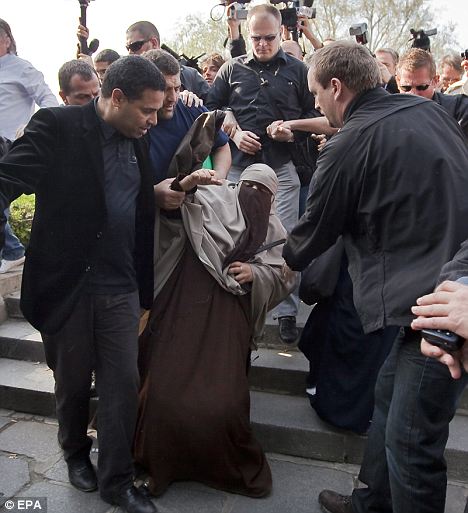
 June 2009, Palais de Versailles: French president Nicolas Sarkozy declares in a major policy speech that the “burqa is not a sign of religion, it is a sign of subservience. It will not be welcome on the territory of the French republic.” Sarkozy does this while ignoring the fact that the women wearing this garment are as French as he is. In this fiercely republican discourse taking place in a monarchist palace he also declares that the burqa “is not the idea that the French republic has about a women’s dignity” while missing another point — this “idea” about women’s dignity did not allow French women to vote until 1944. French women earned their right to vote after Turkish women, whose access to European citizenship is now denied by Sarkozy.
 P U L S E