The call for academic and cultural boycott is clearly a way to encourage civil society to play a broader political role—that is why it has the support of wide sections of Palestinian civil society. One of the most significant questions that call poses to us is simply this: How could those of us who oppose apartheid, occupation, and colonialism not support such a call?
Dear Amitav Ghosh,
We wish to express our deep disappointment in your decision to accept the Dan David prize, administered by Tel Aviv University and to be awarded by the President of Israel. As a writer whose work has dwelled consistently on histories of colonialism and displacement, your refusal to take stance on the colonial question in the case of Israel and the occupation of Palestine has provoked deep dismay, frustration, and puzzlement among readers and fans of your work around the world. Many admired your principled stand, and respected your decision not to accept the Commonwealth Writers Prize in rejection of the colonialist framework it represented.
Could the root causes of the Arab-Muslim ‘malaise’ be cultural? That’s what journalist Brian Whitaker suggests in his book ‘What’s Really Wrong With the Middle East’. The thesis sounds suspicious, but Whitaker isn’t a cheap Orientalist, and he uses interviews with Arabs as his raw material. The key issues his informants keep pointing to are indeed the issues that, wherever you meet them, young Arabs complain about. These include an undue emphasis on submission and obedience in the education system, at work, and in the home, the social valorisation of conformity, and a corrupt public space.
The personal is the political. The problem in every sphere is one of overbearing authority, and it’s true that this is ultimately family-based, ultimately the result of overly-narrow personal identifications. In fact, I would argue that tribalism, nepotism, sectarianism, even forced marriage and honour killing, are all manifestations of the tyranny of the clan. And the tyranny of the clan is the result of bad governance.
Shahrukh Khan (SRK) has a long history of playing the fraught field (of the Indian context) with flawless diplomacy, perhaps even overplaying the field. In early 2002, precisely during the days of the state-sponsored anti-Muslim pogroms in Indian Gujarat, the then Indian Prime Minister Atal Bihari Vajpayee, from BJP (a Hindu Nationalist party), released an MTV-esque album,Samvedna [Sensitivity]. Widely broadcast on Doordarshan, the State-owned television channel, as well as on Indian-American programs (at least in the San Francisco Bay Area), the video features Vajpayee reciting his Hindi poetry while Jagjit Singh, the ghazal singer, sings in tune. The album is prefaced by the rhapsodizing words of Javed Akhtar — another famous Muslim from Bollywood, narrated by Amitabh Bachhan.
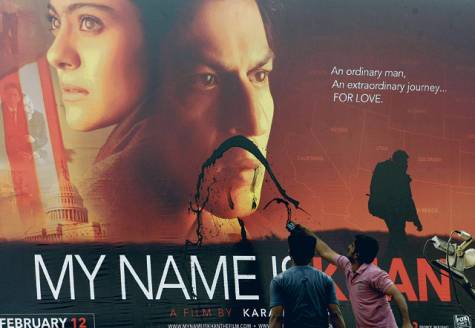
My Name is Khan, although narratively based mostly in the USA, has to be theorized within and around the framework of Bollywood; the Urdu-Hindi film history, and its transnational circuits of production, distribution, and consumption; Shahrukh Khan’s star narrative, and the determining context of the Indian political scene along with that in the US and its “war on/of terror.”
by Huma Dar
The Defacing of Khan: It's Not Easy Being Muslim in Mumbai or in Newark
My Name is Khan, although narratively based mostly in the USA, has to be understood and theorized within and around the framework of Bollywood; the Urdu-Hindi film history and its transnational circuits of production, distribution, and consumption; Shahrukh Khan’s star narrative, and the determining context of the Indian political scene along with that in the US and its “War on/of Terror.” Even prior to the Indian Partition in 1947, most Muslim artists had what Sa’adat Hasan Manto (1912-1955) mockingly called “shuddified” or Hinduized names – Dilip Kumar for Yusuf Khan, Madhubala for Mumtaz Begum Jahan Dehlavi (1933-1969), Meena Kumari for Mahjabeen Bano (1932-1972), or the more ambivalent (non-halal) Johnny Walker for Badruddin Jamaluddin Qazi (1923-2003) and Nargis for Fatima Rashid (1929-1981). At the contemporary moment, the biggest stars of the Urdu-Hindi film industry in India are Khans: Shahrukh, Salman, Aamir, Saif Ali et al. It might therefore be tempting to conclude that the Bombay film industry is indeed a level playing field. The Khans are all Muslims, at least nominally. Cinematically, they enact, with a few notable exceptions, Hindu characters. Culturally, the vigorous fanzines of Bollywood idolize them as comfortably suave denizens of metropolitan Bombay[Mumbai] with understated or unexpressed Muslimness — their Hindu wives, girlfriends, or mothers facilitating this imagined assimilation or passing. Of course, for regular, non-filmi (“film-related” in Urdu-Hindi) Muslim men, this assimilation through marriage to Hindu women is generally frowned upon and can have potentially fatal consequences.
My ruminations on My Name is Khan, like a typical Urdu-Hindi film, lengthy and replete with intermissions, are an entryway into not just the film as cinematic text, but also its complex and rich transnational contexts that must be read in tandem. In a series of six thematic posts, with this as the first, I will expand on:
We often project our current political concerns backwards in time in order to justify ourselves. I say ‘we’ because everyone does it. Nazi Germany invented a mythical blonde Aryan people who had always been kept down by lesser breeds. The Hindu nationalists in India imagine that Hinduism has always been a centralised doctrine rather than a conglomerate of texts and local traditions, and describe Muslim, Buddhist, Christian, Sikh, Jain and animist influences on Indian history as foreign intrusions. Black nationalists in the Americas depict ancient Africa as a continent not of hunter-gatherers and subsistence farmers but as a wonderland of kings and queens, gold and silk, science and monumental architecture. To our current cost, Zionists and the neo-cons have been able to reactivate old Orientalist myths in the West, myths in which the entirety of Arab and Islamic history has involved the slaughter and oppression of Christians, Jews, Hindus, women, gays, intellectuals .. and so on.
Such retrospective mythmaking frequently goes to the most absurd extremes in young nations conscious of their weakness or of a need for redefinition (America may be one of these). Probably for that reason it is particularly evident in the Middle East.
Many Muslims go beyond adherence to those concepts and taboos that are necessary for religious belief and idolise or demonise historical figures who have nothing to do with the divine revelation. For many Sunnis, the first caliphs were ‘rightly guided’ saints who could do no wrong. During their reign there was no crime, poverty or injustice in the realm of Islam. For many Shia, the same men (apart from Ali) were decadent criminals. These secular figures were not deities or prophets but human beings working in specific contexts, with all the good and bad and moral ambiguity that implies, but Muslims frequently hold religious positions on their worth. The same applies even to later worldly figures like Haroon ar-Rasheed (saint or criminal) and Salahuddeen al-Ayubbi (likewise; as well as Kurdish traitor and hero of Arabism).
Working in intolerably humid conditions clearing the salt marshes of southern Mesopotamia, fed on a poor diet of dates and semolina, frequently racially abused, the ‘Zanj’ – east African slaves in 9th Century Iraq – rose in their hundreds of thousands in a revolt which lasted for 15 years. They conquered large parts of Iraq, Iran and Bahrain, held the city of Basra for a decade, established their own capital, and even minted their own currency.
As labour intensive activities such as mining and plantation agriculture had expanded in the Muslim empires, so the slave trade had developed, especially the commerce in African slaves. Simultaneously, cultural justifications for the enslavement of Africans multiplied, with many classical writers depicting blacks as slow-witted and bestial. One writer who did not rehearse the stereotype was Jahiz of Basra, himself perhaps of African origin, who wrote:
“Everybody agrees that there is no people on earth in whom generosity is as universally well developed as the Zanj. These people have a natural talent for dancing to the rhythm of the tambourine, without needing to learn it. There are no better singers anywhere in the world, no people more polished and eloquent, and no people less given to insulting language. No other nation can surpass them in bodily strength and physical toughness. They are courageous, energetic, and generous, which are the virtues of nobility, and also good-tempered and with little propensity to evil. They are always cheerful, smiling, and devoid of malice, which is a sign of noble character.”
Speak the truth,
even if it were against yourselves.
Quran (4:134)
It was my master, Abu Sahl, who led me on to it.
“Write what you know about the Hindus,” he said,
“There are people who want to converse with them,
To understand their religion, science and literature.
We only have hear-say, a farrago of materials never
Sifted for accuracy. Give us facts with analysis.”
And so I put my heart to it, starting with Sanskrit.
This wasn’t an easy undertaking, without grammar
And dictionaries. I traveled through their country
Quite a bit, talking to learned Brahmans, and spared
Neither trouble nor money collecting manuscripts.
Often I invited their scholars from far-away places–
Kashmir and Kashi–to come and work with me
In Ghazni. I have endeavored in writing this book
Not to be polemical. I intend this account of India
To be nothing but a simple historic record of facts,
At once comprehensive and objective. I present
To you the theories of the Hindus, exactly as they
See them, supporting my explanations of them
With ample quotations. If any of this strikes you
As heathenish, then try to understand that such
Are the beliefs of the Hindus, and they themselves
Are best able to defend it. This book should suffice
Anyone who wants to understand the Hindus,
And discuss with them their myths, metaphysics,
And mathematics; their astronomy, arithmetic,
And astrology; their codes, customs, and conceits
On the very basis of their own civilization.
The launch of a new book by Joe Sacco is a major event, and with considerable expectation a crowd recently gathered in London to hear the great Maltese-American cartoonist and author discuss his latest book: Footnotes in Gaza. [1] Sacco spent seven years researching and drawing about two sordid events that took place in November 1956 when Israeli forces invaded Gaza as part of the joint British-French attack against Egypt. The Israeli army conducted two massacres where hundreds of Palestinians were murdered, and Sacco set out to collate the oral histories of the Palestinians who witnessed or were the victims of the events. Sacco engaged in a detailed investigative work finding the witnesses who could credibly recollect what happened, sifted through the accounts to eliminate the factual inconsistencies due to the deteriorated memories, and then spent four years bringing these histories to life in his inimitable style. The book doesn’t only focus on the past, but the present is also very much part of his account; in present day Gaza giant armoured bulldozers flatten houses in Rafah and where the ongoing siege affects everybody’s lives. Sacco says: “… the past and the present cannot be so easily disentangled; they are part of a remorseless continuum…”
Contemporary history is usually written by academics with access to the main protagonists, usually politicians or military commanders, inert archives, and press accounts. This history is usually antiseptic – there are no piles of corpses to embarrass the generals. It is also imbued with certainty – historians usually don’t question the politician’s say-so. It is rare for mainstream historians to listen to victims; their accounts are seldom incorporated into the victor’s history. What sets Joe Sacco apart is that not only is he a great artist, but also a peoples’ historian who is willing to listen to the victims; his historiography is imbued with sympathy and respect for the these victims; their history is worthwhile recording. Sacco also focused on a usually-ignored slice of history. In 2001, he travelled in Gaza with Chris Hedges, the American journalist, to research an article about the 1956 massacres for an article for Harper’s magazine. When the article finally appeared, the history of the massacres had been editorially expunged; not all histories are treated equally. Perhaps it was this incident that piqued his interest to write about the neglected massacres.


 On
On  P U L S E
