Israelpolitik, the Neocons and the Long Shadow of the Iraq War—A Review of Muhammad Idrees Ahmad’s book ‘The Road to Iraq: The Making of a Neoconservative War’

This essay first appeared in The Drouth (‘The Thirst’), a quarterly magazine published in Glasgow (Issue 50, Winter 2014/2015). I wrote it in December 2014.

The Road to Iraq book coverThe Road to Iraq: The Making of a Neoconservative War
By Muhammad Idrees Ahmad
Edinburgh University Press
£19.99

Reviewed by Danny Postel

I was reluctant to review this book. With all the dramatic developments in the Middle East today—the ISIS crisis, the siege of Kobanê, the deepening nightmare in Syria, the escalating repression in Egypt, the fate of Tunisia’s democratic transition, the sectarianization of regional conflicts driven by the Saudi-Iranian rivalry—delving back into the 2003 invasion of Iraq seemed rather less than urgent. It’s hard enough just to keep up with the events unfolding day-to-day in the region. Reading—let alone reviewing—a detailed study of the internal processes that led to the United States toppling Saddam Hussein over a decade ago seemed remote, if not indeed a distraction.

But I’m glad I set these reservations aside and took the assignment. This forcefully argued and meticulously researched (with no fewer than 1,152 footnotes, many of which are full-blown paragraphs) book turns out to be enormously relevant to the present moment, on at least three fronts:

  • ISIS emerged from the ashes of al Qaeda in Iraq, which formed in the immediate aftermath of the 2003 invasion and occupation of Iraq. Without the 2003 invasion, there would be no ISIS as we know it—and the region’s political landscape would look very different.
  • The US Senate report on CIA torture has brought back into focus the rogues gallery of the Bush-Cheney administration—the same cast of characters who engineered the 2003 Iraq invasion. This book shines a heat lamp on that dark chapter and many of its protagonists.
  • There is talk of a neoconservative comeback in Washington. This thoroughly discredited but zombie-like group are now angling for the ear of Hillary Clinton, who might be the next US president. Ahmad’s book provides a marvelously illuminating anatomy of the neocons, which has lessons that apply directly to this movement’s potentially ominous next chapter.

The central question Ahmad attempts to answer is: Why did the 2003 Iraq War happen? In one of the book’s most valuable sections, felicitously titled ‘Black Gold and Red Herrings’, he goes through several prevalent explanations/theories and takes them apart one by one: Continue reading “Israelpolitik, the Neocons and the Long Shadow of the Iraq War—A Review of Muhammad Idrees Ahmad’s book ‘The Road to Iraq: The Making of a Neoconservative War’”

Solidarity is not a Crime: Statement from the Minnesota Committee in Solidarity with the People of Syria (Minnesota CISPOS)

As members of an organization committed to peace and justice, the Committee in Solidarity with the People of Syria (CISPOS), it was disheartening for us to see an article in Huffington Post that falsely alleges that we are working “in sync with neocon warhawks to produce and sustain a perpetual state of U.S. war.” Coleen Rowley and Margaret Sarfehjooy’s article “Selling ‘Peace Groups’ on US-Led Wars” does not provide insightful analysis and is constructed on unfounded claims.

The article is fallout from the widespread controversy in the peace movement over how to respond to the brutal war in Syria.

Many anti-war pundits and activists have bought into U.S. propaganda that the U.S. is actively supporting the Syrian rebels to overthrow the Assad regime in Syria. They point to the 1997 Project for a New American Century plan for regime change in Afghanistan, Iraq, Libya and Syria. They believed Hillary Clinton in 2012 when she said the Assad regime must go and that the international community stands with the Syrian people.  In fact…the U.S. has given very little training, small weapons, and funds to very few rebel groups.  Congress recently dropped $300 million for the Syrian rebels from the defense bill, almost completely cutting what the Syrian opposition already saw as paltry support from the U.S.  On the other hand, the CIA has long had a working relationship with Assad, sending him numerous terrorist suspects to torture as part of their rendition program. Assad has provided Israel with a secure border.

Continue reading “Solidarity is not a Crime: Statement from the Minnesota Committee in Solidarity with the People of Syria (Minnesota CISPOS)”

Let’s Talk About Genocide: Palestine and United Nations Realpolitik

For other articles in this series 123, 4, 5678, 9, 10, 11

On the 7th of April 2004, then United Nations Secretary General to the Commission on Human Rights, Kofi Annan, launched his Action Plan to Prevent Genocide:
We must never forget our collective failure to protect at least 800,000 defenceless men, women and children who perished in Rwanda 10 years ago. Such crimes cannot be reversed. Such failures cannot be repaired. The dead cannot be brought back to life. So what can we do?

In my series of articles about Israel’s ongoing genocide of the Palestinian people, I tackle this assertion through different aspects of prevention mechanisms that have been put forth by the United Nations, such as The Convention of Prevention of Genocide, the UN Special Adviser on Prevention of Genocide statements, and other reports and documents. In this article, I’d like to discuss Annan’s plan, which is an overarching document and a promise of the UN to endangered communities that asses the dangers as they happen, and to bring it to task about its inaction to prevent Israel’s genocide of the Palestinian People.

Continue reading “Let’s Talk About Genocide: Palestine and United Nations Realpolitik”

Should We Oppose the Intervention Against ISIS? An Exchange of Views

Reposted from In These Times


Should We Oppose the Intervention Against ISIS?

Most U.S. leftists say yes. But voices we rarely hear—Kurds and members of the Syrian opposition—have more ambiguous views.

ISIS (or ISIL, or the Islamic State) sent shock waves through the Middle East and beyond in June when it seized Mosul, Iraq’s second-largest city. The organization has now laid claim to a swath of territory “stretching from Baghdad to Aleppo and from Syria’s northern border to the deserts of Iraq in the south,” in the words of Patrick Cockburn, author of The Jihadis Return: ISIS and the New Sunni Uprising.

In August, the United States assembled an international coalition (eventually including more than a dozen countries) to conduct a campaign of air strikes on ISIS positions in Iraq, coordinating with Iraqi and Kurdish Peshmerga forces. Then, in October, the coalition expanded the intervention into Syria, coordinating with Kurdish fighters on the Syrian-Turkish border and Free Syrian army forces.

American progressives have been relatively uniform in opposing the intervention against ISIS. But to most Kurds and many Syrian activists, the intervention is more welcome. Turkish and Syrian Kurds along the border watch the battles against ISIS from hilltops, breaking out in cheers and chanting, “Obama, Obama.” Within the Syrian opposition, one finds a range of perspectives—some support intervention, others oppose it, and many, like the Syrian leftist intellectual Yassin al-Haj Saleh, are torn. In late September Saleh told me, Continue reading “Should We Oppose the Intervention Against ISIS? An Exchange of Views”

Sectarianization: Steven Heydemann & Joshua Landis on the Trajectory of the Syrian Nightmare

Earlier this month I had the opportunity to interview two of the leading Syria experts in the world, Steven Heydemann and Joshua Landis, about the “big picture” of the Syrian conflict and the wider crisis engulfing the Middle East today, as part of the CMES Conversations series produced by the Center for Middle East Studies at the University of Denver. Landis, while best known as a blogger and commentator on Syria, is an historian. Heydemann is a political scientist who has written an influential study of Syrian politics covering the years 1946-1970.

The two interviews offer contrasting perspectives, but both take us several steps back from the news cycle and place the events unfolding in the region today in a wider historical, comparative and global lens. This was the focus of the forum that brought them to Denver, “Sectarianization: ISIS, the Syrian Conflict & the Future of the Middle East”. Sectarianization will be a central focus of our  in the coming months, and is the theme of the book my colleague Nader Hashemi and I are currently co-editing (our last book being The Syria Dilemma).

Steven Heydemann is Vice President of Applied Research on Conflict at the United States Institute of Peace (USIP). He’s the author of Authoritarianism in Syria: Institutions and Social Conflict, 1946-1970, the editor of War, Institutions and Social Change in the Middle East and co-editor of Middle East Authoritarianisms: Governance, Contestation, and Regime Resilience in Syria and Iran.

Our interview revolves largely around Heydemann’s far-reaching report “Syria’s Uprising: sectarianism, regionalisation, and state order in the Levant”, published by the European think tank FRIDE. Have a look:

Joshua Landis is Associate Professor in the College of International Studies at the University of Oklahoma, where he is also Director of the Center for Middle East Studies. Widely regarded as one of the leading Syria experts in the world, he is the former President of the Syrian Studies Association. He writes and edits the widely-read blog Syria Comment.

Our interview revolves principally around two of his recent articles: “The Great Sorting Out: Ethnicity & the Future of the Levant” and “Why Syria is the Gordian knot of Obama’s anti-ISIL campaign”. Have a look:

Let’s Talk About Genocide: The UN Special Adviser on the Prevention of Genocide Standard and Israel

For other articles in this series 1, 2, 345678, 9, 10, 11

001-14686227666_c69c156c75_o
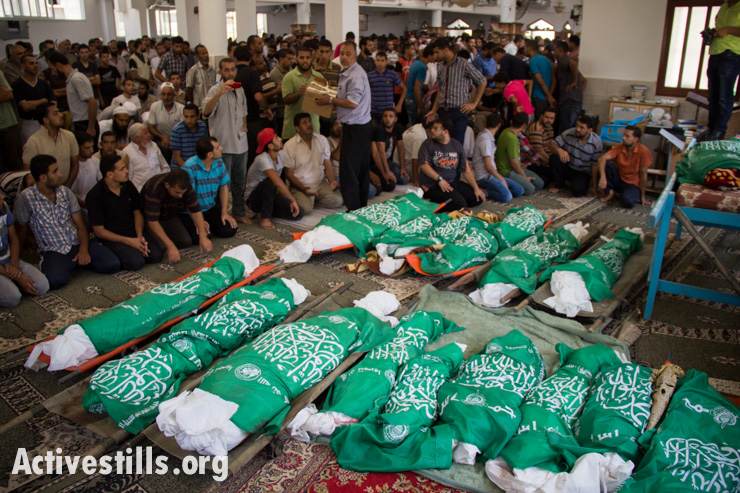
Mourners fill the mosque during the funeral for 26 members of the Abu Jame’ family, who were killed the previous day during an Israeli attack over the Bani Suhaila neighborhood of Khan Younis, Gaza Strip, July 21, 2014. Reports indicate that 15 of the 24 killed were children of Abu Jame’ family. (Taken from 972 Magazine)

On the 24th of July 2014, when Israel had already massacred 697 Palestinians in Gaza, of whom at least 170 are children, Adama Dieng and Jennifer Welsh of the UN Office of the Special Adviser on the Prevention of Genocide published a statement, which I would characterize as aiding and abating genocide.

The Responsibility to Protect

While acknowledging the incomprehensible numbers of the dead, and the staggering destruction to civilian infrastructure to the besieged Gaza strip, which the UN itself has described as “uninhabitable” even before Israel’s latest onslaught, the Office of the Special Adviser on the Prevention of Genocide seems to see fit to equate the meagre damage inflicted by the resistance of the victims of genocide, to that of the perpetrators of this genocide, as they execute massacres alongside a campaign of mass destruction.

The word Genocide is fast becoming yet another synonym for Israel’s crimes against the Palestinian people, alongside Apartheid and Ethnic Cleansing. I’ve already began to scratch the surface of the applicability of the Crime of Genocide to Israel, by examining the definition provided in the Convention on the Prevention and Punishment of the Crime of Genocide, adopted by the UN General Assembly on December 9th 1948. My conclusion prompted me to create a call to action, calling for concerned citizens of the world to contact the UN Special Adviser on the Prevention of Genocide and demand an enquiry and publish its findings and recommendations as to the possibility that Israel is committing the Crime of Genocide.

Continue reading “Let’s Talk About Genocide: The UN Special Adviser on the Prevention of Genocide Standard and Israel”

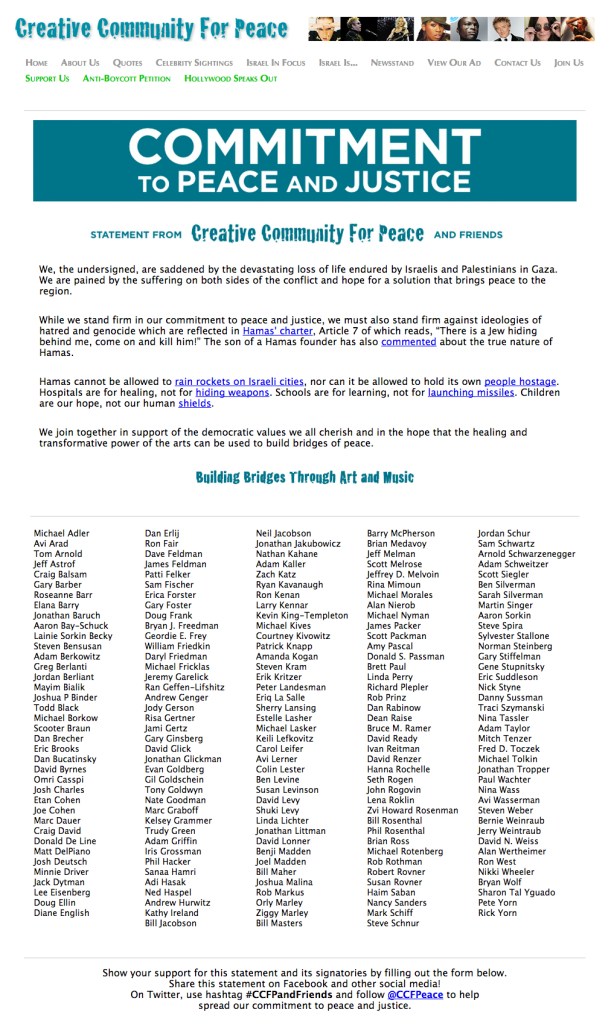
Almost 200 Hollywood Celebrities Sign on to Israel’s Genocide of the Palestinian People

Screen Shot 2014-08-25 at 16.36.04

Today, [Creative Community for Peace] say, there is not a single musical act, from Justin Timberlake to the Rolling Stones to Alicia Keys, that they have not approached and coached in advance of their performance in Israel. ~Times of Israel

It’s no surprise that the genocidal Times of Israel is so eager to push anti-BDS initiatives. It’s also no surprise that one of Israel’s most well connected, elite whitewashing team, Creative Community for Peace [CCfP], is doing exactly what it vowed to do- whitewash genocide. However one might wonder about some of the names on the below statement that CCfP has published:Crceative Community For Peace Genocide

Continue reading “Almost 200 Hollywood Celebrities Sign on to Israel’s Genocide of the Palestinian People”

Let’s Talk About Genocide: The Case of Palestine

For other articles in this series 1, 2345678, 9, 10, 11

declaration made by the General Assembly of the United Nations in its resolution 96 (I) dated 11 December 1946 that genocide is a crime under international law

Article II: In the present Convention, genocide means any of the following acts committed with intent to destroy, in whole or in part, a national, ethnical, racial or religious group, as such:

(a) Killing members of the group;
(b) Causing serious bodily or mental harm to members of the group;
(c) Deliberately inflicting on the group conditions of life calculated to bring about its physical destruction in whole or in part;
(d) Imposing measures intended to prevent births within the group;
(e) Forcibly transferring children of the group to another group.  

Though still contentious in some circles even within the Palestine solidarity movement, I’d like to join Ali Abunimah, Ilan Pape and others [1,2] and put forth that Israel, typical of a colonialist entity, isn’t only guilty of war crimes, discrimination, and employing an apartheid system on the Palestinian people, but is actually committing genocide. Before the reader rules me out as another “extremist” and clicks on, I’d like to remind you that all these terms are legal terms. And though I’m by no means a legal expert, I intend to argue the legal points in this article, in hopes of not only proving that Israel is in fact committing the crime of genocide, but that legal professionals would refine these arguments and take them where they belong- International Criminal Court.

Continue reading “Let’s Talk About Genocide: The Case of Palestine”

Lessons from South Africa: On the Path to Negotiations with Leverage

Solidarity disclaimer: This piece was written about a half a year ago, as I returned excitedly from a workshop in South Africa. These are my (a privileged beneficiary of the Israeli apartheid system) conclusions and analysis, and in no way presume to be an “ultimate truth”, or an attempt at dictation for Palestinian action. I only hope that it’s instructive and serves as yet another window, out of many, for thoughts, debate and input. The word “we” refers to participants of the workshop.

Often when I’m asked what the point of BDS is, I quickly answer “to get the Israeli regime  to the negotiating table with no preconditions” and then I move on to tactics. Sometimes we get so mired in the blood and brutality on our path of resistance, that we need to be yanked out of it, in order to stop and see our golden milestones.

Negotiations and the Death of Liberation Continue reading “Lessons from South Africa: On the Path to Negotiations with Leverage”

Mishra and Lydon on the Ruins of Empire

Two dear friends of mine, Pankaj Mishra and Chris Lydon, in conversation. Pankaj is easily one of the world’s most important public intellectuals and Chris is the world’s best interviewer. Radio Open Source is the place where all the intellectual synergy happens week after week.

Pankaj Mishra is sounding a wake-up call about “angry Asia” — from an alarm clock that, he’ll tell you, has been ringing for more than a century. He’s made it a story for today on the conviction that de-colonization is still the world’s pre-occupying project: to regain dignity that non-Westerners remember enjoying before the Europeans came. From the Ruins of Empire is Pankaj Mishra’s re-introduction of “The Intellectuals Who Remade Asia,” the god-parents of Gandhi, Ho Chi Minh and Nasser. No less an icon on the East-West bridge than Nobel-laureate Orham Pamauk testifies that Pankaj Mishra is giving us “modern history as it has been felt by the majority of the world’s population from Turkey to China.”

Continue reading “Mishra and Lydon on the Ruins of Empire”