Of Niqabs, Monsters, and Decolonial Feminisms

By Huma Dar

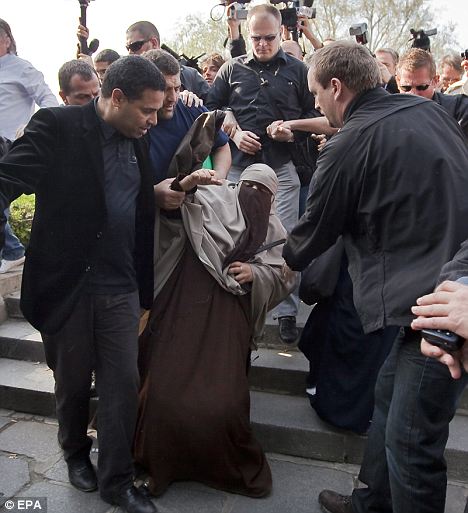
A woman in niqab being arrested in Paris, April 12, 2011, copyright EPA

Of Civilities and Dignities

On 22 June 2009, Nicolas Sarkozy, the French President, asserted that burqas (or the burqa-clad?) are “not welcome” in France, adding that “[i]n our country, we cannot accept that women be prisoners behind a screen, cut off from all social life, deprived of all identity” and that “the veils reduced dignity.” France’s Muslim minority is Western Europe’s largest Muslim minority, estimated at six-million-strong.  And this is just an approximation, as the French Republic implicitly claims to be post-race and post-religion via a prohibition on any census that would take into account the race or religion of its citizens. (This anxiety mirrors the brouhaha in Indian media àpropos the much-contested enumeration of OBCs or Other Backward Castes in the Indian census surveys of 2011, or the urgency to declare some spaces post-caste, post-feminist, and post-racist while casteism, patriarchy and racism continue unabated.)

Continue reading “Of Niqabs, Monsters, and Decolonial Feminisms”

The death of fear

Good to see that Al Jazeera made a journalist out of Rageh Omar, who while working for the BBC breathlessly relayed the false narrative on the stage-managed toppling of Saddam Hussein’s statue in Baghdad. (Also see Part II)

Rageh Omaar examines how the death of a street vendor led to a wave of uprisings across Arab world.

The death of fear

Don’t mess with Anonymous

Anonymous, or Anon, is a movement made up of a number of nameless internet activists from around the world. For many, the ‘hacktivist’ group has become the face of the new cyber-war against oppressive governments and all-powerful corporates. Others say the group’s actions are reckless. Describing itself as “the freedom of speech, the freedom of information and the freedom of expression taken to a logical extreme,” Anon says it breaks laws, but only for the greater good.

Al Jazeera’s Scott Heidler reports.

The revolt comes to Saudi Arabia

Riot police clash with protesters in the Gulf coast town of Awwamiya

Meaningful change in the Middle East is not possible until the malign influence of the House of Saud is lifted. For nearly eight decades it has served as a bulwark of American power in the region, and in more recent years has emerged as a key ally of Israel. When Israel was devastating Lebanon in 2006 and Gaza in 2009, the Saudi government reserved its criticism for the war’s victims. It has also tried to draw attention away from its own domestic failings by joining Israel and the US in ratcheting up propaganda against Iran. (As with pre-Jan25 Egypt, the accomodation with Zionism resulted in Iran replacing Israel as the chief bogeyman). It has yet to pay a price for the repeated betrayals of its own people and for spreading the brand of conservative, intolerant Salafist Islam that is today fragmenting societies from Beirut to Jakarta. It is time for a reckoning, and as Robert Fisk reports, the date has been set for March 11.

Saudi Arabia was yesterday drafting up to 10,000 security personnel into its north-eastern Shia Muslim provinces, clogging the highways into Dammam and other cities with busloads of troops in fear of next week’s “day of rage” by what is now called the “Hunayn Revolution”.

Saudi Arabia’s worst nightmare – the arrival of the new Arab awakening of rebellion and insurrection in the kingdom – is now casting its long shadow over the House of Saud. Provoked by the Shia majority uprising in the neighbouring Sunni-dominated island of Bahrain, where protesters are calling for the overthrow of the ruling al-Khalifa family, King Abdullah of Saudi Arabia is widely reported to have told the Bahraini authorities that if they do not crush their Shia revolt, his own forces will.

Continue reading “The revolt comes to Saudi Arabia”

A Perfect Storm in the Arab World?

Middle East scholar Prof. Fawaz Gerges on the Arab revolt.

Regardless of the outcome of events in Egypt, for Arabs, psychologically and symbolically, this is their Berlin Wall moment. They are on the brink of a democratic wave similar to the one that swept through Eastern Europe more than 20 years ago, hastening the Soviet Union’s collapse. The Arab intifada has put to rest the claim that Islam and Muslims are incompatible with democracy. The democratic virus is mutating and will probably give birth to a new language – and a new era – of politics in the Arab world. Fawaz A. Gerges is a Professor of Middle Eastern Politics and International Relations at the London School of Economics and Political Science.
This event was recorded on 24 February 2011 in Sheikh Zayed Theatre, New Academic Building. It was chaired by Dr Maha Azzam.

Available as: mp3 (41 MB; approx 87 minutes)
Event Posting: A Perfect Storm in the Arab World?

The political power of literature

Can literature inspire revolutions? What role do artists and intellectuals play on the frontline of popular uprisings?

US, the Arab Revolt and al-Qaida

M. Shahid Alam

On December 24 2004, I wrote an essay, “America and Islam,” for which I received much heat from Zionist and right-wing bloggers in the United States.

The article made the point that the leaders of al-Qaida believe that they have to carry their war to the home ground of the ‘far enemy’ – the United States, Israel and Western powers – in order to free the Muslim world from foreign domination. This anyone can verify from the numerous communiqués of al-Qaida.

To say this is not to endorse the terrorist methods that al-Qaida employs. This was my moral position then: and it is my moral position now. At the same time, we should not shrink from recognizing that the total wars waged by many states, including the United States, since WWII differ from the methods of al-Qaida only in the infinitely greater scale of the destruction they wreak upon civilians.

The article made another critical point. It argued that al-Qaida, in some measure, reflects the political and moral failings of Muslim societies. If Muslims had shown more spine in resisting local tyrannies through non-violent means, their courage would have scotched the violent extremism of groups like al-Qaida.

Continue reading “US, the Arab Revolt and al-Qaida”

Celebrations across the Arab world

Mosaic’s round-up of the celebrations across the Middle East on Egypt’s people power toppling of Mubarak.

Vodpod videos no longer available.

Pakistan: A Deficit of Dignity

M. Shahid Alam

Pakistan’s rulers and ruling elites may well be thinking that the wave of people’s indignation that started in Tunisia and is now working its way through Egypt, Jordan and Yemen will never reach them. Perhaps, they are telling each other, ‘We are safe: we are a democracy.’

The Arabs who are pouring into the streets of Tunisia, Egypt, Jordan and Yemen are not protesting only against their dictatorships. Simultaneously, they are also protesting against governments that have sold their dignity and bartered the honor of their country. Nearly, all the Arab rulers are self-castrated eunuchs in the courts of foreign powers, who have turned their own countries into police states, and who jail, maim, torture and kill their own people to please their masters.

The Arabs are venting their anger against elites who have stymied their energies by turning their societies into prisons. In complicity with foreign powers, these elites have ruled by fear, blocking the forward movement of their people because this movement collides with the imperialist ambitions of Israel and the United States.

It is true that Pakistan has had ‘elected’ governments alternating with military dictatorships. Increasingly, however, these governments, whether civilian or military, have differed little from each other. The priority for both is to keep their power and US-doled perks by doing the bidding of the United States and Israel.

Starting in the early 1990s, Pakistan hurriedly embraced the neoliberal paradigm that emanated from Washington. Hastily, successive ministers of finance and privatization – all of them IMF appointees – went about dismantling Pakistan’s industries, selling off for a song its state-owned enterprises, and empowering Pakistan’s elites to engage in unchecked consumerism.

Continue reading “Pakistan: A Deficit of Dignity”

People Power in the Middle East

M. Shahid Alam

From his weekly perch at CNN, Fareed Zakaria, speculated last Sunday (or the Sunday before) whether George Bush could take credit for the events that were unfolding in Tunisia, whether this was the late fruit of the neoconservative project to bring ‘democracy’ to the Middle East.

It is quite extraordinary watching Zakaria – a Muslim born and raised in India, and scion of a leading political family – mimic with such facility the language of America’s ruling classes, and show scarce a trace of empathy for the world’s oppressed, despite his propinquity to them by reason of history and geography. He does have a bias for India, but here too he only shows a concern for India’s strategic interests, not the interests of its subjugated classes, minorities and ethnicities. This I offer only as an aside about how easy it is for members of the upper classes in countries like India, Pakistan or Egypt to slip into an American skin whenever that dissimulation offers greater personal advantages.

As a cover for deepening US control over the Middle East – here is the latest civilizing mission for you – the neoconservatives in the Bush administration argued that the Islamic world produces ‘terrorists’ because it lives under autocracies. To solve the ‘terrorist’ problem, therefore, the US would have to bring democracy to the Middle East. This demagoguery only reveals the bankruptcy of America’s political class. It is a shame when the President of the United States and his neoconservative puppet-masters peddle such absurdities without being greeted by squeals of laughter – and shouted down as hypocritical, as farcical.

Who has been the leading ally and sponsor these past decades of nearly all the despotisms in the Middle East – those of royal pedigree and others seeking to become royalties?

Regardless, the real plan of United States failed miserably. It was dispatched to its grave by a people’s resistance in Iraq, Afghanistan and Pakistan.

Continue reading “People Power in the Middle East”