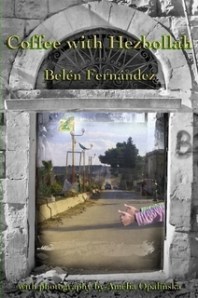
Coffee With Hezbollah: A Review

by Tom Chartier

Lately, in the last few years… like since Richard Milhous Nixon assumed the coveted title of POTUS… I have had trouble falling asleep at night. Sound familiar? You betcha! The stresses and anxiety of the days have a tendency to beat us to death, and relaxation is tough to find.

How to switch off the horrors of tomorrow’s deadlines, tomorrow’s exams, and tomorrow’s humiliations at the TSA pat-down and peep show? Tough questions indeed.

To make matters worse, I also have trouble getting out of bed in the morning. Not only do I live in complete terror of… well, terror… I also live in terror of saying the wrong thing. Look at all the trouble that dude Assange has caused with his little website, wikileaks.com! My God! State secrets, plots, skullduggery and shenanigans are being exposed! Is there no decency left in America?

God… or State… forbid the First Amendment and Free Speech should actually be upheld. We have our national paranoia to protect!

But… I have veered from the path of the straight and narrow and my purpose. Let me return to the subject of stress relief.

Continue reading “Coffee With Hezbollah: A Review”

Zionists: terrorist pioneers

Via Stuart Littlewood:

Here’s the roll-call [from delphiforums] on who introduced terrorism (along with biological, chemical and nuclear weapons) to the Middle East:

  • Bombs in cafés: first used by Zionists in Palestine on 17 March 1937 in Jaffa (they were grenades)
  • Bombs on buses: first used by Zionists in Palestine on 20 August- 26 September 1937
  • Drive-by shootings with automatic weapons: IZL and LHI in 1937-38 and 1947-48 (Morris, Righteous Victims, p681.)
  • Bombs in market places: first used by Zionists on 6 July 1938 in Haifa. (delayed-action, electrically detonated)
  • Bombing of a passenger ship: first used by the Zionists in Haifa on 25 November 1940, killing over 200 of their own fellows.
  • Bombing of hotels: first used by Zionists on 22 July 1946 in Jerusalem (Menachem Begin went on to become prime minister of Israel).
  • Suitcase bombing: first used by Zionists on 1 October 1946 against British embassy in Rome.
  • Mining of ambulances: first used by Zionists on 31 October 1946 in Petah Tikvah
  • Car-bomb: first used by Zionists against the British near Jaffa on 5 December 1946.
  • Letter bombs: first used by Zionists in June 1947 against members of the British government, 20 of them.
  • Parcel bomb: first used by Zionists against the British in London on 3 September 1947.
  • Reprisal murder of hostages: first used by Zionists against the British in Netanya area on 29 July 1947.
  • Truck-bombs: first used by Zionists on January 1948 in the centre of Jaffa, killing 26.
  • Aircraft hijacking: world-first by Israeli jets December 1954 on a Syrian civilian airliner (random seizure of hostages to recover five spies) – 14 years before any Palestinian hijacking.

Continue reading “Zionists: terrorist pioneers”

Reese Erlich: “Stop using the word ‘terrorist'”

Defining what a terrorist is and isn’t is a major dilemma. What one may consider terrorism, another may consider resistance. So where does one draw the line? Reese Erlich tackles that topic in his latest book “Conversations with Terrorists: Middle East Leaders on Politics, Violence, and Empire.” Erlich is a veteran journalist who has covered U.S. foreign policy for decades. He has freelanced for National Public Radio, Radio Deutsche Welle, the Australian Broadcasting Corp. Radio, the Canadian Broadcasting Corp. Radio, and writes for The San Francisco Chronicle and The Dallas Morning News.
Drawing on firsthand interviews and original research, Erlich argues that yesterday’s terrorist is often today’s national leader and that today’s freedom fighter may become tomorrow’s terrorist. By branding all of American’s opponents as “terrorists,” it makes it more difficult to look beyond the individual or the political group and understand what they are really all about. I caught up with Erlich recently and here’s what he had to say.

Continue reading “Reese Erlich: “Stop using the word ‘terrorist’””

Moment of Silence

by Emmanuel Ortiz

Before I start this poem,
I’d like to ask you to join me
In a moment of silence
In honor of those who died in the World Trade Center and the
Pentagon last September 11th.

I would also like to ask you
To offer up a moment of silence
For all of those who have been harassed, imprisoned,
disappeared, tortured, raped, or killed in retaliation for those strikes
For the victims in both Afghanistan and the U.S.

And if I could just add one more thing…
A full day of silence
For the tens of thousands of Palestinians who have died at the
hands of U.S.-backed Israeli
forces over decades of occupation.
Six months of silence for the million and-a-half Iraqi people,
mostly children, who have died of
malnourishment or starvation as a result of an 11-year U.S.
embargo against the country.

Before I begin this poem,
Two months of silence for the Blacks under Apartheid in South Africa,
Where homeland security made them aliens in their own country.
Nine months of silence for the dead in Hiroshima and Nagasaki,
Where death rained down and peeled back every layer of
concrete, steel, earth and skin
And the survivors went on as if alive.
A year of silence for the millions of dead in Vietnam – a people,
not a war – for those who
know a thing or two about the scent of burning fuel, their
relatives’ bones buried in it, their babies born of it.
A year of silence for the dead in Cambodia and Laos, victims of
a secret war … ssssshhhhh….
Say nothing
we don’t want them to learn that they are dead.
Two months of silence for the decades of dead in Colombia,
Whose names, like the corpses they once represented,
have piled up and slipped off our tongues.

Continue reading “Moment of Silence”

More Constitutional Buffoonery…

Shayana Kadidal of the Center for Constitutional Rights speaks candidly about the latest bad joke from Senator Joe Lieberman and Republican Scott Brown, who have co-sponsored a new bill, the Terrorist Ex-Patriation Act,  which seeks to strip Americans charged with terrorism of their U.S. citizenship.

According to Lieberman, the new bill simply ‘updates’ an existing statute that has been “on the books for seventy years”. As Lieberman sees it, “If the President can  authorize the killing of a United States citizen because he is fighting for a foreign terrorist organization…..we can also have a law that allows the U.S. government to revoke a locked-in citizenship.”

Outing the Muslimness, Finally: Some Viewing (and Hearing) Pleasures (The King is Out: Part VI)

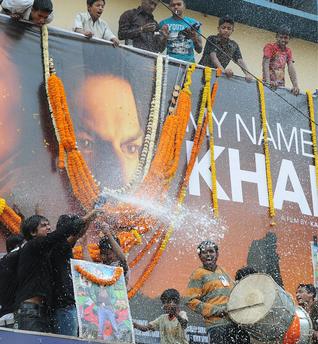
The King is out: he is irreversibly a Muslim. His name is Khan: pronounce it correctly please. Long Live the King!

by Huma Dar

[Read Part I Part II Part III Part IV Part V]

Rizwan Khan Offering His Namaz

[I]n one scene I wanted to have just a half open door and I wanted to be shown saying namaz once. We couldn’t take that shot. Then we put that bit where I say the prayer: Nasrun minal lahe wah fatahun kareeb (God give me strength to win) [sic] [Victory is Allah’s, and the opening/victory is close] which is my own prayer too. I don’t think we should intellectualise entertainment.  See the fun of it.

This is how Shahrukh Khan describes his experience working in the film Chak De! India (Dir: Shimit Amin, 2007).  With apologies to King Khan for discarding his proposal to not “intellectualize” films, yet taking due “fun” in it, I argue that it is only in My Name is Khan (Dir: Karan Johar, 2010) that the King finally comes “out” as a Muslim.  No “half open door” is needed.  This coming out affords particular visceral pleasures to an audience (or at least a large section of it spread across the globe) long resigned to seeing SRK endlessly and persistently marked by the specifically filmic variety of Hinduness practiced in Bollywood: doing various pujas and aartis at different Hindu temples, or adorning his spouses’ hair-parting with sindhoor and smearing his own forehead with tilaks.  This performative Hinduization of Shahrukh Khan in Urdu-Hindi cinema is unrelenting precisely due to the dogged presumption of SRK’s Muslimness that is not easily obscured.  “In my films I have been going to temples and singing bhajans; no one has questioned that,” (my emphasis) SRK exclaims in the same interview.  No one “questions” the diegetic (filmic) Hinduness of SRK; it is expected and mandatory.  With the increasing and explicit polarization in India since 1990s, the anxiety around Muslimness is such that it requires perpetual masking: an iterative performance of Hinduness, secular or otherwise.  When the mask slips off, the performance is momentarily paused – as when SRK plays a Muslim character in a film and critiqued the anti-Pakistani politics of Indian Premier League (IPL) – Hindutva activists target SRK’s suburban Bombay home, Mannat, with massive demonstrations (See the earlier Part II for more).[1]

Continue reading “Outing the Muslimness, Finally: Some Viewing (and Hearing) Pleasures (The King is Out: Part VI)”

Placating the gods of Citizenship: the Ritual Sacrifice (The King is Out: Part III)

The obligatory declaration of cinematic patriotism for Indian Muslims necessitates a continuous performance of “loyal citizenship” invariably through offering the sacrifice of a “disloyal” one. This leaves little space for critical engagement with the nation and the state.

by Huma Dar

[read Part I Part II]


King Khan and his divinity

The obligatory declaration of cinematic patriotism for Indian Muslims (discussed in Parts I and II earlier) necessitates a continuous performance of “loyal citizenship” invariably through offering the sacrifice of a “disloyal” one. This leaves little space for critical engagement with the nation, the state, and the unending wars.  An example of this ritual performance is the sequence in My Name is Khan where Rizwan Khan, played by Shahrukh Khan (SRK), reports the “doctor” in the Los Angeles Masjid to the FBI.  How do we know the “bad” doctor is an al-Qaeda member or a terrorist?  Dr. Faisal Rahman does indeed talk about his “blood boiling” at the oppression of the Muslim Ummah in Iraq, Afghanistan, Palestine, Chechnya, Kashmir et al and even exhorts the handful of audience in a completely open space inside the Masjid to “join him and do something.”  The details of that “something” are never revealed.

Continue reading “Placating the gods of Citizenship: the Ritual Sacrifice (The King is Out: Part III)”

Pakistan: A new wave of attacks?

This is a video of my appearance on Al Jazeera’s Inside Story. For context, I’d encourage viewers to read my articles in Political Insight and Le Monde Diplomatique.

The Pakistani Taliban have claimed responsibility for an attack on the US consulate in Peshawar on Monday. Is Pakistan paying the price for battles waged by the United States in the region?

Photo Essay of a Settler

A friend of mine started a cyber-satirical Facebook profile for ex Israeli Air Force commander and Israeli army Chief of Staff, Dan Halutz (you’re all very welcome to join). Fortunately for the anthropology dabblers among us, some people don’t recognize satire when they see it, and among Lt. General Halutz’s friends, I stumbled upon “supporters of the settlers of the Simon the Righteous [aka Sheikh Jarrah] neighborhood”. Who are these supporters of criminals and ethnic cleansers? From their Facebook group (limited by my translation):

Lately, a number of houses have been saved in the “ Simon the Righteous” neighborhood in Jerusalem, which is very upsetting to the Anarchists and anti-semites around the world that are harassing the Jewish residents and the worshippers at the Simon the Righteous tomb, thinking that this will prevent Jews from visiting the area and living around it. Here at the group we’ll update about the going ons at the site and about the struggle to return the stolen Jewish houses.

News:
In honor of the new Christian year the Muslims are brown-nosing the Christians. A big christmas tree has been stationed in front of the settlers houses which proves to us that where there is sanctity the devil grows. We’d like to remind the Christians what happened when Bethlehem was given to Palestinian terrorists: Their daughters were raped, their houses robbed, and most of them left the country.

This delightful group is very active, but rather than waste my time on translating more racist, colonialist blather, I’d like to share with you the choice photos and their labels, from the group, which give lingual and graphic insight into their warped perspective. I call it “Photo Essay of a Settler”.

Continue reading “Photo Essay of a Settler”

Pakistan creates its own enemy

Funeral for the eight civilians killed in the Pakistani military's failed attempt to assassinate militant leader Mangal Bagh Afridi (EPA)

The is a version of my Le Monde Diplomatique article updated for the Arabic, French, German, Italian, Norwegian, and Portuguese editions. It is also on Counterpunch, December 4-6, 2009 (It also appears in the February 2010 issue of the Japanese monthly Sekai)

On the day I arrived in Peshawar mid-September, the evening stillness was broken by nine loud explosions, each preceded by the sucking sound of a projectile as it arced into Hayatabad, the suburban sprawl west of the city. Their target was a Frontier Constabulary post guarding the fence that separates the city from the tribal region of Khyber.

When I lived here seven years ago, Hayatabad hosted many Afghan refugees; those with fewer resources lived in the slums of Kacha Garhi, along the Jamrud Road to the Khyber Pass. Many established businesses here and dominated commerce and transportation in parts of the city. Some would temporarily migrate to Afghanistan in summer where it was cooler. But Peshawar was a sanctuary, as Afghanistan was perpetually at war. Now the remaining Afghans are leaving because Afghanistan feels safer. There are checkpoints all over the city, many kidnappings, and during my visit, there were at least three suicide bombings and four rocket attacks, many of them targeting Hayatabad.

Continue reading “Pakistan creates its own enemy”