Rocking the Boat: A Brief History of Anti-Migrant Hysteria in Canada

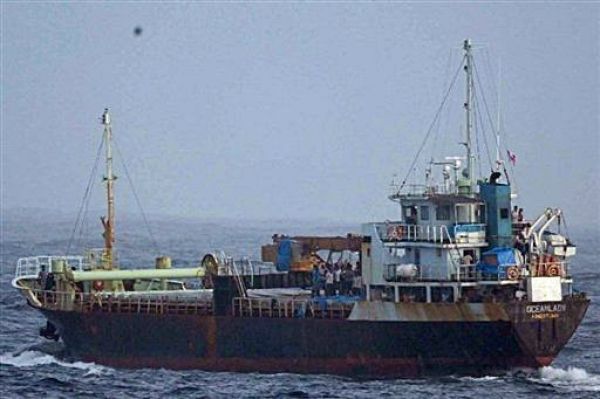
In November, 76 Tamil refugees escaped Sri Lanka on a rusty freighter. They arrived in Victoria, where they were met by Royal Canadian Mounted Police (RCMP) and Canadian Border Services Agency (CBSA) officials, who promptly jailed them for three months on allegations of terrorism. It would be fully half a year before the CBSA would admit that it had never had any evidence… In 2008, the federal and provincial governments were forced to issue apologies for the Komagata Maru. Now, two years later, if those words are to mean anything, we cannot afford to repeat history: let them stay.

by Fathima Cader

"MV Sun Sea" Uncredited Photo at: http://www.edynews.com/top-news/18-almost-500-sri-lankan-migrants-are-in-canadian-custody.html

They’re at it again.

In November, 76 Tamil refugees escaped Sri Lanka on a rusty freighter. They arrived in Victoria, where they were met by Royal Canadian Mounted Police (RCMP) and Canadian Border Services Agency (CBSA) officials, who promptly jailed them for three months on allegations of terrorism. It would be fully half a year before the CBSA would admit that it had never had any evidence.

By then, however, it was too late: anti-Tamil and anti-refugee hysteria had spread like wildfire. Now, mere weeks after that most tepid of mea culpas from the CBSA, the hysteria greeting the Tamil MV Sun Sea passengers is worse. As with the Ocean Lady, these migrants will be detained in Maple Ridge jails before their refugee claims are considered. The Conservatives have begun to create new rules to treat refugees who arrive by boat differently from others. Meanwhile, Paul Fromm, the infamous neo-Nazi, has been receiving uncritical coverage in mainstream media with his demands that the migrants be sent back.

As the paranoia grows ever more heightened, it becomes increasingly important that we resist it. The universal rights of safety and mobility must be upheld, not only for the Sun Sea migrants, but for all people fleeing violence.

Continue reading “Rocking the Boat: A Brief History of Anti-Migrant Hysteria in Canada”

Exit Afghanistan

This excellent documentary produced by the Dutch VPROInternational is a must see. It presents a picture of the Afghan  conflict with the kind of nuance you are unlikely to find on British or American TV.

Continue reading “Exit Afghanistan”

A Class War by Any Other Name

IDF Economics: Keynote Speaker Chief of the IDF General Staff, Lt. Gen. Gabi Ashkenazi addressing the audience at the Friends of the IDF 2010 National NY Gala Dinner, where 20 million dollars was raised

About a month ago I wrote an article about a bill proposition to heavily fine initiators and encouragers of a boycott directed at the state of Israel. On Wednesday, I joined a “Non Violence Short Course”. Today a friend posted an article on my Facebook wall [translation of important parts below] about the inflated “security budget”. I’m an activist in Israel, so naturally the boycott, nonviolence and the IDF budget all fall within my interest span. But this morning, as I read this very not-new news article about wining and dining generals, the assumptions tickling at last month’s article were driven home like a punch in the gut: Class war.

Continue reading “A Class War by Any Other Name”

Gaza farmers risk being shot

And the world continues to tolerate all this…

As a Libyan backed aid ship sails for the Gaza Strip, another group of international activists has been defying the blockade, but this time on the land. Foreigners acting as human shields have been helping farmers in Gaza harvest their crops. About 30 per cent of Gaza’s arable land is on the border with Israel and the area has been declared a buffer zone by the Israeli army. Palestinian farmers risk being shot with live fire for working their fields.

Nicole Johnston reports from Bani Salah.

Occupation 101 by Jimmy Carter

Also, check out the recent article by the brilliant Amira Hass, Lexicon of most misleading terms in Israeli-Palestinian conflict, for a much-needed factual and historical corrective to the amnesia that too often afflicts mainstream journalists covering the issue. Incidentally, she has this to say about the discourse of “(non-)violent resistance”, raised by Robin Yassin-Kassab in an essay published earlier on P U L S E:

When we define the struggle against foreign rule as “non-violent” or “violent,” it’s as if we asked the occupied to prove their resistance is kosher (or not ). And to whom? The very foreign ruler who considers boycotting settlement products to be unkosher. The adjectives “non-violent” or “violent” presume that the occupation is a natural state of affairs, whose violence is permitted, a civilized norm meant to tame its subjects. “A non-violent struggle” therefore diverts attention from the fact that forced rule is based on the use of violence. Every soldier at a roadblock, every camera on the separation fence, every military edict, a supermarket in a settlement and an Israeli diaper factory on Palestinian land – they are all part of the nonstop violence.

Continue reading “Occupation 101 by Jimmy Carter”

Terror reigns on Pakistan’s Northwest Frontier

by Rustam Shah Mohmand

The devastation could not be more heartbreaking. From one end to the other, the whole tribal area presents the spectacle of a war zone. Houses blown up, villages decimated, infrastructure no more.

Add Dir, Buner and Swat to that. Vast swaths are in ruins in Maidan, in the Dir region. Whole villages in Buner have disappeared. Matta and the adjoining areas in Swat present a picture of a powerful cyclone having devastated the whole area.

Between Khar and Nawagai, in what once was a most fertile area, villages on both sides of the road have been razed to the ground.

Many of the returning IDPs of Bajaur and Dir could not determine where their villages had once stood, to say nothing of their homes. They had to make return journeys to their camps.

In Qaudahari, in the Safi area of Mohmand, the situation is no better. The wreckage of a war is everywhere, with houses and villages having ceased to exist.

Bara, in Khyber Agency, an area once administered by an Assistant Political Agent, presents the picture of a ghost town.

Continue reading “Terror reigns on Pakistan’s Northwest Frontier”

Suicide Bombers

The Riz Khan show asks what motivates a person to sacrifice their own life in order to kill others. There are sensible answers from the venerable Robert Pape, Director of the Chicago Project on Security and Terrorism and author of Dying to Win: The Strategic Logic of Suicide Terrorism, and much twaddle from Farhana Ali, a particularly clueless terrorologist. If this stupid woman is serving as a ‘senior instructor for the US Afpak team’, then God help America and God help the people of ‘Afpak’. (I suspect Pape was thinking the same. His laughter at the end of the interview was eloquent).

Atrocities in Afghanistan: A Troubling Timetable

by Kathy Kelly and Dan Pearson

Photo: Paula Bronstein/Getty Images

Peace activists can hasten an end to the U.S. war in Afghanistan by demanding a timetable for U.S. military withdrawal. [A bill in the U.S. Congress] introduced by Representatives McGovern and Jones, requires such a timetable. In the Senate, a similar bill has been introduced by Senator Feingold. Arguments in favor of a timetable for withdrawal of U.S. forces from Afghanistan should include readiness to examine disturbing patterns of misinformation regarding U.S./NATO attacks against Afghan civilians.

It is worth noting that even General McChrystal acknowledges that U.S. forces have killed civilians who meant them no harm. During a biweekly videoconference with US soldiers in Afghanistan, he was quite candid. “We’ve shot an amazing number of people and killed a number and, to my knowledge, none has proven to have been a real threat to the force,” said General McChrystal. “To my knowledge, in the nine-plus months I’ve been here, not a single case where we have engaged in an escalation of force incident and hurt someone has it turned out that the vehicle had a suicide bomb or weapons in it and, in many cases, had families in it.”

Those families and individuals that General McChrystal refers to should be our primary concern. We should try to imagine the sorrow and horror afflicting each individual whose tragic story is told in the “timetable” of atrocities committed against innocent people. How can we compensate people who have endured three decades of warfare, whose land has been so ravaged that, according to noted researcher Alfred McCoy, it would cost $34 billion dollars to restore their agricultural infrastructure. We should notify our elected representatives that the $33 billion dollar supplemental funding bill sought by the Obama administration to pay for U.S. wars in Afghanistan and Iraq could be directed toward helping Afghanistan replant its orchards, replenish its flocks, and rebuild its irrigation systems. We should insist on an end to atrocities like those which follow.

Continue reading “Atrocities in Afghanistan: A Troubling Timetable”

The Price of Translating a Narrative and its Context (The King is Out: Part V)

Karan Johar falteringly attempts to fashion a cinematic alliance of sorts between African-Americans and South Asians — very unusual in the Bollywood context and more so for Karan Johar, himself — but fails to seize the radical politics embedded. One wishes that the spirit of this song was continuously re-thought, re-energized, re-contextualized, re-translated. A revolution that stops moving, stops “revolving,” is nothing but an aborted one.

by Huma Dar

[read Part I Part II Part III Part IV]


In an interesting twist, Karan Johar’s My Name is Khan displaces or translates (one original meaning of “translate” is to bear or carry across from one place to another) the convoluted and complex, determining context from India, with a specific genealogy, on to the US.  The post-9/11 circumstances provide some unfortunate resonances, yet much of the untranslated/untranslatable context results in the particular aporias of the filmic text.  Even beyond Mandira’s furious and irrational directive to Rizwan Khan, he has to go around saying his name is Khan and “he is not a terrorist” because in that originary terrain of imposed defensiveness there is not much space for a “Muslim name” (besides certain limited spheres), leave alone for “My Name is Khan, and I am an American.”  This latter, more “affirmative” alternative to the “apologetic” cinematic version, is proposed by Suad Abdul-Khabeer in her excellent critique of the film.

Continue reading “The Price of Translating a Narrative and its Context (The King is Out: Part V)”

Shahrukh Khan and the Pound of Flesh: the Cost of Stardom (The King is Out: Part II)

by Huma Dar

[read Part I]

Shahrukh Khan (SRK) has a long history of playing the fraught field (of the Indian context) with flawless diplomacy, perhaps even overplaying the field.  In early 2002, precisely during the days of the state-sponsored anti-Muslim pogroms in Indian Gujarat, the then Indian Prime Minister Atal Bihari Vajpayee, from BJP (a Hindu Nationalist party), released an MTV-esque album,Samvedna [Sensitivity]. Widely broadcast on Doordarshan, the State-owned television channel, as well as on Indian-American programs (at least in the San Francisco Bay Area), the video features Vajpayee reciting his Hindi poetry while Jagjit Singh, the ghazal singer, sings in tune.  The album is prefaced by the rhapsodizing words of Javed Akhtar — another famous Muslim from Bollywood, narrated by Amitabh Bachhan.

Continue reading “Shahrukh Khan and the Pound of Flesh: the Cost of Stardom (The King is Out: Part II)”