Outing the Muslimness, Finally: Some Viewing (and Hearing) Pleasures (The King is Out: Part VI)

The King is out: he is irreversibly a Muslim. His name is Khan: pronounce it correctly please. Long Live the King!

by Huma Dar

[Read Part I Part II Part III Part IV Part V]

Rizwan Khan Offering His Namaz

[I]n one scene I wanted to have just a half open door and I wanted to be shown saying namaz once. We couldn’t take that shot. Then we put that bit where I say the prayer: Nasrun minal lahe wah fatahun kareeb (God give me strength to win) [sic] [Victory is Allah’s, and the opening/victory is close] which is my own prayer too. I don’t think we should intellectualise entertainment.  See the fun of it.

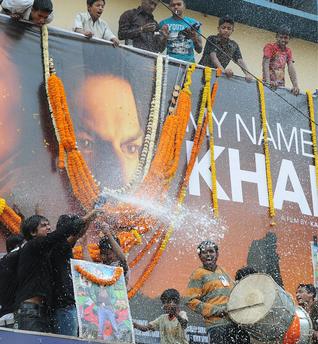
This is how Shahrukh Khan describes his experience working in the film Chak De! India (Dir: Shimit Amin, 2007).  With apologies to King Khan for discarding his proposal to not “intellectualize” films, yet taking due “fun” in it, I argue that it is only in My Name is Khan (Dir: Karan Johar, 2010) that the King finally comes “out” as a Muslim.  No “half open door” is needed.  This coming out affords particular visceral pleasures to an audience (or at least a large section of it spread across the globe) long resigned to seeing SRK endlessly and persistently marked by the specifically filmic variety of Hinduness practiced in Bollywood: doing various pujas and aartis at different Hindu temples, or adorning his spouses’ hair-parting with sindhoor and smearing his own forehead with tilaks.  This performative Hinduization of Shahrukh Khan in Urdu-Hindi cinema is unrelenting precisely due to the dogged presumption of SRK’s Muslimness that is not easily obscured.  “In my films I have been going to temples and singing bhajans; no one has questioned that,” (my emphasis) SRK exclaims in the same interview.  No one “questions” the diegetic (filmic) Hinduness of SRK; it is expected and mandatory.  With the increasing and explicit polarization in India since 1990s, the anxiety around Muslimness is such that it requires perpetual masking: an iterative performance of Hinduness, secular or otherwise.  When the mask slips off, the performance is momentarily paused – as when SRK plays a Muslim character in a film and critiqued the anti-Pakistani politics of Indian Premier League (IPL) – Hindutva activists target SRK’s suburban Bombay home, Mannat, with massive demonstrations (See the earlier Part II for more).[1]
Continue reading “Outing the Muslimness, Finally: Some Viewing (and Hearing) Pleasures (The King is Out: Part VI)”

Placating the gods of Citizenship: the Ritual Sacrifice (The King is Out: Part III)

The obligatory declaration of cinematic patriotism for Indian Muslims necessitates a continuous performance of “loyal citizenship” invariably through offering the sacrifice of a “disloyal” one. This leaves little space for critical engagement with the nation and the state.

by Huma Dar

[read Part I Part II]


King Khan and his divinity

The obligatory declaration of cinematic patriotism for Indian Muslims (discussed in Parts I and II earlier) necessitates a continuous performance of “loyal citizenship” invariably through offering the sacrifice of a “disloyal” one. This leaves little space for critical engagement with the nation, the state, and the unending wars.  An example of this ritual performance is the sequence in My Name is Khan where Rizwan Khan, played by Shahrukh Khan (SRK), reports the “doctor” in the Los Angeles Masjid to the FBI.  How do we know the “bad” doctor is an al-Qaeda member or a terrorist?  Dr. Faisal Rahman does indeed talk about his “blood boiling” at the oppression of the Muslim Ummah in Iraq, Afghanistan, Palestine, Chechnya, Kashmir et al and even exhorts the handful of audience in a completely open space inside the Masjid to “join him and do something.”  The details of that “something” are never revealed.

Continue reading “Placating the gods of Citizenship: the Ritual Sacrifice (The King is Out: Part III)”

“Veil in the Time of War” or “Veilin’ the Time of War”

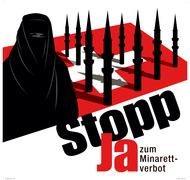
In the context of the current multiple arenas of war and occupation in Muslim-majority regions, the issues of gender and sexuality are vitally linked to the casus belli, both within and without academia. Such linkages, with a long and complicated genealogy thoroughly imbricated in the politics of colonization, decolonization, and neo-colonization, also indicate an obsessive desire to re-enact the “discovery narrative” or the “rescue narrative.” Examining current contestations in popular media – including recent articles written by Maureen Dowd, Naomi Wolf and Phyllis Chesler et al and the poster designed by Alexander Segert, which was integral to the success of the anti-minaret Swiss referendum – this essay investigates whether, how, and where the neoconservative, neoliberal, and the mainstream feminist discourses converge, diverge, and intersect.

Segert's Anti-Minaret Poster

by Huma Dar

In the context of the current multiple arenas of war and occupation in Muslim-majority regions, the issues of gender and sexuality are vitally linked to the casus belli, both within and without academia.  Such linkages, with a long and complicated genealogy thoroughly imbricated in the politics of colonization, decolonization, and neo-colonization, theorized by Inderpal Grewal, Gayatri Spivak, Lata Mani, Leila Ahmed, Sherene Razack, Saba Mahmood, Sunera Thobani amongst others, also indicate an obsessive desire to re-enact the “discovery narrative” or the “rescue narrative.”  Examining current contestations in popular media – including recent articles written by Maureen Dowd, Naomi Wolf and Phyllis Chesler et al and the poster designed by Alexander Segert, which was integral to the success of the anti-minaret Swiss referendum – I investigate whether, how, and where the neoconservative, neoliberal, and the mainstream feminist discourses converge, diverge, and intersect.  I undertake to deconstruct the ongoing debates that obsessively revolve around the veil or the sexuality that is variously professed to be suppressed, annihilated, or even “discovered” beneath the veil by some liberal explorers.

Continue reading ““Veil in the Time of War” or “Veilin’ the Time of War””

The King is Out, His Name is Khan: Long Live the King (Part I)

My Name is Khan, although narratively based mostly in the USA, has to be theorized within and around the framework of Bollywood; the Urdu-Hindi film history, and its transnational circuits of production, distribution, and consumption; Shahrukh Khan’s star narrative, and the determining context of the Indian political scene along with that in the US and its “war on/of terror.”

by Huma Dar


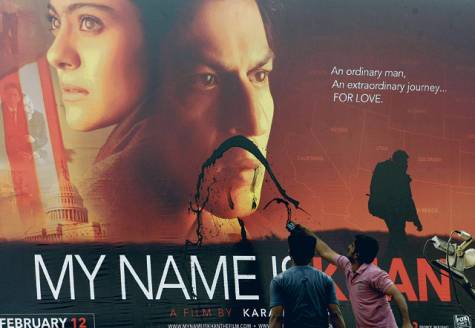
The Defacing of Khan: It's Not Easy Being Muslim in Mumbai or in Newark

My Name is Khan, although narratively based mostly in the USA, has to be understood and theorized within and around the framework of Bollywood; the Urdu-Hindi film history and its transnational circuits of production, distribution, and consumption; Shahrukh Khan’s star narrative, and the determining context of the Indian political scene along with that in the US and its “War on/of Terror.”  Even prior to the Indian Partition in 1947, most Muslim artists had what Sa’adat Hasan Manto (1912-1955) mockingly called “shuddified” or Hinduized names – Dilip Kumar for Yusuf Khan, Madhubala for Mumtaz Begum Jahan Dehlavi (1933-1969), Meena Kumari for Mahjabeen Bano (1932-1972), or the more ambivalent (non-halal) Johnny Walker for Badruddin Jamaluddin Qazi (1923-2003) and Nargis for Fatima Rashid (1929-1981).  At the contemporary moment, the biggest stars of the Urdu-Hindi film industry in India are Khans: Shahrukh, Salman, Aamir, Saif Ali et al.  It might therefore be tempting to conclude that the Bombay film industry is indeed a level playing field.  The Khans are all Muslims, at least nominally.  Cinematically, they enact, with a few notable exceptions, Hindu characters.  Culturally, the vigorous fanzines of Bollywood idolize them as comfortably suave denizens of metropolitan Bombay[Mumbai] with understated or unexpressed Muslimness — their Hindu wives, girlfriends, or mothers facilitating this imagined assimilation or passing.  Of course, for regular, non-filmi (“film-related” in Urdu-Hindi) Muslim men, this assimilation through marriage to Hindu women is generally frowned upon and can have potentially fatal consequences.

My ruminations on My Name is Khan, like a typical Urdu-Hindi film, lengthy and replete with intermissions, are an entryway into not just the film as cinematic text, but also its complex and rich transnational contexts that must be read in tandem.  In a series of six thematic posts, with this as the first, I will expand on:

(i) The (B)Onus of Muslimness in Bollywood

(ii) Shahrukh Khan and the Pound of Flesh: the Cost of Stardom

(iii) Placating the gods of Citizenship: the Ritual Sacrifice

(iv) A Suitable Boy, “Decent” People, and Names that Pass

(v) The Price of Translating a Narrative and its Context

(vi) Outing the Muslimness, Finally: Some Viewing (and Hearing) Pleasures

Continue reading “The King is Out, His Name is Khan: Long Live the King (Part I)”

Pakistan: A new wave of attacks?

This is a video of my appearance on Al Jazeera’s Inside Story. For context, I’d encourage viewers to read my articles in Political Insight and Le Monde Diplomatique.

The Pakistani Taliban have claimed responsibility for an attack on the US consulate in Peshawar on Monday. Is Pakistan paying the price for battles waged by the United States in the region?

From the Front Line: Insurgent Pakistan

This article appeared in the Political Studies Association‘s excellent new publication Political Insight.

by Muhammad Idrees Ahmad

No nation has ever made a frank avowal of its real imperial motives. It always claims to be primarily concerned with the peace and prosperity of the people whom it subjugates. — Reinhold Niebuhr

The ironies of US President Barack Obama’s Nobel acceptance speech in Oslo were widely noted. Not since Theodore Roosevelt had a Nobel laureate used the acceptance ceremony to make a case for war. Both men appealed to St Augustine’s authority to support the justness of their cause. However, when Roosevelt spoke he had already concluded the peace for which he was honoured; Obama’s lies distant in the purgatory of  ‘hope’. In the present he remains at war — as Henry Kissinger was, when he picked up his prize — having recently ordered the second major escalation of his brief presidency. Kissinger’s war simmered on for two more years; Obama’s will likely last longer.

Afghanistan may well become Obama’s Vietnam, but his diversion is not Cambodia, or Laos, it is nuclear-armed Pakistan. History sometimes repeats itself both as tragedy and farce.

Weeks before Obama described al-Qaeda as a threat on a par with Nazi Germany, national security adviser, General James Jones, told CNN that the organisation had fewer than a hundred men in Afghanistan. Driven by institutional inertia and vulnerable to the charge of weakness, Obama appears unable to disengage. Instead he has borrowed Bush’s rhetoric of good and evil and joined the fear factory. He has subsumed al-Qaeda and the Taliban into a singular threat of global proportions whose defeat he pronounced ‘fundamental to the defense of our people’. Afghanistan, he argued,will not be pacified until the Taliban’s allies in Pakistan are vanquished. Precipitate withdrawal will restore the Taliban to power, and create a safe haven for al-Qaeda to plan more terrorist attacks on the west.

Continue reading “From the Front Line: Insurgent Pakistan”

ESRC, Islamophobia, and the British sense of humour

A couple of years back a leading Scots philosopher, a friend, applied for funding to the Economic and Social Research Council (ESRC), the main public research-funding body in the UK, to study the tradition of non-violence in Islam. After much delay, he received a letter from the ESRC in which an anonymous reviewer informed him that his bid had been rejected because ‘there is no tradition of non-violence in Islam’.
On 23 March 2010, the British Home Office’s counter-terrorism communications unit RICU announced its top 20 most influential “pro-Islamic” political bloggers. Topping the list are Ali Eteraz and the Angry Arab News Service. Eteraz is a US-based writer, an aggressive self-promoter, who is known less for his ‘pro-Islamic’ views than for his self-conscious cultivation of a ‘moderate’ image which has included forging friendly ties with the notoriously Islamophobic hate site Harry’s Place. Angry Arab News Service is run by As’ad AbuKhalil, a California-based Lebanese anarchist, and atheist. AbuKhalil’s daily output includes ritual denunciations of clerics and Islamists from North Africa to Saudi Arabia. He is an all opportunities offender (sometimes indiscriminately so).

The list was compiled based on research conducted by one David Stevens of Nottingham University whose work, according to his website, is focued ‘within the area of contemporary normative political philosophy’. The man obviously gazes from such Olympian heights that he can’t distinguish between the Pope and a pagan. And to his funders, it appears not to matter.

So who commissioned this exercise in fatuity? Why the ESRC of course.

Continue reading “ESRC, Islamophobia, and the British sense of humour”

Rahimullah Yusufzai on the Taliban, Al-Qaida and the ‘Af-Pak’ theatre

Kudos to The Real News for giving its viewers an opportunity to listen to Rahimullah Yusufzai, the most respected authority on the politics of the Afghanistan-Pakistan frontier. Yusufzai was also among our 20 Top Global Media Figures of 2009.

Capture of leader will not weaken Taliban: Taliban is so strong now they have probably already replaced Baradar


Continue reading “Rahimullah Yusufzai on the Taliban, Al-Qaida and the ‘Af-Pak’ theatre”

Offensive in Marja directed at US public opinion

The reported arrest of Mullah Abdul Ghani Baradar by US forces in cooperation with Pakistan is significant. He was a key member of the Quetta Shura, the central command of the Afghan Taliban. Pakistan sees the Afghan Taliban as a strategic asset in its struggle against regional rivals. It would be odd therefore to hand over such a key figure to US forces. I therefore suspect three possible scenarios: 1) The reported negotiations that Baradar had been conducting with  coalition forces were unauthorized by the shura, and therefore they chose to throw him under the bus with Pakistani cooperation to preempt any possible betrayal; 2) Baradar has already cut a deal and the ‘arrest’ is staged to make his coming in from the cold appear more respectable; 3) Pakistan is trying to signal its indispensability to the Taliban who in recent months had been growing increasingly recalcitrant. Either way, it is unlikely that Baradar’s arrest will do much to diminish the gains that the Taliban have been making in recent year. Here I would also like to recommend one of the best, most comprehensive, books on the Afghan Taliban: Antonio Guistozzi’s Koran, Kalashnikov, and Laptop: The Neo-Taliban Insurgency in Afghanistan 2002-2007.

In related news, one of the world’s finest investigative reporters, Gareth Porter of the Inter Press Service is just back from Afghanistan. He notes that the attack on Marja is meant to prepare Americans to accept negotiations with Taliban.

USA and USSR: Accidental Parallels?

M. Shahid Alam

Cover Image GIFIs the question of parallels between the USA and the USSR idle, even mischievous? Perhaps, it is neither, but, on the contrary, deserves our serious consideration.

During the Cold War, the USA and USSR were arch rivals, each the antipodes of the other. For some four decades, they battled each other for ‘survival’ and global hegemony, staring down at each other with nuclear tipped missiles, ready at the push of a button to consummate mutually assured destruction. What parallels could there possibly exist between such irreconcilable antagonists?

Dismissively, the skeptic might retort that their similarities start and end with the first two letters in their names. The USA won and the USSR lost the Cold War. With all four of the letters in its name, the USSR is dead and gone. Its successor state, Russia, now ranks a distant second behind the USA in military power, a position it retains only by virtue of its nuclear arsenal. Measured in international dollars, the Russian economy ranked eighth in the world in 2009, trailing behind its former client, India.

On the other hand, the USA still believes it can ride roughshod over much of the world like a Colossus. It came close to doing this for a few years after the collapse of communism. In the years since its occupation of Iraq, that image has been deflated quite a bit. Haven’t the events of the last decade – the growing challenge to its hegemony in Latin America, the economic rise of India and China, and the recovery of Russia from its collapse of the previous decade – downsized the Colossus of the 1990s? Indeed, the near collapse of its economy in 2008 appears to have brought the Colossus down on its knees.

Continue reading “USA and USSR: Accidental Parallels?”