Outing the Muslimness, Finally: Some Viewing (and Hearing) Pleasures (The King is Out: Part VI)

The King is out: he is irreversibly a Muslim. His name is Khan: pronounce it correctly please. Long Live the King!

by Huma Dar

[Read Part I Part II Part III Part IV Part V]

Rizwan Khan Offering His Namaz

[I]n one scene I wanted to have just a half open door and I wanted to be shown saying namaz once. We couldn’t take that shot. Then we put that bit where I say the prayer: Nasrun minal lahe wah fatahun kareeb (God give me strength to win) [sic] [Victory is Allah’s, and the opening/victory is close] which is my own prayer too. I don’t think we should intellectualise entertainment.  See the fun of it.

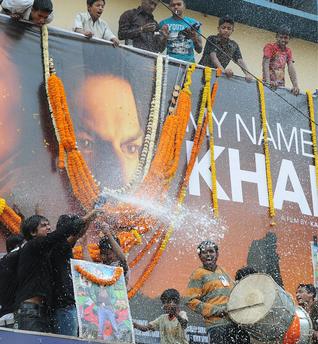
This is how Shahrukh Khan describes his experience working in the film Chak De! India (Dir: Shimit Amin, 2007).  With apologies to King Khan for discarding his proposal to not “intellectualize” films, yet taking due “fun” in it, I argue that it is only in My Name is Khan (Dir: Karan Johar, 2010) that the King finally comes “out” as a Muslim.  No “half open door” is needed.  This coming out affords particular visceral pleasures to an audience (or at least a large section of it spread across the globe) long resigned to seeing SRK endlessly and persistently marked by the specifically filmic variety of Hinduness practiced in Bollywood: doing various pujas and aartis at different Hindu temples, or adorning his spouses’ hair-parting with sindhoor and smearing his own forehead with tilaks.  This performative Hinduization of Shahrukh Khan in Urdu-Hindi cinema is unrelenting precisely due to the dogged presumption of SRK’s Muslimness that is not easily obscured.  “In my films I have been going to temples and singing bhajans; no one has questioned that,” (my emphasis) SRK exclaims in the same interview.  No one “questions” the diegetic (filmic) Hinduness of SRK; it is expected and mandatory.  With the increasing and explicit polarization in India since 1990s, the anxiety around Muslimness is such that it requires perpetual masking: an iterative performance of Hinduness, secular or otherwise.  When the mask slips off, the performance is momentarily paused – as when SRK plays a Muslim character in a film and critiqued the anti-Pakistani politics of Indian Premier League (IPL) – Hindutva activists target SRK’s suburban Bombay home, Mannat, with massive demonstrations (See the earlier Part II for more).[1]

Continue reading “Outing the Muslimness, Finally: Some Viewing (and Hearing) Pleasures (The King is Out: Part VI)”

The Future of Palestine: Righteous Jews vs. the New Afrikaners

John J. Mearsheimer

This is the transcript of the Hisham B. Sharabi Memorial Lecture delivered by John J. Mearsheimer at the The Palestine Center today.

It is a great honor to be here at the Palestine Center to give the Sharabi Memorial Lecture.  I would like to thank Yousef Munnayer, the executive director of the Jerusalem Fund, for inviting me, and all of you for coming out to hear me speak this afternoon.

My topic is the future of Palestine, and by that I mean the future of the land between the Jordan River and the Mediterranean Sea, or what was long ago called Mandatory Palestine.  As you all know, that land is now broken into two parts: Israel proper or what is sometime called “Green Line” Israel and the Occupied Territories, which include the West Bank and Gaza.  In essence, my talk is about the future relationship between Israel and the Occupied Territories.

Of course, I am not just talking about the fate of those lands; I am also talking about the future of the people who live there.  I am talking about the future of the Jews and the Palestinians who are Israeli citizens, as well as the Palestinians who live in the Occupied Territories.

Continue reading “The Future of Palestine: Righteous Jews vs. the New Afrikaners”

Placating the gods of Citizenship: the Ritual Sacrifice (The King is Out: Part III)

The obligatory declaration of cinematic patriotism for Indian Muslims necessitates a continuous performance of “loyal citizenship” invariably through offering the sacrifice of a “disloyal” one. This leaves little space for critical engagement with the nation and the state.

by Huma Dar

[read Part I Part II]


King Khan and his divinity

The obligatory declaration of cinematic patriotism for Indian Muslims (discussed in Parts I and II earlier) necessitates a continuous performance of “loyal citizenship” invariably through offering the sacrifice of a “disloyal” one. This leaves little space for critical engagement with the nation, the state, and the unending wars.  An example of this ritual performance is the sequence in My Name is Khan where Rizwan Khan, played by Shahrukh Khan (SRK), reports the “doctor” in the Los Angeles Masjid to the FBI.  How do we know the “bad” doctor is an al-Qaeda member or a terrorist?  Dr. Faisal Rahman does indeed talk about his “blood boiling” at the oppression of the Muslim Ummah in Iraq, Afghanistan, Palestine, Chechnya, Kashmir et al and even exhorts the handful of audience in a completely open space inside the Masjid to “join him and do something.”  The details of that “something” are never revealed.

Continue reading “Placating the gods of Citizenship: the Ritual Sacrifice (The King is Out: Part III)”

“Veil in the Time of War” or “Veilin’ the Time of War”

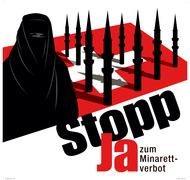
In the context of the current multiple arenas of war and occupation in Muslim-majority regions, the issues of gender and sexuality are vitally linked to the casus belli, both within and without academia. Such linkages, with a long and complicated genealogy thoroughly imbricated in the politics of colonization, decolonization, and neo-colonization, also indicate an obsessive desire to re-enact the “discovery narrative” or the “rescue narrative.” Examining current contestations in popular media – including recent articles written by Maureen Dowd, Naomi Wolf and Phyllis Chesler et al and the poster designed by Alexander Segert, which was integral to the success of the anti-minaret Swiss referendum – this essay investigates whether, how, and where the neoconservative, neoliberal, and the mainstream feminist discourses converge, diverge, and intersect.

Segert's Anti-Minaret Poster

by Huma Dar

In the context of the current multiple arenas of war and occupation in Muslim-majority regions, the issues of gender and sexuality are vitally linked to the casus belli, both within and without academia.  Such linkages, with a long and complicated genealogy thoroughly imbricated in the politics of colonization, decolonization, and neo-colonization, theorized by Inderpal Grewal, Gayatri Spivak, Lata Mani, Leila Ahmed, Sherene Razack, Saba Mahmood, Sunera Thobani amongst others, also indicate an obsessive desire to re-enact the “discovery narrative” or the “rescue narrative.”  Examining current contestations in popular media – including recent articles written by Maureen Dowd, Naomi Wolf and Phyllis Chesler et al and the poster designed by Alexander Segert, which was integral to the success of the anti-minaret Swiss referendum – I investigate whether, how, and where the neoconservative, neoliberal, and the mainstream feminist discourses converge, diverge, and intersect.  I undertake to deconstruct the ongoing debates that obsessively revolve around the veil or the sexuality that is variously professed to be suppressed, annihilated, or even “discovered” beneath the veil by some liberal explorers.

Continue reading ““Veil in the Time of War” or “Veilin’ the Time of War””

Bomb Power: The Rise of the National Security State

Garry Wills discusses his important new book Bomb Power.

Conversations host Harry Kreisler welcomes historian, critic, and Pulitzer Prize-winning author Garry Wills for a discussion his new book, Bomb Power. Wills recalls his formative influences including his Catholic faith and education; William Buckley and the editors of The National Review; the Vietnam War protests; and the Civil Rights movement. He compares Obama to past presidents and explains why his support turned to criticism. He analyzes the impact of the atomic bomb on the U.S. constitutional system arguing that its development created a national security state characterized by an enlargement of Presidential power at the expense of other branches of government.

The King is Out, His Name is Khan: Long Live the King (Part I)

My Name is Khan, although narratively based mostly in the USA, has to be theorized within and around the framework of Bollywood; the Urdu-Hindi film history, and its transnational circuits of production, distribution, and consumption; Shahrukh Khan’s star narrative, and the determining context of the Indian political scene along with that in the US and its “war on/of terror.”

by Huma Dar


The Defacing of Khan: It's Not Easy Being Muslim in Mumbai or in Newark

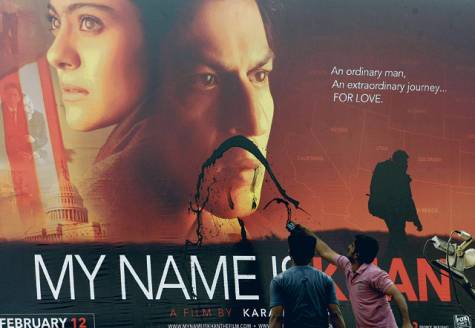
My Name is Khan, although narratively based mostly in the USA, has to be understood and theorized within and around the framework of Bollywood; the Urdu-Hindi film history and its transnational circuits of production, distribution, and consumption; Shahrukh Khan’s star narrative, and the determining context of the Indian political scene along with that in the US and its “War on/of Terror.”  Even prior to the Indian Partition in 1947, most Muslim artists had what Sa’adat Hasan Manto (1912-1955) mockingly called “shuddified” or Hinduized names – Dilip Kumar for Yusuf Khan, Madhubala for Mumtaz Begum Jahan Dehlavi (1933-1969), Meena Kumari for Mahjabeen Bano (1932-1972), or the more ambivalent (non-halal) Johnny Walker for Badruddin Jamaluddin Qazi (1923-2003) and Nargis for Fatima Rashid (1929-1981).  At the contemporary moment, the biggest stars of the Urdu-Hindi film industry in India are Khans: Shahrukh, Salman, Aamir, Saif Ali et al.  It might therefore be tempting to conclude that the Bombay film industry is indeed a level playing field.  The Khans are all Muslims, at least nominally.  Cinematically, they enact, with a few notable exceptions, Hindu characters.  Culturally, the vigorous fanzines of Bollywood idolize them as comfortably suave denizens of metropolitan Bombay[Mumbai] with understated or unexpressed Muslimness — their Hindu wives, girlfriends, or mothers facilitating this imagined assimilation or passing.  Of course, for regular, non-filmi (“film-related” in Urdu-Hindi) Muslim men, this assimilation through marriage to Hindu women is generally frowned upon and can have potentially fatal consequences.

My ruminations on My Name is Khan, like a typical Urdu-Hindi film, lengthy and replete with intermissions, are an entryway into not just the film as cinematic text, but also its complex and rich transnational contexts that must be read in tandem.  In a series of six thematic posts, with this as the first, I will expand on:

(i) The (B)Onus of Muslimness in Bollywood

(ii) Shahrukh Khan and the Pound of Flesh: the Cost of Stardom

(iii) Placating the gods of Citizenship: the Ritual Sacrifice

(iv) A Suitable Boy, “Decent” People, and Names that Pass

(v) The Price of Translating a Narrative and its Context

(vi) Outing the Muslimness, Finally: Some Viewing (and Hearing) Pleasures

Continue reading “The King is Out, His Name is Khan: Long Live the King (Part I)”

Until Justice is Done

by Haifa Zangana

Namir Noor-Eldeen, the photographer murdered by the American helicopter crew (Khalid Mohammed/AP)

I know the area where this massacre was committed. It is a crowded working-class area, a place where it is safe for children to play outdoors. It is near where my two aunts and their extended families lived, where I played as a child with my cousins Ali, Khalid, Ferial and Mohammed. Their offspring still live there.

The Reuters photographer we see being killed so casually in the film, Namir Noor-Eldeen, did not live there, but went to cover a story, risking his life at a time when most western journalists were imbedded with the military. Noor-Eldeen was 22 (he must have felt extremely proud to be working for Reuters) and single. His driver Saeed Chmagh, who is also seen being killed, was 40 and married. He left behind a widow and four children, adding to the millions of Iraqi widows and orphans.

Witnesses to the slaughter reported the harrowing details in 2007, but they had to wait for a western whistleblower to hand over a video before anyone listened. Watching the video, my first impression was, I have no impression. But the total numbness gradually grows into a now familiar anger. I listen to the excited voices of death coming from the sky, enjoying the chase and killing. I whisper: do they think they are God?

Continue reading “Until Justice is Done”

Iraqi family demands justice for US attack death

The US military says it has no reason to doubt the authenticity of a video leaked through the whistleblower website WikiLeaks showing a US military attack on a group of civilians in Iraq.

In the 2007 attack, a US military helicopter fired on a group of Iraqis, killing 12 civilians, according to the website, including two employees of the Reuters news agency.

The footage from a helicopter cockpit also shows a man stopping to help the injured, but he too is shot dead.

In an Al Jazeera exclusive, Omar al-Saleh reports on the man’s children, who were injured but survived the attack. (Apr 07, 2010)

Continue reading “Iraqi family demands justice for US attack death”

Pakistan: A new wave of attacks?

This is a video of my appearance on Al Jazeera’s Inside Story. For context, I’d encourage viewers to read my articles in Political Insight and Le Monde Diplomatique.

The Pakistani Taliban have claimed responsibility for an attack on the US consulate in Peshawar on Monday. Is Pakistan paying the price for battles waged by the United States in the region?

From the Front Line: Insurgent Pakistan

This article appeared in the Political Studies Association‘s excellent new publication Political Insight.

by Muhammad Idrees Ahmad

No nation has ever made a frank avowal of its real imperial motives. It always claims to be primarily concerned with the peace and prosperity of the people whom it subjugates. — Reinhold Niebuhr

The ironies of US President Barack Obama’s Nobel acceptance speech in Oslo were widely noted. Not since Theodore Roosevelt had a Nobel laureate used the acceptance ceremony to make a case for war. Both men appealed to St Augustine’s authority to support the justness of their cause. However, when Roosevelt spoke he had already concluded the peace for which he was honoured; Obama’s lies distant in the purgatory of  ‘hope’. In the present he remains at war — as Henry Kissinger was, when he picked up his prize — having recently ordered the second major escalation of his brief presidency. Kissinger’s war simmered on for two more years; Obama’s will likely last longer.

Afghanistan may well become Obama’s Vietnam, but his diversion is not Cambodia, or Laos, it is nuclear-armed Pakistan. History sometimes repeats itself both as tragedy and farce.

Weeks before Obama described al-Qaeda as a threat on a par with Nazi Germany, national security adviser, General James Jones, told CNN that the organisation had fewer than a hundred men in Afghanistan. Driven by institutional inertia and vulnerable to the charge of weakness, Obama appears unable to disengage. Instead he has borrowed Bush’s rhetoric of good and evil and joined the fear factory. He has subsumed al-Qaeda and the Taliban into a singular threat of global proportions whose defeat he pronounced ‘fundamental to the defense of our people’. Afghanistan, he argued,will not be pacified until the Taliban’s allies in Pakistan are vanquished. Precipitate withdrawal will restore the Taliban to power, and create a safe haven for al-Qaeda to plan more terrorist attacks on the west.

Continue reading “From the Front Line: Insurgent Pakistan”