The obligatory declaration of cinematic patriotism for Indian Muslims necessitates a continuous performance of “loyal citizenship” invariably through offering the sacrifice of a “disloyal” one. This leaves little space for critical engagement with the nation and the state.
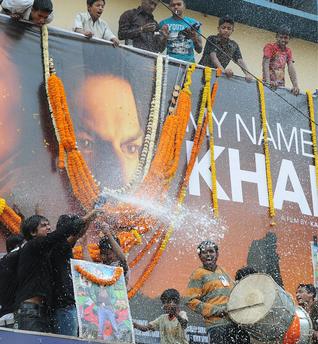
The obligatory declaration of cinematic patriotism for Indian Muslims (discussed in Parts I and II earlier) necessitates a continuous performance of “loyal citizenship” invariably through offering the sacrifice of a “disloyal” one. This leaves little space for critical engagement with the nation, the state, and the unending wars. An example of this ritual performance is the sequence in My Name is Khan where Rizwan Khan, played by Shahrukh Khan (SRK), reports the “doctor” in the Los Angeles Masjid to the FBI. How do we know the “bad” doctor is an al-Qaeda member or a terrorist? Dr. Faisal Rahman does indeed talk about his “blood boiling” at the oppression of the Muslim Ummah in Iraq, Afghanistan, Palestine, Chechnya, Kashmir et al and even exhorts the handful of audience in a completely open space inside the Masjid to “join him and do something.” The details of that “something” are never revealed.
Shahrukh Khan (SRK) has a long history of playing the fraught field (of the Indian context) with flawless diplomacy, perhaps even overplaying the field. In early 2002, precisely during the days of the state-sponsored anti-Muslim pogroms in Indian Gujarat, the then Indian Prime Minister Atal Bihari Vajpayee, from BJP (a Hindu Nationalist party), released an MTV-esque album,Samvedna [Sensitivity]. Widely broadcast on Doordarshan, the State-owned television channel, as well as on Indian-American programs (at least in the San Francisco Bay Area), the video features Vajpayee reciting his Hindi poetry while Jagjit Singh, the ghazal singer, sings in tune. The album is prefaced by the rhapsodizing words of Javed Akhtar — another famous Muslim from Bollywood, narrated by Amitabh Bachhan.
Democracy is supposed to mean ‘government by the people’. In the ancient Greek city states all the free men (but not women or slaves) would cram the theatre for lively, informed debate on a relevant issue, and then would decide it by a show of hands. Not so today. Putting a mark on a piece of paper every five years and imagining that you run things seems like a sad parody of such activity, a demotic populism masking power rather than a popular democracy negotiating it.
In our society the most important decisions are often made by unelected movers of capital and unelected civil servants and generals. Elected officials are very often at least as loyal to the lobbies easing their way as to the voters they supposedly represent.
With speculation growing over who President Obama will nominate to replace the retiring Supreme Court Justice John Paul Stevens, three top contenders have emerged: Solicitor General Elena Kagan, US Appeals Court Judge Merrick Garland and US Appeals Court Judge Diane Wood. In an interview with Democracy Now! legal analyst and contributor for Salon.com, Glenn Greenwald discusses the nominees, focusing in particular on why the nomination of Elena Kagan threatens to shift an already conservative judiciary further to the right.
Particularly alarming about Kagan’s track record is that when Bush-Cheney were abusing inherent executive power, Kagan was a robust defendant of the admnistration’s claim that the entire world was a battlefield and that executive had the right to indefinitely detain….well…anyone!
In the context of the current multiple arenas of war and occupation in Muslim-majority regions, the issues of gender and sexuality are vitally linked to the casus belli, both within and without academia. Such linkages, with a long and complicated genealogy thoroughly imbricated in the politics of colonization, decolonization, and neo-colonization, also indicate an obsessive desire to re-enact the “discovery narrative” or the “rescue narrative.” Examining current contestations in popular media – including recent articles written by Maureen Dowd, Naomi Wolf and Phyllis Chesler et al and the poster designed by Alexander Segert, which was integral to the success of the anti-minaret Swiss referendum – this essay investigates whether, how, and where the neoconservative, neoliberal, and the mainstream feminist discourses converge, diverge, and intersect.
Segert's Anti-Minaret Poster
by Huma Dar
In the context of the current multiple arenas of war and occupation in Muslim-majority regions, the issues of gender and sexuality are vitally linked to the casus belli, both within and without academia. Such linkages, with a long and complicated genealogy thoroughly imbricated in the politics of colonization, decolonization, and neo-colonization, theorized by Inderpal Grewal, Gayatri Spivak, Lata Mani, Leila Ahmed, Sherene Razack, Saba Mahmood, Sunera Thobani amongst others, also indicate an obsessive desire to re-enact the “discovery narrative” or the “rescue narrative.” Examining current contestations in popular media – including recent articles written by Maureen Dowd, Naomi Wolf and Phyllis Chesler et al and the poster designed by Alexander Segert, which was integral to the success of the anti-minaret Swiss referendum – I investigate whether, how, and where the neoconservative, neoliberal, and the mainstream feminist discourses converge, diverge, and intersect. I undertake to deconstruct the ongoing debates that obsessively revolve around the veil or the sexuality that is variously professed to be suppressed, annihilated, or even “discovered” beneath the veil by some liberal explorers.
This Memorial eve, culture in Israel took a turn to the right. Highly respected artist, Amir Bennayun, has written a song that can only described as messianic hateful state incitement and propaganda. Here it is in all its disgusting glory [lyrics below limited by my translation]:
I am reading Soldiers of Reason, Alex Abellas hagiographic account of the rise of the RAND Corporation in which he shows how ideas that originated with its mathematicians have by virtue of its proximity to power come to dominate such diverse disciplines as political science, international relations, philosophy, sociology, (even religious studies!) and economics (NB: for more on the subject, don’t miss Adam Curtis’s classic film The Trap). Prominent among them are systems analysis, game theory, and rational choice theory. The latter gave us everything from the arms race to the recent financial collapse. In his review of Robert Skidelsky’s Keynes: The Return of the Master, the new biography of John Maynard Keynes, Joseph Stiglitz writes:
We should be clear about this: economic theory never provided much support for these free-market views. Theories of imperfect and asymmetric information in markets had undermined every one of the ‘efficient market’ doctrines, even before they became fashionable in the Reagan-Thatcher era. Bruce Greenwald and I had explained that Adam Smith’s hand was not in fact invisible: it wasn’t there. Sanford Grossman and I had explained that if markets were as efficient in transmitting information as the free marketeers claimed, no one would have any incentive to gather and process it. Free marketeers, and the special interests that benefited from their doctrines, paid little attention to these inconvenient truths.
While economists who criticised the ruling free-market paradigm often still employed, as a matter of convenience, simple models of ‘rational’ expectations (that is, they assumed that individuals ‘rationally’ used all the information that they had available), they departed from the ruling paradigm in assuming that different individuals had access to different information. Their aim was to show that the standard paradigm was no longer valid when there was even this seemingly small and obviously reasonable change in assumptions. They showed, for instance, that unfettered markets were not efficient, and could be characterised by persistent unemployment. But if the economy behaves so poorly when such small realistic changes are made to the paradigm, what could we expect if we added further elements of realism, such as bouts of irrational optimism and pessimism, the ‘panics and manias’ that break out repeatedly in markets all over the world?
Joseph Stiglitz on Media Matters with Bob McChesney
Joseph Stiglitz on BookTV, interviewed by Lori Wallach of Public Citizen.
In Bil’in, the army remembers Bassem Abu Rahmeh by escalating to rubber bullets and live ammunition. A big ceremony was held with Fatah and the Fatah Youth marching band:
After a recent talk on racism and other illegitimate hierarchies at a diversity conference in Dallas, I received a letter from one of the people who had attended that asked “why you feel it necessary to perpetuate and even exacerbate the divisiveness of language when addressing a group of people assembled to learn how to live better together and be more accepting of differences?” He suggested that by being so sharply critical, I was part of the problem not the solution.
Calls for diversity and inclusiveness from people with privilege (such as a white man with a professional job living in the United States) are meaningful only when we are willing to address the systems and structures of power in which inequality and discrimination are rooted. But because such a critique strikes many people as too radical, crafting a response to those who want to avoid that analysis is crucial to the struggle for progressive social change. Below is my letter to him.
Conversations host Harry Kreisler welcomes historian, critic, and Pulitzer Prize-winning author Garry Wills for a discussion his new book, Bomb Power. Wills recalls his formative influences including his Catholic faith and education; William Buckley and the editors of The National Review; the Vietnam War protests; and the Civil Rights movement. He compares Obama to past presidents and explains why his support turned to criticism. He analyzes the impact of the atomic bomb on the U.S. constitutional system arguing that its development created a national security state characterized by an enlargement of Presidential power at the expense of other branches of government.


 P U L S E