Outing the Muslimness, Finally: Some Viewing (and Hearing) Pleasures (The King is Out: Part VI)

The King is out: he is irreversibly a Muslim. His name is Khan: pronounce it correctly please. Long Live the King!

by Huma Dar

[Read Part I Part II Part III Part IV Part V]

Rizwan Khan Offering His Namaz

[I]n one scene I wanted to have just a half open door and I wanted to be shown saying namaz once. We couldn’t take that shot. Then we put that bit where I say the prayer: Nasrun minal lahe wah fatahun kareeb (God give me strength to win) [sic] [Victory is Allah’s, and the opening/victory is close] which is my own prayer too. I don’t think we should intellectualise entertainment.  See the fun of it.

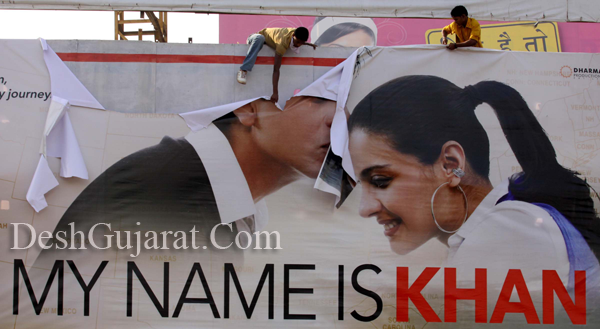
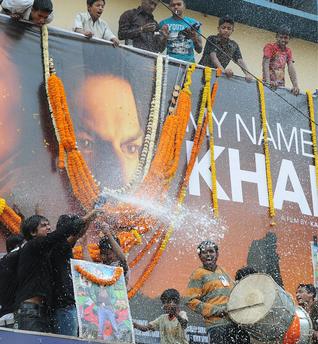
This is how Shahrukh Khan describes his experience working in the film Chak De! India (Dir: Shimit Amin, 2007).  With apologies to King Khan for discarding his proposal to not “intellectualize” films, yet taking due “fun” in it, I argue that it is only in My Name is Khan (Dir: Karan Johar, 2010) that the King finally comes “out” as a Muslim.  No “half open door” is needed.  This coming out affords particular visceral pleasures to an audience (or at least a large section of it spread across the globe) long resigned to seeing SRK endlessly and persistently marked by the specifically filmic variety of Hinduness practiced in Bollywood: doing various pujas and aartis at different Hindu temples, or adorning his spouses’ hair-parting with sindhoor and smearing his own forehead with tilaks.  This performative Hinduization of Shahrukh Khan in Urdu-Hindi cinema is unrelenting precisely due to the dogged presumption of SRK’s Muslimness that is not easily obscured.  “In my films I have been going to temples and singing bhajans; no one has questioned that,” (my emphasis) SRK exclaims in the same interview.  No one “questions” the diegetic (filmic) Hinduness of SRK; it is expected and mandatory.  With the increasing and explicit polarization in India since 1990s, the anxiety around Muslimness is such that it requires perpetual masking: an iterative performance of Hinduness, secular or otherwise.  When the mask slips off, the performance is momentarily paused – as when SRK plays a Muslim character in a film and critiqued the anti-Pakistani politics of Indian Premier League (IPL) – Hindutva activists target SRK’s suburban Bombay home, Mannat, with massive demonstrations (See the earlier Part II for more).[1]

Continue reading “Outing the Muslimness, Finally: Some Viewing (and Hearing) Pleasures (The King is Out: Part VI)”

The Future of Palestine: Righteous Jews vs. the New Afrikaners

John J. Mearsheimer

This is the transcript of the Hisham B. Sharabi Memorial Lecture delivered by John J. Mearsheimer at the The Palestine Center today.

It is a great honor to be here at the Palestine Center to give the Sharabi Memorial Lecture.  I would like to thank Yousef Munnayer, the executive director of the Jerusalem Fund, for inviting me, and all of you for coming out to hear me speak this afternoon.

My topic is the future of Palestine, and by that I mean the future of the land between the Jordan River and the Mediterranean Sea, or what was long ago called Mandatory Palestine.  As you all know, that land is now broken into two parts: Israel proper or what is sometime called “Green Line” Israel and the Occupied Territories, which include the West Bank and Gaza.  In essence, my talk is about the future relationship between Israel and the Occupied Territories.

Of course, I am not just talking about the fate of those lands; I am also talking about the future of the people who live there.  I am talking about the future of the Jews and the Palestinians who are Israeli citizens, as well as the Palestinians who live in the Occupied Territories.

Continue reading “The Future of Palestine: Righteous Jews vs. the New Afrikaners”

Ultra Zionists Take Manhattan, and Demand the Holy Land

Indepedent journalist Max Blumenthal has just released his latest video.  This one deals Jewish extremists at a New York city rally that closely resemble members of the American Tea Party movement.

Blumenthal writes the following.

On April 25, over 1000 New York-area Jewish extremists gathered in midtown Manhattan to rally against the Barack Obama administration’s call for a freeze on construction in occupied East Jerusalem and to demand unlimited rights to colonize the West Bank. With Obama and top White House officials engaged in a charm offensive to repair their relationship with mainstream American Jewish organizations, speakers at the rally lashed out at the Jewish groups and Democratic politicians, warning that cozying up to Obama would endanger Israel and imperil their cherished settlement enterprise.

I’ll let Blumenthal’s video tell the rest.

Last year, Blumenthal, along with Joseph Dana, produced the famous “Feeling the Love in Jerusalem” video that was banned on YouTube and Huffington Post. He also produced “Bomb a Ghetto, Raise a Cheer,” a video documenting pro-Israeli teabaggers rallying in support of Operation Cast Lead. For more of Blumenthal’s works click here.

Ghosts: Documenting Unseen Stories

Canadian documentarian Morvary Samare’s brave new film, Ghosts, premiered last month at the Human Rights Film Festival in Montreal. The film reveals the stories of three Canadian-Arab men who were detained and tortured in Syria and Egypt for months and years only to later be released without  charges. The film raises a number of important questions concerning the use of torture and the role of the Canadian government in these cases. As Samare notes, while the case of another Canadian citizen detained and tortured in Syria, Maher Arar, received enormous attention in the media, the cases of the three men featured in Ghost – Abdullah Almalki, Muayyed Nureddin and Ahmad Abou El-Maati – received none at all. Recent reports have revealed that although the Canadian government was aware that these men were detained and possibly being tortured, officials did little or nothing to question the validity of their detention. Instead, the government maintained that all of information pertaining to their cases concerned national security and as such, were state secrets.  

Here’s a link to a recent CTV interview with Morvary Samare, the producer and director of the film (as well as one of the founders of RamzMedia)

Continue reading “Ghosts: Documenting Unseen Stories”

The Only Democracy in the Middle East: 23-25.04.2010

Emad Rezqaafter being shot with an aluminium canister. Photograph by Hamde Abu Rahmeh

Friday in Bil’in, friend and fellow activist, Emad Rezqa was hit in the forehead by an aluminum tear gas projectile shot directly at him by Israeli soldiers during the weekly anti-Wall demonstration. He suffered a fractured skull and brain hemorrhage, and is currently hospitalized at the Hadassa Ein Karem hospital in Jerusalem. The demonstration Rezqa was injured in concluded the three-day International Bil’in Conference on Popular Struggle, and was attended by hundreds of people. Several other demonstrators were injured from gas inhalation, direct hits by gas canisters, and falling

This is the man who fired the canisters:
Bil'in 23.04.2010 - The day Israeli soldiers started shooting randomly into the crowd. one fractured skull and five arrested. - 16
I was later arrested along with Palestinian journalist Moheb Barghouti, two fellow Israelis and a Mexican activist, after staging a sit-in. (more details soon)

Continue reading “The Only Democracy in the Middle East: 23-25.04.2010”

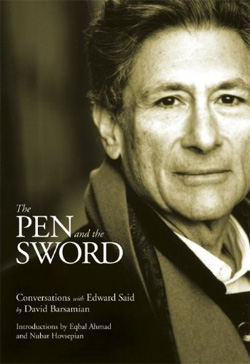
The Pen and the Sword

This review was originally published at the indispensable Electronic Intifada.

Edward Said was one of the great public intellectuals of the twentieth century – prolific, polymathic, principled, and always concerned to link theory to practice. Perhaps by virtue of his Palestinian identity, he was never an ivory tower intellectual. He never feared dirtying his hands in the messy, unwritten history of the present moment. Neither was he ever a committed member of a particular camp. Rather he offered a discomfiting, provocative, constantly critical voice. And against the postmodern grain of contemporary academia, his perspective was consistently moral, consistently worried about justice.

Said was primarily a historian of ideas. More precisely, he was interested in ‘discourse’, the stories a society tells itself and by which it (mis)understands itself and others. His landmark book “Orientalism” examined the Western narrative of empire in the Islamic Middle East, as constructed by Flaubert and Renan, Bernard Lewis and CNN. Said’s multi-disciplinary approach, his treatment of poetry, news coverage and colonial administration documents as aspects of one cultural continuum, was hugely influential in academia, helping to spawn a host of ‘postcolonial’ studies. Said’s “Culture and Imperialism” expanded the focus to include Western depictions of India, Africa, the Caribbean and Latin America, and the literary and political ‘replies’ of the colonised.

Continue reading “The Pen and the Sword”

“I for you and you for me”

Garífuna ELAM graduates Wendy Pérez (l) and Luther Castillo (r), members of the group of students who founded “For the Health of our People¨, at the house where Cuban medical personnel live in Ciriboya. (Photo courtesy of Diane Appelbaum of MEDICC)

By Joanne Shansky

“¡Elsa!  ¿Cómo estás?” exclaimed Dr. Luther Castillo with a huge smile and a very warm hug.  In a rare relaxing moment during a recent whirlwind visit to Milwaukee, Wisconsin, Dr. Castillo was reunited with a family friend from his Garífuna community on the northern coast of Honduras.

Dr. Castillo, founder of the first Garífuna hospital and head of the largest international team of physicians working in Haiti, was in town to share his experiences and speak on the topic of health care as a universal right.  He traveled with Dr. Juan Almendares, rector of the National University of Honduras, long-time human rights activist, and highly-respected leader of the resistance movement against the June, 2009 military coup.

Continue reading ““I for you and you for me””

The Price of Translating a Narrative and its Context (The King is Out: Part V)

Karan Johar falteringly attempts to fashion a cinematic alliance of sorts between African-Americans and South Asians — very unusual in the Bollywood context and more so for Karan Johar, himself — but fails to seize the radical politics embedded. One wishes that the spirit of this song was continuously re-thought, re-energized, re-contextualized, re-translated. A revolution that stops moving, stops “revolving,” is nothing but an aborted one.

by Huma Dar

[read Part I Part II Part III Part IV]


In an interesting twist, Karan Johar’s My Name is Khan displaces or translates (one original meaning of “translate” is to bear or carry across from one place to another) the convoluted and complex, determining context from India, with a specific genealogy, on to the US.  The post-9/11 circumstances provide some unfortunate resonances, yet much of the untranslated/untranslatable context results in the particular aporias of the filmic text.  Even beyond Mandira’s furious and irrational directive to Rizwan Khan, he has to go around saying his name is Khan and “he is not a terrorist” because in that originary terrain of imposed defensiveness there is not much space for a “Muslim name” (besides certain limited spheres), leave alone for “My Name is Khan, and I am an American.”  This latter, more “affirmative” alternative to the “apologetic” cinematic version, is proposed by Suad Abdul-Khabeer in her excellent critique of the film.

Continue reading “The Price of Translating a Narrative and its Context (The King is Out: Part V)”

A Suitable Boy, “Decent” People, and Names that Pass (The King is Out: Part IV)

by Huma Dar

[read Part I Part II Part III]

Ripping Apart the King, Separating Him from Kajol

In the second half of the film, My Name is Khan (2010), Karan Johar shows that Rizwan Khan’s wife, Mandira (played by Kajol) is on a personal journey to obtain justice for her son and accountability from the perpetrators of a hate crime.  It is thus ironic that Mandira’s own negligence towards Rizwan Khan (played by SRK) and the lack of accountability for making him set off on an ostensibly unfeasible mission, albeit in a fit of grief and anger, is not problematized at all in the film.  A mission that might very well have remained unfulfilled but for Rizwan Khan’s Herculean efforts, his unusual talents and disabilities, and a string of exceptional circumstances.  Rizwan Khan, given his Asperger’s syndrome, “fear of new places,” and his Muslimness (actively practiced), would have been equally, if not more, susceptible to the kind of hate crime that victimized Mandira’s son.  After the initial outburst at the place of death, Mandira had had enough time to re-think  the consequences of her angry directive to Khan, yet she never apologizes to Khan.  Here too, the immediate context of Bollywood, the multiple Hindu-Muslim marriages amongst the stars of Bombay, and the general lack of acceptance of such marriages in mainstream India are crucial to keep in mind.

Continue reading “A Suitable Boy, “Decent” People, and Names that Pass (The King is Out: Part IV)”

Placating the gods of Citizenship: the Ritual Sacrifice (The King is Out: Part III)

The obligatory declaration of cinematic patriotism for Indian Muslims necessitates a continuous performance of “loyal citizenship” invariably through offering the sacrifice of a “disloyal” one. This leaves little space for critical engagement with the nation and the state.

by Huma Dar

[read Part I Part II]


King Khan and his divinity

The obligatory declaration of cinematic patriotism for Indian Muslims (discussed in Parts I and II earlier) necessitates a continuous performance of “loyal citizenship” invariably through offering the sacrifice of a “disloyal” one. This leaves little space for critical engagement with the nation, the state, and the unending wars.  An example of this ritual performance is the sequence in My Name is Khan where Rizwan Khan, played by Shahrukh Khan (SRK), reports the “doctor” in the Los Angeles Masjid to the FBI.  How do we know the “bad” doctor is an al-Qaeda member or a terrorist?  Dr. Faisal Rahman does indeed talk about his “blood boiling” at the oppression of the Muslim Ummah in Iraq, Afghanistan, Palestine, Chechnya, Kashmir et al and even exhorts the handful of audience in a completely open space inside the Masjid to “join him and do something.”  The details of that “something” are never revealed.

Continue reading “Placating the gods of Citizenship: the Ritual Sacrifice (The King is Out: Part III)”