Manufacturing Consent and Violence: Azadi, Arundhati, Hindutva Terror, and Indian Media

by Huma Dar

At a groundbreaking seminar, ‘Azadi: The Only Way,’ organized by the Committee for the Release of Political Prisoners (CRPP) in New Delhi, India, on October 21st, 2010, the minutes record that Arundhati Roy, the prize-winning author of The God of Small Things, asserted that

[Kashmir] has never been an integral part of India and the Indian government recognised it as a disputed territory and took it to the UN on its own accord. In 1947 we were told that India became a sovereign democracy. But it became a country as per the imagination of its colonizer, and continued to be a colonizer even after the British left the country. Indian state forcibly or deceitfully annexed the North-East, Goa, Junagarh, Telangana, etc… the Indian state has waged a protracted war against the people which it calls its own. Who are the people it has waged war against? The people of North-East, Kashmir, Punjab, etc. This is an upper caste Hindu state waging a continuing struggle against the people. Continue reading “Manufacturing Consent and Violence: Azadi, Arundhati, Hindutva Terror, and Indian Media”
Kashmir: Trapped Within Hindu Nationalist Imagination

In annexing Kashmir, Indian leaders put aside their progressive anti-colonialism, and pursued a policy that stood in direct confrontation with the goals of struggling Kashmiris. Nehru’s professed derision for princes and despots proved facile in Kashmir in this first real test of his commitment to anti-colonialism and democratic values. His decision to urge the discredited and runaway Dogra ruler to sign the imperial Instrument of Accession, and then accept it, was a defeat for the oppressed Kashmiris who had, with great sacrifices, forced the Dogra ruler out. By recognizing the authority of the Dogra ruler, Indian sovereignty over Kashmir simply replaced the sovereignty enshrined in the Dogra maharaja. But along with that sovereignty, India inherited Dogra rule’s illegitimacy as well.

by Mohamad Junaid

(First published in Greater Kashmir on August 5, 2010)

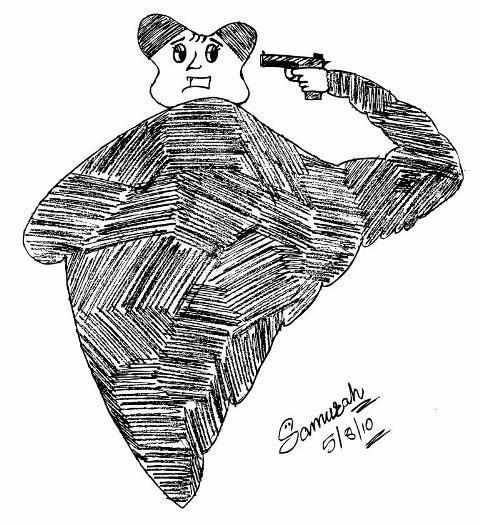
Untitled by Samurah Kashmiri, August 5, 2010
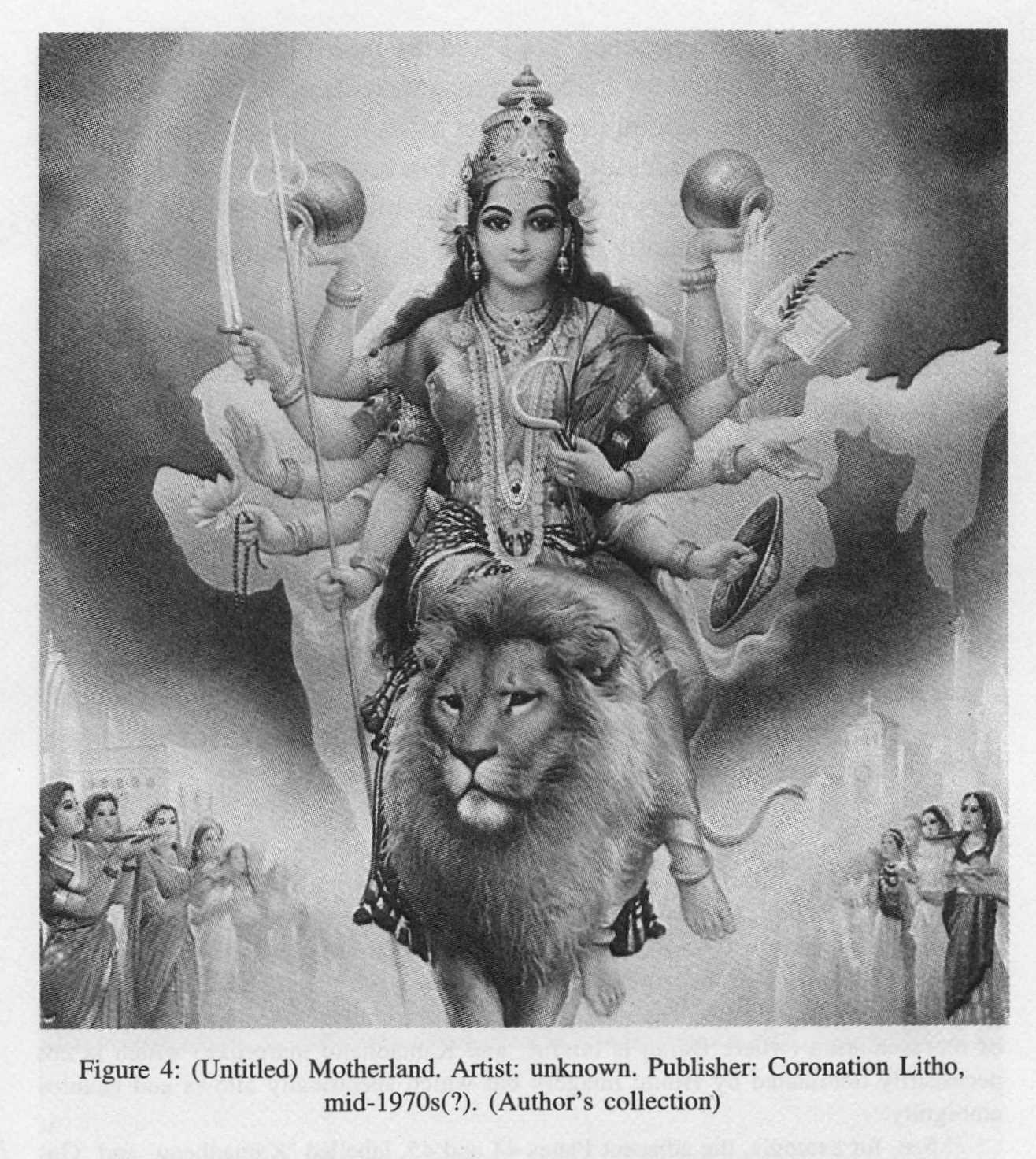
Bharat Mata or Mother India

On 26 January 1992, Murli Manohar Joshi, the leader of the Hindu nationalist Bharatiya Janata Party, after travelling by road all the way from the southern tip of India, was airlifted from Jammu to the heart of Srinagar where he half-raised the Indian flag near historic Lal Chowk. All of Kashmir was put under severe curfew, and the army was given shoot-at-sight orders. Throughout the day soldiers shot dead more than a dozen Kashmiris in the streets of Srinagar. Over the previous two years, the Indian government had unleashed a reign of terror on the people, with massacre upon massacre of unarmed protestors dotting Kashmir’s timeline. Joshi’s Ekta Yatra (Unity March), protected and provided of full support by the Indian government, was an important reminder of the nature of the Indian state and the relationship it sought with the people of Kashmir. The event was designed to put on display the majoritarian character of Indian nationhood, and line up power of the state behind it to send barely coded messages to audiences in India and in Kashmir.

Continue reading “Kashmir: Trapped Within Hindu Nationalist Imagination”

“O, God! Have mercy on me! Distracted, I whirl” — Rumi’s Gift

Not frivolously, around the alleys and bazaars, I whirl.
Lover’s temperament, I have — to have one glimpse of my Beloved, I whirl.

After Maulana Rumi (actual poet unknown)

Singing: Nusrat Fateh Ali Khan and Qawwaals

Translated by Huma Dar

Raqs al-Ruhani, al-Qahirah (Huma Dar 2005)
Naa Man Behooda Gird-e Koocha-o-Baazaar Mi Gardam (Huma Dar 2005)

نه من  بيهوده  گرد کوچه  و  بازار  می  گردم
مذاق عاشقی  دارم  پئ  ديدار  ميگردم

خدايا  رحم  کن  بر  من  پريشان وار  می  گردم
خطا کارم  گناھگارم  به  حال زار  می  گردم

شراب شوق  می نوشم  به  گرد يار  می  گردم
سخن مستانه  می گويم  ولے  هوشيار  می  گردم

گھےخندم  گھے گريم گھے افتم  گھے خيزم
مسيحا  در دلم  پيدا  و  من  بيمار  می گردم

بیا جانا  عنایت  کن  تو  مولانای رومی  را
غلام  شمس  تبریزم  قلندروار  می گردم

Continue reading ““O, God! Have mercy on me! Distracted, I whirl” — Rumi’s Gift”

“Truth Alone Triumphs”: of David, Goliath, Stones, and Speech

“Azadi” is also the chant whose echoes swirl in the Kashmir Valley with greater resonance each day, from the minarets and playgrounds, boulevards and alleys, schools and courts, despite the crushing screeches of teargas and bullets of the Indian (in)security forces. It is “scriptured” into utterance by each breath of Kashmiri women, children, and men; calligraphed by their blood on their emerald valley; embroidered by their bones in Kashmiri Arabesque on worn cobblestones of the downtown; and papier-mâchéd in paisley tears on the blue of their beloved lakes.

by Huma Dar

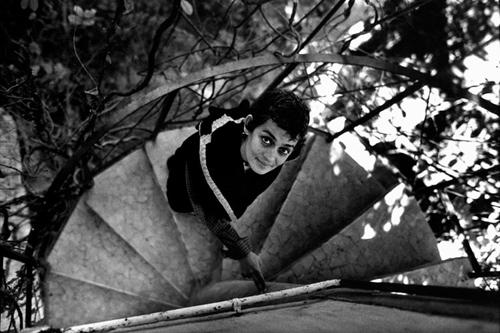
“A Defiant Kashmiri woman being frisked by Indian Security Forces.” 2007. Uncredited photograph from a Kashmiri blogger


And the night’s sun there in Srinagar?  Guns shoot stars into the sky, the storm of constellations night after night, the infinite that rages on.  It was Id-uz-Zuha: a record of God’s inability, for even He must melt sometimes, to let Ishmael be executed by the hand of his father.  Srinagar was under curfew.  The identity pass may or may not have helped in the crackdown.  Son after son–never to return from the night of torture–was taken away.

… But the reports are true, and without song: mass rapes in the villages, towns left in cinders, neighborhoods torched.  “Power is hideous / like a barber’s hands.”  The rubble of downtown Srinagar stares at me from the Times.

… And that blesséd word with no meaning–who will utter it?  What is it?  Will the women pronounce it, as if scripturing the air, for the first time?  Or the last?

… What is the blesséd word?  Mandelstam gives no clue.  One day the Kashmiris will pronounce that word truly for the first time.  (Excerpt from Agha Shahid Ali’s “The Blesséd Word: A Prologue,” in The Country Without A Post Office,  1997: 16-17)

Continue reading ““Truth Alone Triumphs”: of David, Goliath, Stones, and Speech”

The Stones On Our Streets

Lies are created around the truth of our struggle. But truth has a habit of confronting falsehood. Occupation is based on a pile of lies. There’s truth in the resistance of unarmed people on the streets. And truth triumphs in the end. It always does, even if it takes time.

by Majid Maqbool

The street is the home of our stones.  Streets can be occupied, but stones are free for us to pick up, and angrily fling in the air — in protest.  From the hands of the oppressed, once pelted, the stones deliver a message to the oppressor: while you kill with no remorse on my soil, and stage false encounters with all your advanced weapons, I’m not going to keep quiet.  I will not let you kill us without offering resistance.  I have these stones on my streets.  I exist in these stones.  If your occupation is in bullets, our resistance is in these rough-edged, homegrown stones.

We, who come out protesting on the streets, are not an ignorant, frustrated and unemployed lot — as the occupier likes to frame us, and the whole world seems to simplistically believe.  Far from it!  We are the ones who refuse to keep quiet in tyrannical times.  We are the ones who shape the songs of resistance, as we practice them in our streets.  It takes much courage and conviction to come out on the streets, and protest against the heavily militarized state forces.  The sentiment of freedom confronts the idea of occupation.  In every stone that’s pelted, there’s a promise to bring down the structures of occupation, bit by bit, crack by crack.  We know in our hearts and minds that this ugly structure of occupation —  built on deceit over the years — is bound to crumble one day under the force of our stones.  It is this hope that keeps the resistance alive.

Continue reading “The Stones On Our Streets”

Peaches

by Arif Ayaz Parrey

Can I tell how much I love peaches?
Not ordinary ones
But those plucked from
The orchards along Jhelum

The ones in the basket before me
Are nebrim for sure
But they blush like a home-grown innocence
And hold as many juicy promises

I wonder what tree bore them
I wonder if it’s wise to ignore them

The tree of life
Has many buried roots

It is said that my only son
Was killed under the canopy
Of the branches of one such tree
By the army
Also known as the security forces
An old joke
What do they secure
These so-called security forces?
Not the people, not our lives, not our liberty
Not our sentiments, nor our emotions, not our sanity
Not our sons who are shot
Nor our daughters who are raped
Not the truth, not the facts, not humanity

Continue reading “Peaches”

From “Islamist Watch” to Islamic Mimbar: the Politics of Hypocrisy

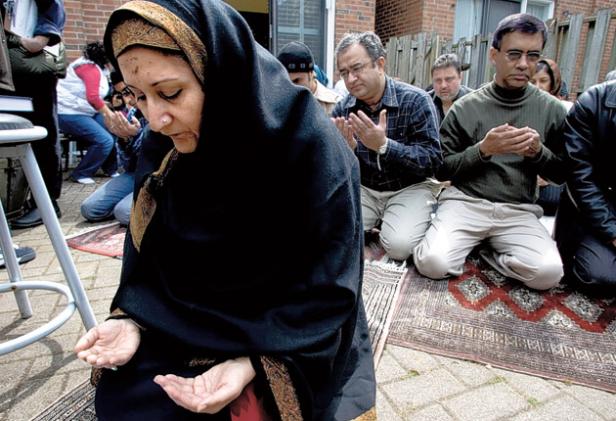
Raheel Raza leads a group of Muslims in prayer in Canada

By Huma Dar

On Thursday, June 10, 2010, Jerome Taylor, the Religious Affairs Correspondent of The Independent posted an article headlined, “First Woman to Lead Friday Prayers in UK.” Two-thirds of the way down this article, we find that:

“Ms Raza’s appearance in Oxford is a repeat of a similar prayer session in 2008 which was led by Amina Wadud, an American-born convert and Muslim feminist. But this is the first time a Muslim-born woman will lead a mixed prayer service in Britain.”

Continue reading “From “Islamist Watch” to Islamic Mimbar: the Politics of Hypocrisy”

Boycott Israel? Amitav Ghosh & the Dan David Prize

The call for academic and cultural boycott is clearly a way to encourage civil society to play a broader political role—that is why it has the support of wide sections of Palestinian civil society. One of the most significant questions that call poses to us is simply this: How could those of us who oppose apartheid, occupation, and colonialism not support such a call?

Dear Amitav Ghosh,

We wish to express our deep disappointment in your decision to accept the Dan David prize, administered by Tel Aviv University and to be awarded by the President of Israel. As a writer whose work has dwelled consistently on histories of colonialism and displacement, your refusal to take stance on the colonial question in the case of Israel and the occupation of Palestine has provoked deep dismay, frustration, and puzzlement among readers and fans of your work around the world. Many admired your principled stand, and respected your decision not to accept the Commonwealth Writers Prize in rejection of the colonialist framework it represented.

Continue reading “Boycott Israel? Amitav Ghosh & the Dan David Prize”

The Carnival at Novara and Unmasking of a Racist Regime

by Huma Dar

The police, in the northern Italian town of Novara, fined a 26-year-old Tunisian woman for wearing a black niqab; she was going to a mosque for the Friday prayers.  According to the New York Times she was fined about $650 under a regulation introduced in January 2010.  Apparently, Novara — a bastion of the xenophobic Northern League — “bans clothing in public that prevents identification by the police.”

Continue reading “The Carnival at Novara and Unmasking of a Racist Regime”

Outing the Muslimness, Finally: Some Viewing (and Hearing) Pleasures (The King is Out: Part VI)

The King is out: he is irreversibly a Muslim. His name is Khan: pronounce it correctly please. Long Live the King!

by Huma Dar

[Read Part I Part II Part III Part IV Part V]

Rizwan Khan Offering His Namaz

[I]n one scene I wanted to have just a half open door and I wanted to be shown saying namaz once. We couldn’t take that shot. Then we put that bit where I say the prayer: Nasrun minal lahe wah fatahun kareeb (God give me strength to win) [sic] [Victory is Allah’s, and the opening/victory is close] which is my own prayer too. I don’t think we should intellectualise entertainment.  See the fun of it.

This is how Shahrukh Khan describes his experience working in the film Chak De! India (Dir: Shimit Amin, 2007).  With apologies to King Khan for discarding his proposal to not “intellectualize” films, yet taking due “fun” in it, I argue that it is only in My Name is Khan (Dir: Karan Johar, 2010) that the King finally comes “out” as a Muslim.  No “half open door” is needed.  This coming out affords particular visceral pleasures to an audience (or at least a large section of it spread across the globe) long resigned to seeing SRK endlessly and persistently marked by the specifically filmic variety of Hinduness practiced in Bollywood: doing various pujas and aartis at different Hindu temples, or adorning his spouses’ hair-parting with sindhoor and smearing his own forehead with tilaks.  This performative Hinduization of Shahrukh Khan in Urdu-Hindi cinema is unrelenting precisely due to the dogged presumption of SRK’s Muslimness that is not easily obscured.  “In my films I have been going to temples and singing bhajans; no one has questioned that,” (my emphasis) SRK exclaims in the same interview.  No one “questions” the diegetic (filmic) Hinduness of SRK; it is expected and mandatory.  With the increasing and explicit polarization in India since 1990s, the anxiety around Muslimness is such that it requires perpetual masking: an iterative performance of Hinduness, secular or otherwise.  When the mask slips off, the performance is momentarily paused – as when SRK plays a Muslim character in a film and critiqued the anti-Pakistani politics of Indian Premier League (IPL) – Hindutva activists target SRK’s suburban Bombay home, Mannat, with massive demonstrations (See the earlier Part II for more).[1]

Continue reading “Outing the Muslimness, Finally: Some Viewing (and Hearing) Pleasures (The King is Out: Part VI)”