Boycotting Ariel: Missing the Forest for the Trees

Ariel is an illegal Israeli settlement in the West Bank.

PACBI Statement

Provoked by the recent announcement of the inauguration of a cultural center in Ariel, the fourth largest Jewish colony in the occupied Palestinian territory, 150 prominent Israeli academics, writers, and cultural figures have declared that they “will not take part in any kind of cultural activity beyond the Green Line, take part in discussions and seminars, or lecture in any kind of academic setting in these settlements” [1].  A few protestors went as far as reiterating the fact that all Israeli colonies built on occupied Palestinian land are in violation of the Fourth Geneva Convention and thus constitute a war crime.

This position by tens of Israeli academics and artists has generated a great deal of controversy within the Israeli public sphere, attracting rebuke from across the political spectrum and especially from the academic and cultural establishment.  All major theaters were quick to declare their refusal to boycott Ariel under the pretense of serving “all Israelis;” university administrations echoed this position or resorted to silence, continuing business as usual with Ariel and other settlements.  The terms of the discourse, however, raise a number of issues for supporters of Palestinian rights.  While we welcome acts of protest against any manifestation of Israel’s regime of colonialism and apartheid, we believe that these acts must be both morally consistent and anchored in international law and universal human rights.

Continue reading “Boycotting Ariel: Missing the Forest for the Trees”
Elaine Hagopian Reviews Israeli Exceptionalism

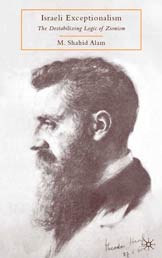
Israeli Exceptionalism: The Destabilizing Logic of Zionism (Palgrave Macmillan, November 10, 2009). Publisher’s link.

by Elaine Hagopian

Cover Image GIFFor those unfamiliar with the extraordinary evolution of Israeli exceptionalism emanating from its Zionist narrative and assuring Israel’s incredible success as a colonial settler state, M. Shahid Alam’s book is the one to read.  He has recorded a compelling, uniquely comprehensive and enlightening historical analysis of the inherently destabilizing dynamic of Zionism.  Of particular note are his detailed Chapters Nine and Thirteen.

In Chapter Nine, he documents the constellation of Jewish factors that came together in the 19th century which assured Zionist success: the spread of Jewish intellectuals and professionals across major cities in Europe; Jewish population growth to 16.7 million in 1939 which could root a nationalist movement; business acumen and ownership of major banks and a strong media presence; growth of interchange with other Jewish leaders contributing to a sense of community – important considering that Jews had not previously formed a sense of nation according to Alam; and as European nationalism grew, Jews were affected by the idea though they had no majority presence in any one state which could be claimed by them.  Historical anti-Semitism prodded the Jewish elites toward formulation of the Zionist project even as Jews were moving out of the ghettos of a liberalized Europe.  Given their distribution throughout Europe and without a territorial base of their own, the Zionist sought and captured the needed “mother” country to implement their colonial settler state in Palestine.  This they found in the U.K initially and then in the U.S. with periodic support by other countries such as France.

Continue reading “Elaine Hagopian Reviews Israeli Exceptionalism”

Boycott Israel? Amitav Ghosh & the Dan David Prize

The call for academic and cultural boycott is clearly a way to encourage civil society to play a broader political role—that is why it has the support of wide sections of Palestinian civil society. One of the most significant questions that call poses to us is simply this: How could those of us who oppose apartheid, occupation, and colonialism not support such a call?

Dear Amitav Ghosh,

We wish to express our deep disappointment in your decision to accept the Dan David prize, administered by Tel Aviv University and to be awarded by the President of Israel. As a writer whose work has dwelled consistently on histories of colonialism and displacement, your refusal to take stance on the colonial question in the case of Israel and the occupation of Palestine has provoked deep dismay, frustration, and puzzlement among readers and fans of your work around the world. Many admired your principled stand, and respected your decision not to accept the Commonwealth Writers Prize in rejection of the colonialist framework it represented.

Continue reading “Boycott Israel? Amitav Ghosh & the Dan David Prize”

Outing the Muslimness, Finally: Some Viewing (and Hearing) Pleasures (The King is Out: Part VI)

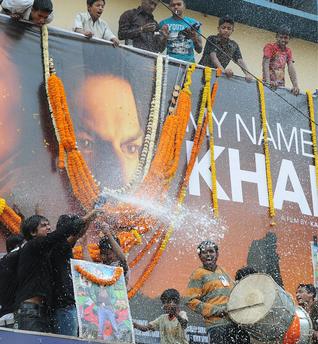
The King is out: he is irreversibly a Muslim. His name is Khan: pronounce it correctly please. Long Live the King!

by Huma Dar

[Read Part I Part II Part III Part IV Part V]

Rizwan Khan Offering His Namaz

[I]n one scene I wanted to have just a half open door and I wanted to be shown saying namaz once. We couldn’t take that shot. Then we put that bit where I say the prayer: Nasrun minal lahe wah fatahun kareeb (God give me strength to win) [sic] [Victory is Allah’s, and the opening/victory is close] which is my own prayer too. I don’t think we should intellectualise entertainment.  See the fun of it.

This is how Shahrukh Khan describes his experience working in the film Chak De! India (Dir: Shimit Amin, 2007).  With apologies to King Khan for discarding his proposal to not “intellectualize” films, yet taking due “fun” in it, I argue that it is only in My Name is Khan (Dir: Karan Johar, 2010) that the King finally comes “out” as a Muslim.  No “half open door” is needed.  This coming out affords particular visceral pleasures to an audience (or at least a large section of it spread across the globe) long resigned to seeing SRK endlessly and persistently marked by the specifically filmic variety of Hinduness practiced in Bollywood: doing various pujas and aartis at different Hindu temples, or adorning his spouses’ hair-parting with sindhoor and smearing his own forehead with tilaks.  This performative Hinduization of Shahrukh Khan in Urdu-Hindi cinema is unrelenting precisely due to the dogged presumption of SRK’s Muslimness that is not easily obscured.  “In my films I have been going to temples and singing bhajans; no one has questioned that,” (my emphasis) SRK exclaims in the same interview.  No one “questions” the diegetic (filmic) Hinduness of SRK; it is expected and mandatory.  With the increasing and explicit polarization in India since 1990s, the anxiety around Muslimness is such that it requires perpetual masking: an iterative performance of Hinduness, secular or otherwise.  When the mask slips off, the performance is momentarily paused – as when SRK plays a Muslim character in a film and critiqued the anti-Pakistani politics of Indian Premier League (IPL) – Hindutva activists target SRK’s suburban Bombay home, Mannat, with massive demonstrations (See the earlier Part II for more).[1]

Continue reading “Outing the Muslimness, Finally: Some Viewing (and Hearing) Pleasures (The King is Out: Part VI)”

The Price of Translating a Narrative and its Context (The King is Out: Part V)

Karan Johar falteringly attempts to fashion a cinematic alliance of sorts between African-Americans and South Asians — very unusual in the Bollywood context and more so for Karan Johar, himself — but fails to seize the radical politics embedded. One wishes that the spirit of this song was continuously re-thought, re-energized, re-contextualized, re-translated. A revolution that stops moving, stops “revolving,” is nothing but an aborted one.

by Huma Dar

[read Part I Part II Part III Part IV]


In an interesting twist, Karan Johar’s My Name is Khan displaces or translates (one original meaning of “translate” is to bear or carry across from one place to another) the convoluted and complex, determining context from India, with a specific genealogy, on to the US.  The post-9/11 circumstances provide some unfortunate resonances, yet much of the untranslated/untranslatable context results in the particular aporias of the filmic text.  Even beyond Mandira’s furious and irrational directive to Rizwan Khan, he has to go around saying his name is Khan and “he is not a terrorist” because in that originary terrain of imposed defensiveness there is not much space for a “Muslim name” (besides certain limited spheres), leave alone for “My Name is Khan, and I am an American.”  This latter, more “affirmative” alternative to the “apologetic” cinematic version, is proposed by Suad Abdul-Khabeer in her excellent critique of the film.

Continue reading “The Price of Translating a Narrative and its Context (The King is Out: Part V)”

Placating the gods of Citizenship: the Ritual Sacrifice (The King is Out: Part III)

The obligatory declaration of cinematic patriotism for Indian Muslims necessitates a continuous performance of “loyal citizenship” invariably through offering the sacrifice of a “disloyal” one. This leaves little space for critical engagement with the nation and the state.

by Huma Dar

[read Part I Part II]


King Khan and his divinity

The obligatory declaration of cinematic patriotism for Indian Muslims (discussed in Parts I and II earlier) necessitates a continuous performance of “loyal citizenship” invariably through offering the sacrifice of a “disloyal” one. This leaves little space for critical engagement with the nation, the state, and the unending wars.  An example of this ritual performance is the sequence in My Name is Khan where Rizwan Khan, played by Shahrukh Khan (SRK), reports the “doctor” in the Los Angeles Masjid to the FBI.  How do we know the “bad” doctor is an al-Qaeda member or a terrorist?  Dr. Faisal Rahman does indeed talk about his “blood boiling” at the oppression of the Muslim Ummah in Iraq, Afghanistan, Palestine, Chechnya, Kashmir et al and even exhorts the handful of audience in a completely open space inside the Masjid to “join him and do something.”  The details of that “something” are never revealed.

Continue reading “Placating the gods of Citizenship: the Ritual Sacrifice (The King is Out: Part III)”

“Getting rid of hope and faith”: Abe Osheroff on the struggle for a better world

by Robert Jensen

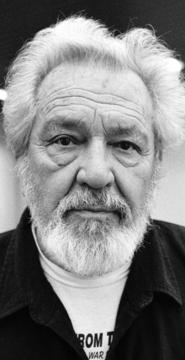
Abe Osheroff

After a recent talk about the struggle for social justice and the threats to the ecosystem, a student lingered, waiting to talk to me alone, as if he had something to confess.

“I feel so overwhelmed,” he finally said, wondering aloud if political organizing could really make a difference. The young man said he often felt depressed, not about the circumstances of his own life but about the possibilities for change. Finally, he looked at me and asked, “Once you see what’s happening — I mean really see it — how are you supposed to act like everything is going to be OK?”

I hear such concerns often, from young and older people alike. Perhaps the questions are rationalizations for political inaction for some people, attempts to persuade themselves that there’s no reason to join left/progressive movements. But most of the people I meet who struggle with this question are activists, engaged in all kinds of worthy projects. They aren’t looking for a reason to drop out but are trying to face honestly the state of the world. They want to stay engaged but recognize the depth of multiple crises — economic, political, cultural, and ecological.

Some organizers respond to such concerns with upbeat assurances that if we just get more people on board and work a little bit harder, the problems will be solved — if not tomorrow, certainly within some reasonable period of time. I used to say things like that, but now I think it’s more honest, and potentially effective, to acknowledge how massive the obstacles that need to be overcome really are. We must not only recognize that the world’s resources distributed in a profoundly unjust way and the systems in which we live are fundamentally unsustainable ecologically, but also understand there’s no guarantee that this state of affairs can be reversed or even substantially slowed down. There are, in fact, lots of reasons to suspect that many of our fundamental problems have no solutions, at least no solutions in any framework we currently understand.

Continue reading ““Getting rid of hope and faith”: Abe Osheroff on the struggle for a better world”

Raymond Deane’s Open Letter to the Heinrich Böll Foundation on Norman Finkelstein

UPDATE: It now appears that the Rosa Luxemburg House has also cancelled the lecture. For shame.

Raymond Deane, renowned composer and founding member and former chairperson of the Ireland-Palestine Solidarity Campaign, sent this open letter to the Heinrich Böll Foundation after they cancelled Norman Finkelstein’s scheduled lecture in Berlin under the pretense that Finkelstein is a “controversial” figure.  PULSE is the first site to publish this letter in English.  The letter is also being translated into German, and will be appearing on several German websites shortly.  Finkelstein’s talk will still take place, but will be hosted by the Rosa Luxembourg Foundation.

Continue reading “Raymond Deane’s Open Letter to the Heinrich Böll Foundation on Norman Finkelstein”

BDS: Calling all Geographers

What follows is an open letter in response to the International Geographical Union’s (IGU) refusal to relocate its July 12 – 16, 2010 regional conference outside of Tel Aviv in support of the internationally supported Boycott, Divestment and Sanctions campaign aimed at Israel.  The IGU was initially confronted by the Palestinian Campaign for the Academic and Cultural Boycott of Israel in November 2009.  This letter was printed on the US Campaign for the Academic & Cultural Boycott of Israel’s website today.

Geographers and other academics can sign the letter here.

As geographers, faculty, students, and people of conscience, we are profoundly dismayed by IGU’s decision to hold its July 2010 regional conference in Tel Aviv, in violation of the widely endorsed Palestinian civil society call for Boycott, Divestments, and Sanctions (BDS) against Israel. We are equally troubled by IGU’s response [1] to the open letter issued by the Palestinian Campaign for the Academic and Cultural Boycott of Israel (PACBI), which urged the Executive Committee to relocate the upcoming regional conference out of Israel [2].

Continue reading “BDS: Calling all Geographers”

Remember Zinn by Organizing

by Ralph Nader

There are several memorial services and events being planned for Howard Zinn whom The New York Times called a “historian, shipyard worker, civil rights activist and World War II bombardier, when he passed away at age 87 late last month.”

His legion of friends, students, admirers and colleagues will be out in force reminding the country about his impact as a civic leader, motivational teacher, author of the ever more popular book A People’s History of the United States, and all around fine, compassionate, and level-headed human being.

Judging by similar gatherings for remembering other progressive activists and writers, the encomiums for Professor Zinn, who taught at Spelman College in the late fifties and early sixties (two of his students were Marian Wright Edelman and Alice Walker) and at Boston University until 1988, will be heartfelt, wide-ranging and inspiringly anecdotal.

Receptions will follow and those in attendance will return to their homes, hoping that what Howard Zinn spoke and wrote and how he acted will serve as an example for those who follow his public philosophy of being and doing.

Continue reading “Remember Zinn by Organizing”