On the ‘Precision’ of Language: Why the Term ‘Genocide’ is So Wrong, or Who Can Use the Term

This essay is a response to the emerging discussions over the ‘appropriateness’ of the use of the word ‘genocide’ in the context of the Indian military occupation in Kashmir on PulseMedia and elsewhere on Facebook.

by Mohamad Junaid

[This essay is a response to the emerging discussions over the ‘appropriateness’ of the use of the word ‘genocide’ in the context of the Indian military occupation in Kashmir on PulseMedia and elsewhere on Facebook.]
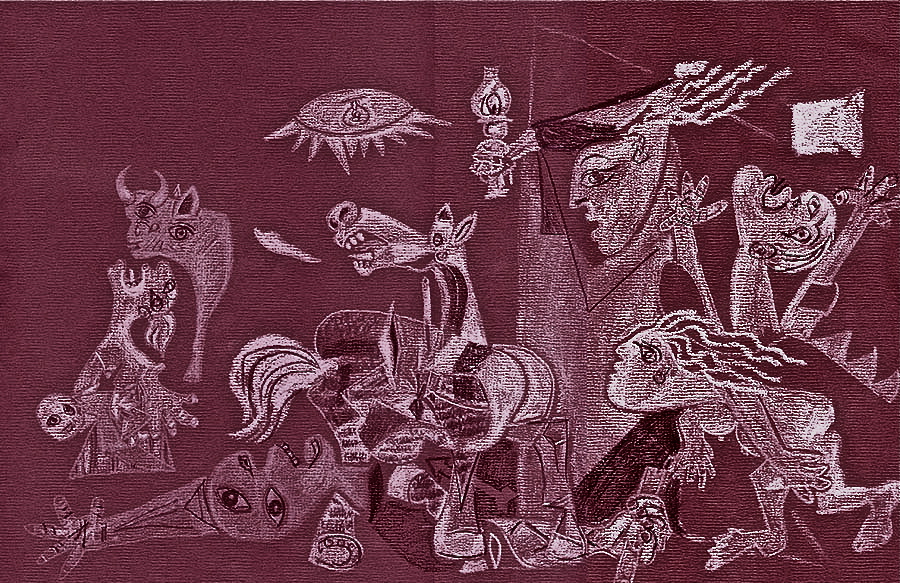
Homage to Picasso's Guernica (HD 2002)

But, which language? Which one language expresses all joyous, exhilarating, or traumatic experiences?

When Kashmiris are told to be precise in their language there are largely two positions involved: one, a sympathetic (if inadequate and self-censorious) one, which suggests that following ‘the convention’ will allow for legalistic interpretation and some form of retributive or ‘restorative’ justice. Often such a position traps itself in legal discourse, and by seeking to bottle people’s experiences into tight categories, fetishizes those categories, and in the end reduces the depth of traumatic experiences to mere data points on the grid of classification. This compliant and self-disciplining position forgets the origins of law in violence (and the inverse), and how ‘law’ serves to maintain ‘order’—which is, in other words, the systematized, legally endorsed structure of oppression. The peculiar claim to universalism (to create a universal system of law) that drives this position pays no heed to where, and for whom, these supposedly ‘universal’ categories of law are created, and what connection law has with power or ‘international’ law with the empire. Continue reading “On the ‘Precision’ of Language: Why the Term ‘Genocide’ is So Wrong, or Who Can Use the Term”
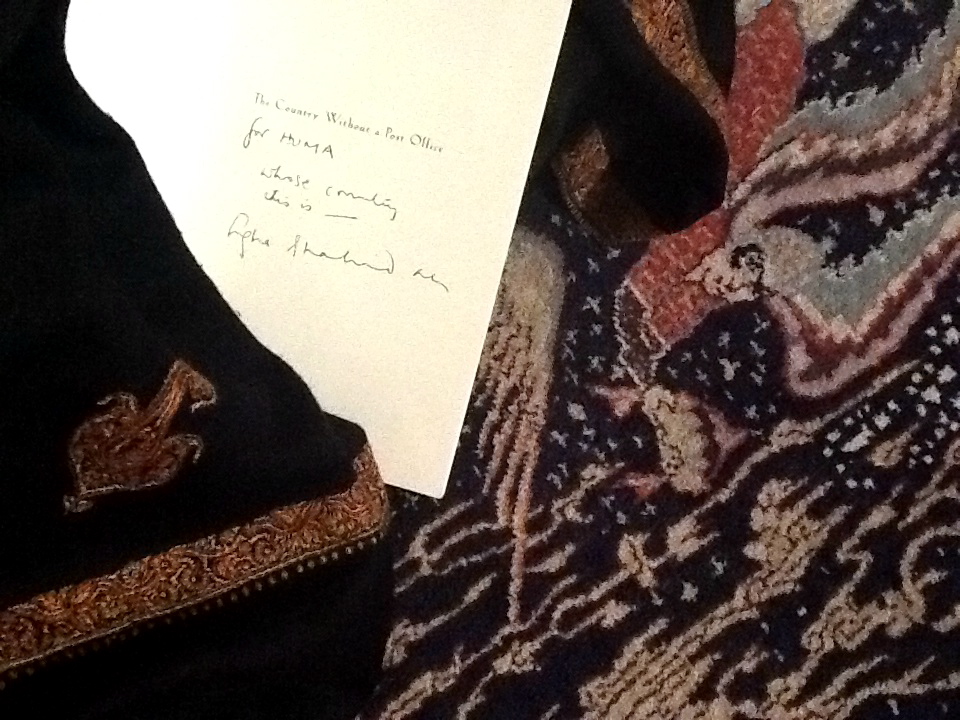
A Passport Of The Country Without A Post Office

The genocide in Kashmir is not over yet, but the land fertilized by the blood of innumerable, amaranthine martyrs is blossoming bouquets of tulips and roses in quick succession. New possibilities of spring, of poetry, of Azadi, of freedom, of peace are here, and they are unstanchable. I wish you were here, Shahid: Beloved, Witness, and perhaps with the slip of tongue, even Shahd, or Honey.

by Huma Dar

Passport to The Country Without A Post Office

I met Shahid between noon and one pm, in the Lipman Room of Barrows Hall, almost exactly thirteen years ago, on December 3, 1998.  He’d come to recite from The Country Without A Post Office (1997) for the Lunch Poems Reading Series at UC Berkeley.  His jokes, tinged with a very particular Kashmiri black humor — irreverent, risqué, ridiculous — mirrored my family’s wacky one.  All that heartache about Kashmir, finding not many kindred souls around, found solace in Shahid’s scriptured lament, “After the August Wedding in Lahore, Pakistan.”

A brigadier says, The boys of Kashmir
break so quickly, we make their bodies sing,
on the rack, till no song is left to sing.
“Butterflies pause / On their passage Cashmere –”
And happiness: must it only bring pain?
The century is ending.  It is pain
from which love departs into all new pain:
Freedom’s terrible thirst, flooding Kashmir,
is bringing love to its tormented glass.
Stranger, who will inherit the last night
of the past?  Of what shall I not sing, and sing?

Continue reading “A Passport Of The Country Without A Post Office”

The State of Palestine – A Hint of Liberation?

State of Palestine Stamp by Khaled Jarrar It occurs to me that I can’t address the issue of a Palestinian state without addressing my Anarchism. The national struggle is an issue of inevitable debate for many Anarchists who support the Palestinian struggle for liberation. Truth be told, as a local Anarchist, in a time when Palestine is still occupied territory, when asked about the Palestinian bid at the UN for a Palestinian state, I worry mostly about how more violent the Israeli army could get when we demonstrate with the villages. I worry about being denied entry into the occupied territory, in order to get to the demonstrations. I worry about not being able to see my friends, or being prosecuted for attempting to do so.

Many of us- “on the ground” as they say- Palestinians, Anarchists and allies, have been brushing off the reality of a Palestinian-state-positive vote in the UN , because we doubt it’ll change anything ”on the ground.” To those shot at, holding a flag or holding a stick is at best a semantic exercise.

That said, declaring a Palestinian state is not one of those small issues that can be brushed aside, especially because “state” is an internationally accepted legal term. As an Anarchist the idea of an international general assembly, in which whole populations have their say is remarkable to me. Had the United Nations been fashioned after a participatory society model, rather than a hierarchical, neo-liberal, democratic model, maybe it needn’t have had to hang its head in shame. But for now, one must hold the status of a “state”, in order to be recognized as a people- and consequently a person. So in a bid to understand the repercussions of next week, over our lives, more deeply, I’d like to delve into the legal opinions that have been published about the move.

Continue reading “The State of Palestine – A Hint of Liberation?”

UN School of Etiquette: How to Conduct an “Appropriate” Blockade

Just as I arrived in Bil’in for the Friday weekly demonstration, word came that the UN Report of the Secretary-General’s Panel of Inquiry on the 31 May 2010 Flotilla Incident (a.k.a. “The Palmer Committee Report”) has named the blockade of the Gaza Strip “legal and appropriate”. Which is rather surprising, seeing as the blockade was defined by the UN as “illegal” as well as  “illegal and inhumane”, time and time again. (And again.)

Vodpod videos no longer available.

Continue reading “UN School of Etiquette: How to Conduct an “Appropriate” Blockade”

Edward Said on Hardtalk

The following is an old episode of the BBC’s Hardtalk featuring Edward Said.

Continue reading “Edward Said on Hardtalk”

Dear Coen Brothers, It’s Nothing Personal (It’s all Political)

Ethan and Joel Coen recieve the $1M Dan David Prize on May 15th 2011 at Tel Aviv University. ~ Photo by REUTERS/Amir Cohen

On May 15th, while thousands of people were getting shot and gassed in the streets, the Coen Brothers (and many others) took a million dollars from Tel Aviv University, in the form of the Dan David Prize. I’m sure someone would have cared to protest, had  over 15 people not been killed and hundreds injured, during the Nakba Day commemoration demonstrations, that same day.

Update (17.5.11): 21 dead, and over 200 injured.

Continue reading “Dear Coen Brothers, It’s Nothing Personal (It’s all Political)”

Khirbat Tuqu’ & the Silent World

It must have been late at night when this rare, short, late-night segment on Channel 10 sneaked by the editors:

Between Judea and Samaria & the West Bank

While I’m astonished that an Israeli mainstream news service would even address this story at all, let alone report in a considerably balanced manner; There are many very basic questions that this 2-and-a-half minute segment whizzes through, that I’d like to comment on.
Continue reading “Khirbat Tuqu’ & the Silent World”

New Who Profits Report: Forbidden Fruit- The Israeli Wine Industry and the Occupation

From the Who Profits Newsletter:

Vinyards and olive groves of the settlement of Giv'at Har'el on the lands of the Palestinian village of Qaryut.  Photo: ETA new report by Who Profits maps the involvement of the Israeli wine industry in the occupation of the West Bank and the Syrian Golan Heights and traces some of the ways in which it masks this involvement. For this purpose, this report surveys the Israeli wine industry, maps the vineyards and wineries in the occupied territory and traces the connections between the main Israeli wine producers and this settlement industry.

The full report is available here: http://www.whoprofits.org/articlefiles/WhoProfits-IsraeliWines.pdf
Continue reading “New Who Profits Report: Forbidden Fruit- The Israeli Wine Industry and the Occupation”

Of Niqabs, Monsters, and Decolonial Feminisms

By Huma Dar

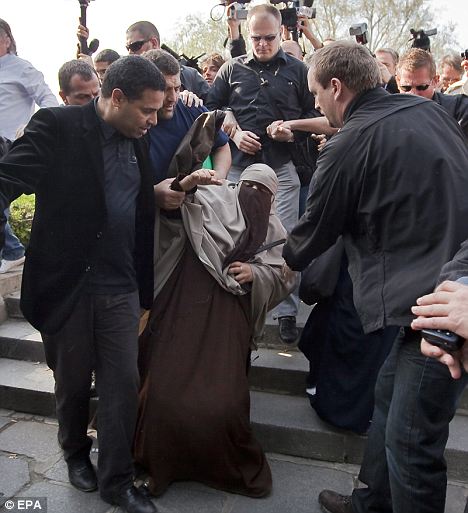
A woman in niqab being arrested in Paris, April 12, 2011, copyright EPA

Of Civilities and Dignities

On 22 June 2009, Nicolas Sarkozy, the French President, asserted that burqas (or the burqa-clad?) are “not welcome” in France, adding that “[i]n our country, we cannot accept that women be prisoners behind a screen, cut off from all social life, deprived of all identity” and that “the veils reduced dignity.” France’s Muslim minority is Western Europe’s largest Muslim minority, estimated at six-million-strong.  And this is just an approximation, as the French Republic implicitly claims to be post-race and post-religion via a prohibition on any census that would take into account the race or religion of its citizens. (This anxiety mirrors the brouhaha in Indian media àpropos the much-contested enumeration of OBCs or Other Backward Castes in the Indian census surveys of 2011, or the urgency to declare some spaces post-caste, post-feminist, and post-racist while casteism, patriarchy and racism continue unabated.)

Continue reading “Of Niqabs, Monsters, and Decolonial Feminisms”