Want to make your war a “Just War”? A quick how-to, with help from WikiLeaks.

War is hell, war is pain and sorrow–unless of course it’s a Just War which is noble, heroic, every true Christian’s blessed jihad, and if you can swing it, fully authorized by the UN Security Council.  Even if Just Wars both ancient (say, the Albigensian crusade) and modern (the starvation of thousands of Iraqis by UN Security Council-authorized sanctions) have been unspeakably nasty, Just Wars are still at least Just, so what’s not to like?

cluster-bombs.jpg
These cluster bombs are just.

There are two ways to make your war a Just War, with all the fringe benefits.  Please read carefully.

First, convince the world that the war is just by invoking the UN Charter and getting Security Council authorization.   The law involved is less straightforward than the Scholastic neo-Aristotelianism that used to justify Just Wars, so you’ll be wanting to hire some lawyers.  Less intelligent presidents will put angry anti-diplomats like John Bolton on the task, but cannier ones will hire smoother jurists like Harold Koh and Samantha Power to make the case in the dulcet tones of humanitarian NGOese.  This is the preferred way of making a war Just nowadays, most likely a matter of supply and demand, as there’s no shortage of secular casuists graduating from the top law schools, and the US Department of Defense has 15,000 lawyers on hand.

The second way to make your war a Just War is to get the Pope to declare it so, or at least not denounce it as an unjust war.  This may sound self-consciously retro, but new WikiLeaks disclosures reveal that it has never truly gone out of style.  The story Continue reading “Want to make your war a “Just War”? A quick how-to, with help from WikiLeaks.”
A Call from Home

By Majid Maqbool

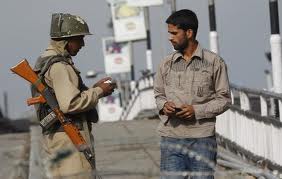
Checking a Kashmiri Youth’s ID Card

“Card chukha seath thavaan?”

(Do you carry the ID card with you?)

Mother worries over frequent phone calls

Away from home, home enters questions

‘Identity’ printed on a piece of paper

cuts through her voice; a discomforting lullaby:

“Card gase hamashe seath thavun”

(always carry the ID card with you)

Home leaves a permanent imprint…

On scattered notes, stamped on memories

At home, mother would tiptoe after me

At the door, before endless blessings, she always asked –

That question mothers have for their sons –

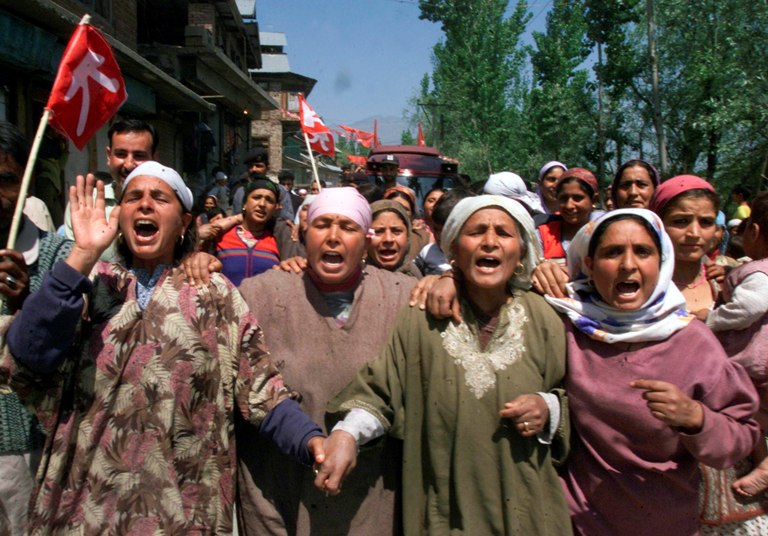
Protesting Kashmiri Women al (Yawar Nazir, IMOW)

“Card tultha seath?”

(are you carrying your ID card?)

From Delhi now, your question settles on my unrest

Identity – detached from the card – hangs heavy

This is not Kashmir, mother

“Toete gase card seath thavun…”

(Still you must carry the card with you…)

The line dropped on this insistence

I kept redialing, to rest her concerns,

her unfinished questions, unanswered

Hello..helloo… mother

Can you hear me?

I left the card at home, mother

In the back pocket of my worn-out jeans

Interrogating Identity in Kashmir

Find: a fading photograph, scrutinized edges

And no trace of those unrecognized questions

forever inked on my memory

For troops to question my absence

The proof I left behind is not enough

That frisked ID card remains

like a festering wound, pocketed pain

I carry everywhere


Majid Maqbool is a young journalist/writer from Kashmir.  Some of his writings can be found on his blog maqboolvoice.blogspot.com.

Manufacturing Consent and Violence: Azadi, Arundhati, Hindutva Terror, and Indian Media

by Huma Dar

At a groundbreaking seminar, ‘Azadi: The Only Way,’ organized by the Committee for the Release of Political Prisoners (CRPP) in New Delhi, India, on October 21st, 2010, the minutes record that Arundhati Roy, the prize-winning author of The God of Small Things, asserted that

[Kashmir] has never been an integral part of India and the Indian government recognised it as a disputed territory and took it to the UN on its own accord. In 1947 we were told that India became a sovereign democracy. But it became a country as per the imagination of its colonizer, and continued to be a colonizer even after the British left the country. Indian state forcibly or deceitfully annexed the North-East, Goa, Junagarh, Telangana, etc… the Indian state has waged a protracted war against the people which it calls its own. Who are the people it has waged war against? The people of North-East, Kashmir, Punjab, etc. This is an upper caste Hindu state waging a continuing struggle against the people. Continue reading “Manufacturing Consent and Violence: Azadi, Arundhati, Hindutva Terror, and Indian Media”

Rocking the Boat: A Brief History of Anti-Migrant Hysteria in Canada

In November, 76 Tamil refugees escaped Sri Lanka on a rusty freighter. They arrived in Victoria, where they were met by Royal Canadian Mounted Police (RCMP) and Canadian Border Services Agency (CBSA) officials, who promptly jailed them for three months on allegations of terrorism. It would be fully half a year before the CBSA would admit that it had never had any evidence… In 2008, the federal and provincial governments were forced to issue apologies for the Komagata Maru. Now, two years later, if those words are to mean anything, we cannot afford to repeat history: let them stay.

by Fathima Cader

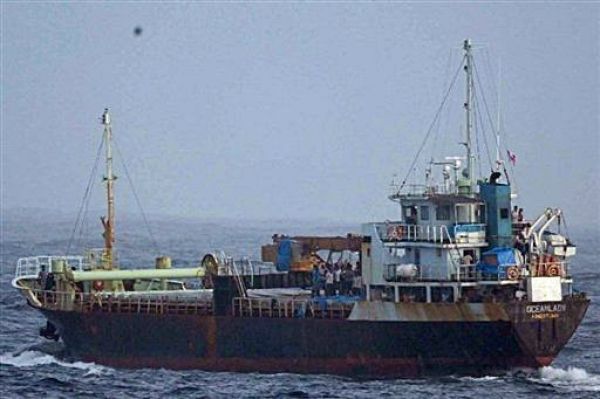
"MV Sun Sea" Uncredited Photo at: http://www.edynews.com/top-news/18-almost-500-sri-lankan-migrants-are-in-canadian-custody.html

They’re at it again.

In November, 76 Tamil refugees escaped Sri Lanka on a rusty freighter. They arrived in Victoria, where they were met by Royal Canadian Mounted Police (RCMP) and Canadian Border Services Agency (CBSA) officials, who promptly jailed them for three months on allegations of terrorism. It would be fully half a year before the CBSA would admit that it had never had any evidence.

By then, however, it was too late: anti-Tamil and anti-refugee hysteria had spread like wildfire. Now, mere weeks after that most tepid of mea culpas from the CBSA, the hysteria greeting the Tamil MV Sun Sea passengers is worse. As with the Ocean Lady, these migrants will be detained in Maple Ridge jails before their refugee claims are considered. The Conservatives have begun to create new rules to treat refugees who arrive by boat differently from others. Meanwhile, Paul Fromm, the infamous neo-Nazi, has been receiving uncritical coverage in mainstream media with his demands that the migrants be sent back.

As the paranoia grows ever more heightened, it becomes increasingly important that we resist it. The universal rights of safety and mobility must be upheld, not only for the Sun Sea migrants, but for all people fleeing violence.

Continue reading “Rocking the Boat: A Brief History of Anti-Migrant Hysteria in Canada”

Kashmir: Trapped Within Hindu Nationalist Imagination

In annexing Kashmir, Indian leaders put aside their progressive anti-colonialism, and pursued a policy that stood in direct confrontation with the goals of struggling Kashmiris. Nehru’s professed derision for princes and despots proved facile in Kashmir in this first real test of his commitment to anti-colonialism and democratic values. His decision to urge the discredited and runaway Dogra ruler to sign the imperial Instrument of Accession, and then accept it, was a defeat for the oppressed Kashmiris who had, with great sacrifices, forced the Dogra ruler out. By recognizing the authority of the Dogra ruler, Indian sovereignty over Kashmir simply replaced the sovereignty enshrined in the Dogra maharaja. But along with that sovereignty, India inherited Dogra rule’s illegitimacy as well.

by Mohamad Junaid

(First published in Greater Kashmir on August 5, 2010)

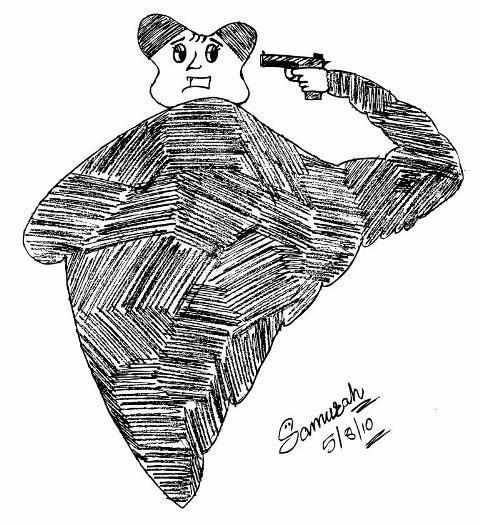
Untitled by Samurah Kashmiri, August 5, 2010
Bharat Mata or Mother India

On 26 January 1992, Murli Manohar Joshi, the leader of the Hindu nationalist Bharatiya Janata Party, after travelling by road all the way from the southern tip of India, was airlifted from Jammu to the heart of Srinagar where he half-raised the Indian flag near historic Lal Chowk. All of Kashmir was put under severe curfew, and the army was given shoot-at-sight orders. Throughout the day soldiers shot dead more than a dozen Kashmiris in the streets of Srinagar. Over the previous two years, the Indian government had unleashed a reign of terror on the people, with massacre upon massacre of unarmed protestors dotting Kashmir’s timeline. Joshi’s Ekta Yatra (Unity March), protected and provided of full support by the Indian government, was an important reminder of the nature of the Indian state and the relationship it sought with the people of Kashmir. The event was designed to put on display the majoritarian character of Indian nationhood, and line up power of the state behind it to send barely coded messages to audiences in India and in Kashmir.

Continue reading “Kashmir: Trapped Within Hindu Nationalist Imagination”

The Stones On Our Streets

Lies are created around the truth of our struggle. But truth has a habit of confronting falsehood. Occupation is based on a pile of lies. There’s truth in the resistance of unarmed people on the streets. And truth triumphs in the end. It always does, even if it takes time.

by Majid Maqbool

The street is the home of our stones.  Streets can be occupied, but stones are free for us to pick up, and angrily fling in the air — in protest.  From the hands of the oppressed, once pelted, the stones deliver a message to the oppressor: while you kill with no remorse on my soil, and stage false encounters with all your advanced weapons, I’m not going to keep quiet.  I will not let you kill us without offering resistance.  I have these stones on my streets.  I exist in these stones.  If your occupation is in bullets, our resistance is in these rough-edged, homegrown stones.

We, who come out protesting on the streets, are not an ignorant, frustrated and unemployed lot — as the occupier likes to frame us, and the whole world seems to simplistically believe.  Far from it!  We are the ones who refuse to keep quiet in tyrannical times.  We are the ones who shape the songs of resistance, as we practice them in our streets.  It takes much courage and conviction to come out on the streets, and protest against the heavily militarized state forces.  The sentiment of freedom confronts the idea of occupation.  In every stone that’s pelted, there’s a promise to bring down the structures of occupation, bit by bit, crack by crack.  We know in our hearts and minds that this ugly structure of occupation —  built on deceit over the years — is bound to crumble one day under the force of our stones.  It is this hope that keeps the resistance alive.

Continue reading “The Stones On Our Streets”

Peaches

by Arif Ayaz Parrey

Can I tell how much I love peaches?
Not ordinary ones
But those plucked from
The orchards along Jhelum

The ones in the basket before me
Are nebrim for sure
But they blush like a home-grown innocence
And hold as many juicy promises

I wonder what tree bore them
I wonder if it’s wise to ignore them

The tree of life
Has many buried roots

It is said that my only son
Was killed under the canopy
Of the branches of one such tree
By the army
Also known as the security forces
An old joke
What do they secure
These so-called security forces?
Not the people, not our lives, not our liberty
Not our sentiments, nor our emotions, not our sanity
Not our sons who are shot
Nor our daughters who are raped
Not the truth, not the facts, not humanity

Continue reading “Peaches”

Boycott Israel? Amitav Ghosh & the Dan David Prize

The call for academic and cultural boycott is clearly a way to encourage civil society to play a broader political role—that is why it has the support of wide sections of Palestinian civil society. One of the most significant questions that call poses to us is simply this: How could those of us who oppose apartheid, occupation, and colonialism not support such a call?

Dear Amitav Ghosh,

We wish to express our deep disappointment in your decision to accept the Dan David prize, administered by Tel Aviv University and to be awarded by the President of Israel. As a writer whose work has dwelled consistently on histories of colonialism and displacement, your refusal to take stance on the colonial question in the case of Israel and the occupation of Palestine has provoked deep dismay, frustration, and puzzlement among readers and fans of your work around the world. Many admired your principled stand, and respected your decision not to accept the Commonwealth Writers Prize in rejection of the colonialist framework it represented.

Continue reading “Boycott Israel? Amitav Ghosh & the Dan David Prize”

Outing the Muslimness, Finally: Some Viewing (and Hearing) Pleasures (The King is Out: Part VI)

The King is out: he is irreversibly a Muslim. His name is Khan: pronounce it correctly please. Long Live the King!

by Huma Dar

[Read Part I Part II Part III Part IV Part V]

Rizwan Khan Offering His Namaz

[I]n one scene I wanted to have just a half open door and I wanted to be shown saying namaz once. We couldn’t take that shot. Then we put that bit where I say the prayer: Nasrun minal lahe wah fatahun kareeb (God give me strength to win) [sic] [Victory is Allah’s, and the opening/victory is close] which is my own prayer too. I don’t think we should intellectualise entertainment.  See the fun of it.

This is how Shahrukh Khan describes his experience working in the film Chak De! India (Dir: Shimit Amin, 2007).  With apologies to King Khan for discarding his proposal to not “intellectualize” films, yet taking due “fun” in it, I argue that it is only in My Name is Khan (Dir: Karan Johar, 2010) that the King finally comes “out” as a Muslim.  No “half open door” is needed.  This coming out affords particular visceral pleasures to an audience (or at least a large section of it spread across the globe) long resigned to seeing SRK endlessly and persistently marked by the specifically filmic variety of Hinduness practiced in Bollywood: doing various pujas and aartis at different Hindu temples, or adorning his spouses’ hair-parting with sindhoor and smearing his own forehead with tilaks.  This performative Hinduization of Shahrukh Khan in Urdu-Hindi cinema is unrelenting precisely due to the dogged presumption of SRK’s Muslimness that is not easily obscured.  “In my films I have been going to temples and singing bhajans; no one has questioned that,” (my emphasis) SRK exclaims in the same interview.  No one “questions” the diegetic (filmic) Hinduness of SRK; it is expected and mandatory.  With the increasing and explicit polarization in India since 1990s, the anxiety around Muslimness is such that it requires perpetual masking: an iterative performance of Hinduness, secular or otherwise.  When the mask slips off, the performance is momentarily paused – as when SRK plays a Muslim character in a film and critiqued the anti-Pakistani politics of Indian Premier League (IPL) – Hindutva activists target SRK’s suburban Bombay home, Mannat, with massive demonstrations (See the earlier Part II for more).[1]

Continue reading “Outing the Muslimness, Finally: Some Viewing (and Hearing) Pleasures (The King is Out: Part VI)”

Placating the gods of Citizenship: the Ritual Sacrifice (The King is Out: Part III)

The obligatory declaration of cinematic patriotism for Indian Muslims necessitates a continuous performance of “loyal citizenship” invariably through offering the sacrifice of a “disloyal” one. This leaves little space for critical engagement with the nation and the state.

by Huma Dar

[read Part I Part II]


King Khan and his divinity

The obligatory declaration of cinematic patriotism for Indian Muslims (discussed in Parts I and II earlier) necessitates a continuous performance of “loyal citizenship” invariably through offering the sacrifice of a “disloyal” one. This leaves little space for critical engagement with the nation, the state, and the unending wars.  An example of this ritual performance is the sequence in My Name is Khan where Rizwan Khan, played by Shahrukh Khan (SRK), reports the “doctor” in the Los Angeles Masjid to the FBI.  How do we know the “bad” doctor is an al-Qaeda member or a terrorist?  Dr. Faisal Rahman does indeed talk about his “blood boiling” at the oppression of the Muslim Ummah in Iraq, Afghanistan, Palestine, Chechnya, Kashmir et al and even exhorts the handful of audience in a completely open space inside the Masjid to “join him and do something.”  The details of that “something” are never revealed.

Continue reading “Placating the gods of Citizenship: the Ritual Sacrifice (The King is Out: Part III)”