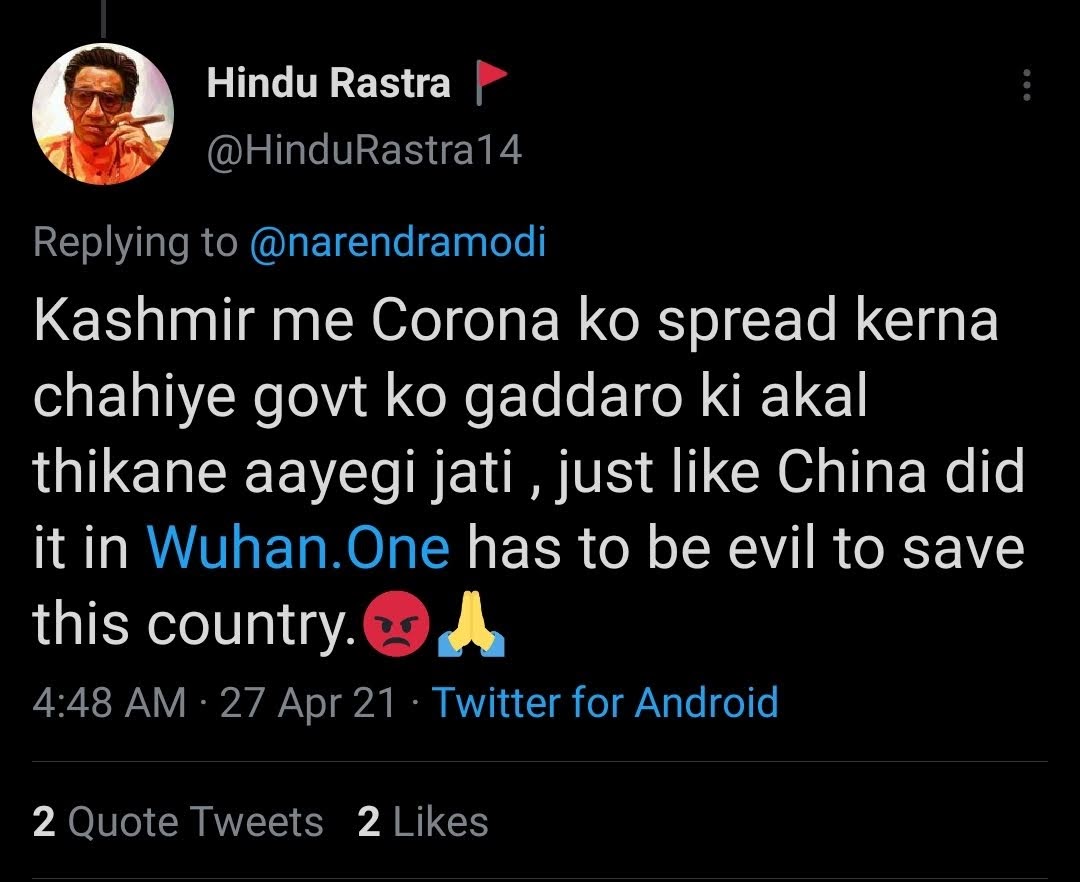
“[Indian] Government should spread Corona in Kashmir. The traitors will be taught a lesson, just like China did in Wuhan. One has to be evil to save this country. 😡🙏” @HinduRastra14 in response to Indian PM Narendra Modi, @narendramodi. April 27, 2021.
Official figures rank India as second only to the United States at 30.50 million confirmed cases of Covid-19 and 401,050 deaths,with a mere 3.9% rate of full vaccination as of July 3, 2021.The New York Times reports a much graver situation, including an intensive study of three different antibody tests, called serosurveys, which convincingly demonstrate the utter gravity of Covid-19 pandemic in India. The in-depth scientific analysis of the serosurveys by NYT indicates that at the most conservative the estimated number of deaths in India is at least 600,000, with a more likely estimate of 1.6 million deaths, and a worst case scenario of 4.2 million deaths. Post-August 5, 2019, when India unilaterally derogated Articles 370 and 35A, after dismissing even the façade of the elected assembly in 2018, the Indian State has even more vigorously discriminated against the people of Jammu & Kashmir, particularly its Muslim population, especially in the form of explicitly prejudicial new land laws aimed at full-blown settler-colonialism. In a frightening feedback loop, the Indian state violence draws upon and abets Islamophobic violence against Muslims of Jammu & Kashmir at large, and includes a rising number of lynchings, the latest on June 21, 2021. The pandemic situation in Kashmir is thus exacerbated by a settler-colonialism aimed at “drowning Kashmiris once and for all.”
stargazing on the backs of our children
what kind of heaven lies under our feet, yet
starry, starry nights on the backs of our beloveds: “Andromeda, you see, sweeps from right to left. Ursa Major just above it, Cassiopeia is the loose bunch near the shoulder, within, there are all the signs.”
stars, also, on the pitch-black eyes of our daughters, our sons
dying stars, supernovae of frightful beauty
freedom’s terrible thirst clotting into black holes
amidst galaxies of desire
desire of freedom, both deadly and rejuvenating
the dead(ly) gaze of our youth
still threatens to annihilate the brutal
despite their guns
turn the enemy into stone, my dear child!
look him in the eye.
“Make this your star gazing, your horoscope for the week, for all of tomorrow. A starry eyed tomorrow…”
they shoot our young on their backs, on their eyes,
our eyes will petrify them still
the battle will be won
Medusa, the freedom fighter, will have her day
P.S: This poem was originally written as a Facebook post on Aug 27 or 28, 2015, inspired by Najeeb Mubarki’s caption, within quotation marks above, of a photograph of a Kashmiri youth’s back, shimmering with scores of pellet injuries… Pellet injuries that are touted to be “non-lethal,” but are anything but.
It happens to be one of the few things coincidentally saved from my now-disabled account — please sign here to demand that Facebook reinstate it.
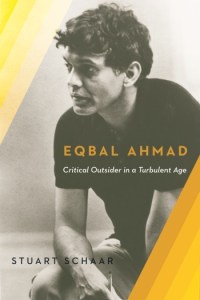
Among many other endeavours, Ahmad directed the Transnational Institute in Amsterdam, collaborated with Algerian revolutionaries, edited the journal Race & Class, wrote a column for the Pakistani newspaper Dawn, and sat trial for conspiring to kidnap Henry Kissinger. He was a Third Worldist, an internationalist, and a humanist in the very best sense of those terms.
Eqbal Ahmad was a remarkable human being as well as a seminal progressive political thinker. In this illuminating intellectual biography, Stuart Schaar brings his subject to life, drawing on their long, intimate friendship and shared scholarly engagement with the politics of the Middle East and the Islamic world. Above all, Ahmad grasped the toxic interplay between the maladies of postcolonialism and the persistent imperial ambitions of the West better than any of his contemporaries.
In November I had the pleasure of interviewing Schaar about his book for Middle East Dialogues, a video series produced by the Center for Middle East Studies at the University of Denver. Here it is.
“Prominent writers in India are collectively protesting what they consider an increase in hostility and intolerance, which they argue has been allowed to fester under the government of Prime Minister Narendra Modi, by returning a prestigious literary award.”
Referring to attacks against Muslims, including the killing of a man who had been suspected of slaughtering a cow, he said, “This is not the country that our great leaders had envisioned.” (Ghulam Nabi Khayal, Sahitya Akademi Award, 1975)
The newsfeed on most South Asian social media has been deluged by articles like the one in The New York Times above. However, one has to wonder what kept these literary “stars” from this praiseworthy gesture of returning their State-given awards when the Gujarat pogroms were going on in 2002, or against the pogroms that followed the demolition of Babri masjid in 1992/3, or against the genocide of Sikhs around 1984, or heck, against the ongoing genocide in Indian Occupied Kashmir or that of Dalits…
My apologies for this query, which despite seeming cynical at first blush, is actually a probing of the very problematic and exceptionalizing notions of “India as a nation” and “Indian secularism” that these authors and poets valorize, explicitly or implicitly, through this joint gesture of returning their awards or through their separate oeuvre at large. It is precisely these twin concepts of unprobed “Indian secularism” and even more foundationally, the unproblematized, dehistoricized, and normalized idea of “India as a nation” (see The Indian Ideology (2012) by Perry Anderson for a resounding deconstruction of this) that are the fecund incubating grounds of much violence – violence which is Brahminical, colonial, and Islamophobic at the core. This is true not only with regard to the acts of spectacular violence, like the mob lynching of Muhammad Ikhlaq in the current context of Dadri, at the contemporary moment of Modi-fied India, but also for the billion and one banal acts of quotidian casteist, colonial, and communal violence that fertilize the roots of the phenomenon in modern India. This is especially true for the comparably spectacular violence of the allegedly “secular” contexts – the genocidal violence of the Indian state in Kashmir, Punjab, Hyderabad, Assam, Manipur, Jharkhand, Chhattisgarh, in every Dalit basti et al – that preceded the current Hindutva regime (and co-exist at any given time). In fact, it can be argued that the exceptionalization of India not only papers over much of this epistemic violence by making it invisible but actually enables it by helping it elide scrutiny. Thus no gesture of protest, however “well intentioned” it might be, will bear fruit until and unless the very problematic exceptionalism that undergirds the allegedly “secular India” is deconstructed.
Free Kashmiri Political Prisoners, an online campaign to release Kashmiri political prisoners from various Indian jails, has attracted endorsement and support from academics, intellectuals and filmmakers from around the world. The campaign has been successful in raising awareness about the condition of Kashmiri political prisoners, young and old, who have been languishing in Indian prisons for years or live under continuous threat from draconian ordinances like Public Safety Act. This might also be the beginning of the end of Indian colonial obfuscation around its occupation of Kashmir in academia worldwide.
Indian Occupied Kashmir
Free Kashmiri Political Prisoners, an online campaign for the release of Kashmiri political prisoners from various Indian jails, has attracted endorsement and support from academics, intellectuals and filmmakers from around the world. Eminent intellectuals and scholars like Judith Butler (Hannah Arendt Chair at the European Graduate School and Maxine Elliot Professor in the Departments of Rhetoric and Comparative Literature, University of California at Berkeley), Hamid Dabashi (Hagop Kevorkian Professor of Iranian Studies and Comparative Literature, Columbia University), Ayesha Jalal (Mary Richardson Professor of History, Professor at Fletcher School of Law and Diplomacy, Director of Center for South Asian and Indian Ocean Studies, Tufts University), Lisa Duggan (Professor, American Studies and Gender and Sexuality Studies, Department of Social and Cultural Analysis, New York University (NYU), President-Elect American Studies Association (ASA), USA), Tariq Modood (Professor of Sociology, Politics and Public Policy, Director of the University Research Centre for the Study of Ethnicity and Citizenship, University of Bristol), Lisa Hajjar (Professor of Sociology, University of California at Santa Barbara), Chandra Talpade Mohanty (Distinguished Professor, Department of Women’s and Gender Studies, Dean’s Professor of the Humanities, Syracuse University), Abdul R. JanMohamed (Professor, English Department, Emory University, University of California at Berkeley), Rabab Ibrahim Abdulhadi (Associate Professor of Ethnic Studies/Race and Resistance Studies, Senior Scholar, Arab and Muslim Ethnicities and Diasporas Initiative (AMED), San Francisco State University), Suvir Kaul (A. M. Rosenthal Professor of English, University of Pennsylvania), Ania Loomba (Catherine Bryson Professor of English, University of Pennsylvania), Joel Beinin (Donald J. McLachlan Professor of History, Professor of Middle East History, Department of History, Stanford University), Sherene Razack (Professor, Department of Humanities, Social Sciences and Social Justice Education and Department of Comparative, International and Development Education, OISE, University of Toronto), Ruth Wilson Gilmore (Professor of Earth & Environmental Sciences, and American Studies, Director of Center for Place, Culture, and Politics, Graduate Center, City University of New York), Ibrahim Abdurrahmani Farajajé (Provost and Professor of Cultural Studies and Islamic Studies, Starr King School, Graduate Theological Union (GTU), Berkeley), Neferti Tadiar (Professor and Chair of Women’s Studies, Barnard College, Columbia University), Kamala Visweswaran (Associate Professor of Anthropology, University of Texas at Austin), Piya Chatterjee (Dorothy Cruickshank Backstrand Chair of Gender and Women’s Studies, Scripps College), and Joseph Massad (Associate Professor, Middle Eastern, South Asian, and African Studies, Columbia University) are amongst the prominent signatories. Continue reading “PRESS RELEASE from Free Kashmiri Political Prisoners Campaign”
We send you this request in hopes of garnering your crucial and valuable support for the letter attached below. This letter is a response to the dire conditions of thousands of Kashmiri political prisoners, both adults and minors, under the Indian Occupation. Your support will help bring global attention to this critical and urgent issue.
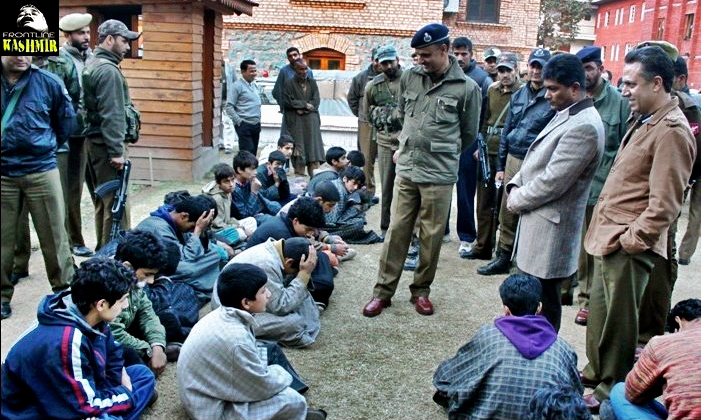
Indian Occupation Forces and their ‘Fearsome’ Targets: Young Kashmiri Boys
Greetings,
We send you this request in hopes of garnering your crucial and valuable support for the letter attached below. This letter is a response to the dire conditions of thousands of Kashmiri political prisoners, both adults and minors, under the Indian Occupation. Your support will help bring global attention to this critical and urgent issue.
On the ground, in Kashmir and elsewhere, we have a concurrent month-long campaign, the “Fast for Freedom,” first initiated via Facebook, which involves optional fasting, sit-ins, protests, lectures, and film-screenings. This will culminate in civil protests, fasts and sit-ins by various organizations – including the Association of Parents of Disappeared Persons(APDP) – and campus events in Srinagar, Delhi, and Berkeley et al, from 9th to 11th February 2014. It is an opportunity not just for Kashmiris but for all people of conscience to show solidarity with an oppressed people, to protest an illegal military occupation, the illegal detention and torture of thousands of Kashmiri political prisoners, and incessant human rights abuse, including mass graves, fake encounters, forced disappearances, mass and gang-rapes, and daily humiliation under the ongoing military occupation. (Please see the linked reportAlleged Perpetrators for more details.)
Your endorsement of the attached letter will help bring urgently needed political attention to this long-festering issue, as well as help to generate intellectual energy to begin necessary conversations on military occupations with regard to power and privilege, coloniality and postcolonialism, sexual assault as a weapon of war, imperial and decolonial feminisms, the colonial politics of prisons and capital punishment, post/colonial tourism, the construction of the “terrorist,” Islamophobia and other forms of racialization in the context of Kashmir. Continue reading “Free Kashmiri Political Prisoners, End the Occupation of Kashmir”
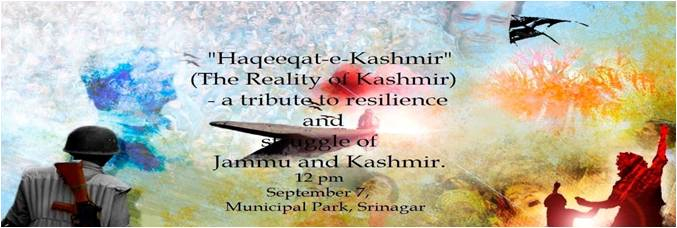
We appeal all sections of Kashmiri society to join the Haqeeqat-e-Kashmir event to express their solidarity with the resilience and suffering of people of Jammu and Kashmir.
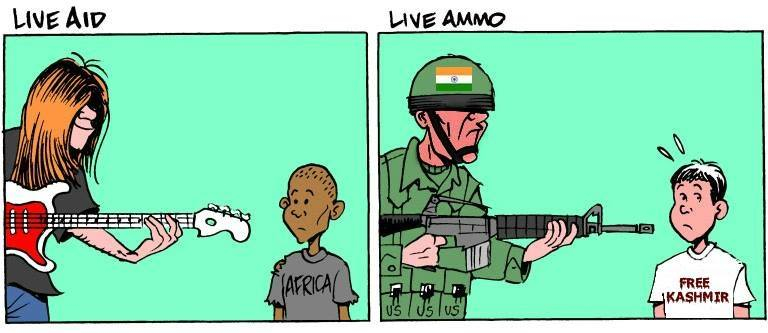
Live Aid, Live Ammo: India and Zubin Mehta’s Psyop Concert in Indian Occupied Kashmir
Organizing Committee, Haqeeqat-e-Kashmir
Press release, 5 September 2013
On 22 August 2013, the German Embassy, New Delhi, issued a press release that Zubin Mehta would be conducting an orchestra on 7 September 2013, at the Mughal Garden, Shalimar Bagh, in Srinagar, Jammu and Kashmir. On 26 August 2013, civil society members of Jammu and Kashmir – from lawyers and businessmen to poets and scholars – registered a strong protest against the proposed concert and concerns were communicated to the German Embassy and the people of Germany – from political representatives to artists and activists.
The people of Jammu and Kashmir take immense pride in our rich history of resisting oppression. We also have historically cultivated a sublime tradition in, and love for, music. Music – which appeals to the higher values of love, justice, dignity, and peace; which genuinely acknowledges the long-suffering, yet bravely resisting, Kashmiris; and which is performed for the actual public – is wholeheartedly welcome.
However, legitimizing an occupation via a musical concert is completely unacceptable. Art as propaganda, as abundantly documented in history, is put to horrific use across the world. Art as propaganda in Jammu and Kashmir is unacceptable. The Zubin Mehta concert is organized and controlled by Government of India and the German Embassy, with extensive corporate sponsorship. It serves to build on the State narrative that seeks to dilute the reality of Jammu and Kashmir and peoples’ aspirations. It seeks to promote an image of a “peaceful” and “normal” Jammu and Kashmir. The pain, suffering, courage and bravery of the resistance will find no place in this concert. Indian State operations that seek to support the occupation must be resisted. To build this Statist narrative of Jammu and Kashmir, an estimated Rs.100 crores [INR 10 billion or USD 16 million] is reported to being spent, and invitations have been sent to corporate India (Tatas, Birlas, Ambanis, Bajajs, CII, FICCI..), the film world (Amitabh Bachchan, Rajinikanth, Katrina Kaif…) and sportsmen (Sachin Tendulkar, Boris Becker…). It is most condemnable that the Government of Germany has chosen to be party to the Indian States’ continued political machinations in Jammu and Kashmir. So far Indian army and various Indian institutions have been organizing psychological operations which are termed by Indian military as Sadbhavana Operation. We protest German government’s joining the efforts of Indian army. It appears an attempt by the Indian State to outsource its military psychological operations to the international community. Continue reading “More on “Haqeeqat-e-Kashmir”: India and Zubin Mehta’s Psyop Concert in Indian Occupied Kashmir”
We submit that it is incumbent upon the people of Germany to put pressure on the German Embassy to immediately recognize the reality, the horrifying context, within which this proposed concert is to take place, issue a statement that accepts the disputed nature of Jammu and Kashmir, and recognizes the pain and legitimate political and legal struggle of its people. Crucially, pressure must be put on the German Embassy to withdraw its support to the concert.
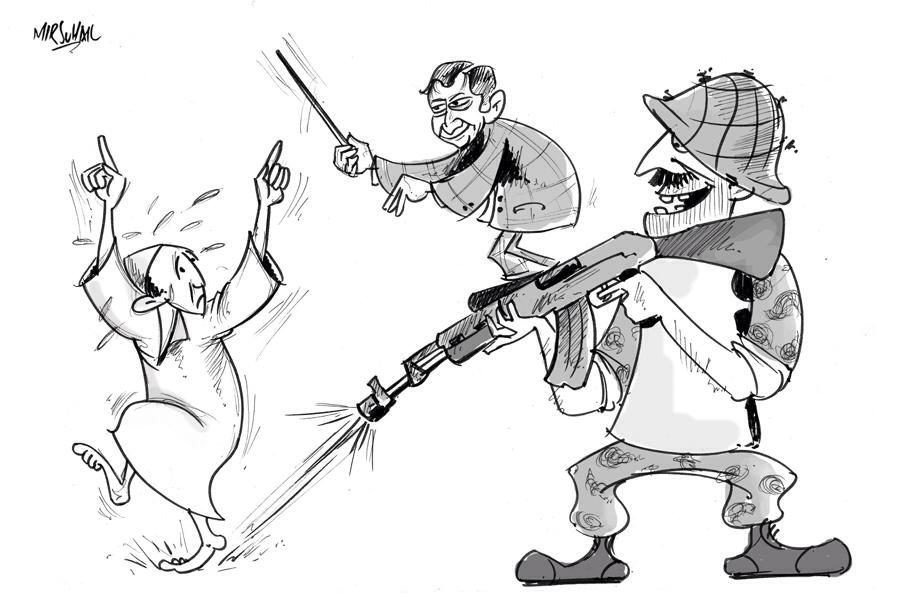
“Zubin Mehta, Indian Army, and Kashmir” by Mir Suhail Qadiri
September 2, 2013
To
The People of Germany
(Political Representatives, Civil Society, Artists, Activists and Citizens)
Of Occupation, Resistance and Music: An Appeal
1. On 22 August 2013, the German Embassy, New Delhi, issued a press release that Zubin Mehta would be conducting an orchestra on 7 September 2013, at the Mughal Garden, Shalimar Bagh, in Srinagar, Jammu and Kashmir. The press release stated that the concert was “a wonderful cultural tribute to Kashmir,” and intended “to reach the hearts of the Kashmiris with a message of hope and encouragement.” “The ‘Kashmir Concert’ is part of a broader engagement,” it further stated.
2. On 26 August 2013, civil society members of Jammu and Kashmir – from lawyers and businessmen to poets and scholars – registered a strong protest against the proposed concert. To date, the German Embassy has failed to respond – privately or publicly – to this letter of protest. Faced with this unforeseen and complete apathy from the German embassy, we believe it is incumbent upon us to reach out to the people of Germany to express our serious concerns with a concert that seeks not to entertain, but to subtly control the political message from Jammu and Kashmir, i.e. manipulate it into a message of “peace” and “normalcy” that ignores ground realities. For example, even as we write this appeal, Jammu and Kashmir Police are conducting door to door searches and identification exercises at the homes of the residents in and around the Shalimar neighborhood, the proposed venue of the concert. Surely this exposes the rot at the core of the much-touted “peace” and “normalcy.”
3. The people of Jammu and Kashmir take immense pride in our rich history of resisting oppression. We also have historically cultivated a sublime tradition in, and love for, music. Music – which appeals to the higher truths of love, justice, dignity, and peace; which genuinely acknowledges the long-suffering, yet bravely resisting, Kashmiris; and which is performed for the actual public – is wholeheartedly welcome.
4. However, legitimizing an occupation via a musical concert is completely unacceptable. Art as propaganda, as abundantly documented in history, is put to horrific use across the world. We are sure you will understand that we cannot welcome anything even remotely analogous in Jammu and Kashmir. In a state of affairs where the poets and musicians of Jammu and Kashmir, such as Ghulam Nabi Sheikh, well-known Kashmiri national singer, Inayatullah Bhat, a guitar/harmonium player, and Ali Mohammad Shahbaz, a poet from Handwara, have themselves been victims of the violence of the Indian State, it is but obvious that there needs to be a political understanding of the uses and abuses of art. Given this sordid context, which cannot be naïvely wished away, we must then ask this crucial question of the people of Germany, and the world citizenry at large: Should we, as people of conscience, support art which not only does not highlight the sufferings of an oppressed people, leave alone which offers balm to its pain, but instead which, through its setting within the particular landscape of power, actively serves to silence and obfuscate our appeals to the rest of humanity, and thus furthers oppression? Continue reading “Of Occupation, Resistance and Music: An Appeal”
On Sept 7, we invite EVERYONE to come join us at noon, at the Municipal Park (near GPO), Srinagar, as we mark the “dark times” of the military occupation, and commemorate the luminosity of AZADI: the light of faith, of freedom, of our blood-soaked struggle for justice, dignity, and true peace. Luminosity that cuts through the deep darkness of the “dark times” and reflects the resilience of human spirit in all its grace.
Haqeeqat-e-Kashmir: The Reality of Kashmir
A Cultural Aesthetic Tribute to the Resilience and Struggle of the People of Jammu & Kashmir
“In the dark times
Will there also be singing?
Yes, there will also be singing.
About the dark times.”
~ Bertolt Brecht
On Sept 7, we invite EVERYONE — and not just a handpicked 1500 — to come join us at noon, at the Municipal Park (near GPO), Srinagar, as we mark the “dark times” of the military occupation, and commemorate the luminosity of AZADI: the light of faith, of freedom, of our blood-soaked struggle for justice, dignity, and true peace. Luminosity that cuts through the deep darkness of the “dark times” and reflects the resilience of human spirit in all its grace.
We invite EVERYONE to send in cultural aesthetic texts: poetry, paintings, photographs, multimedia, performance art, songs, et cetera on the ABOVE THEME to haqeeqatekashmir@gmail.com
2 a: a sudden, radical, or complete change b: a fundamental change in political organization; especially : the overthrow or renunciation of one government or ruler and the substitution of another by the governed c: activity or movement designed to effect fundamental changes in the socioeconomic situation d : a fundamental change in the way of thinking about or visualizing something : a change of paradigm <the Copernican revolution> e : a changeover in use or preference especially in technology <the computer revolution> <the foreign car revolution>
Almost a year ago a wave of massive popular protests began within the state of Israel. Though my initial criticisms still stands, I’d like to add that over the past year, at least in the south of Tel Aviv, there’s a constant learning about egalitarian politics, co-ops and community projects. People are changing and that can’t be a bad thing. Still, on the Palestinian liberation front there’s little change. The protests have remained Jewish-centered and protesters are still hostile to the mere mention of Arabs (Palestinians are people from another country, of course).


 ost a year ago a wave of massive popular protests began within the state of Israel. Though
  P U L S E