A World United for Human Rights

by William A. Cook

“ … disregard and contempt for human rights have resulted in barbarous acts which have outraged the conscience of mankind, and the advent of a world in which human beings shall enjoy freedom of speech and belief and freedom from fear and want has been proclaimed as the highest aspiration of the common people …” — United Nations Universal Declaration of Human Rights.

Today the American people, in concert with their brothers and sisters around the world, proclaim the rights to which they are entitled by birth and citizenship, by Constitutional law and Proclamation, and by membership in the collective body of nations that has universalized recognition of these rights for all humanity. And today, in cities and hamlets across this nation, and in many nations around the world, people gather in peace to demand of their governments recognition of these rights that have been abrogated by the few and denied to many.

Citizens no longer control their government; they are slaves to it. Representatives no longer serve the citizen seeking their consent to govern, they are servants of the corporations and lobbies that control the economic system to which the citizen is enslaved. Presidents no longer lead, they are the obedient lackeys of their corporate overseers. Freedom of speech and belief and freedom from fear and want do not determine the needs of humans, economics of the market place supersedes all at the expense of the citizen and human rights. We exist in a corporate world of unending wars, of vengeance and recrimination, of fear as a commodity that imprisons the mind, of greed that destroys the resources of this planet without remorse, and of insatiable arrogance that harbors no concern for those it destroys.
Continue reading “A World United for Human Rights”

Tightening the Siege

by Amal Amireh

“We Travel Like Other People”

“Mamnou3,”* she said from behind the window. The harshness of the word was neither softened by its familiarity nor by the lazy gesture that accompanied it when she threw my application back to me.

It was eleven on a cloudless June day. I have been standing in line since 5 o’clock that morning. I was twenty-four. She looked eighteen. I ventured, “Why?”

Her laziness immediately turned into impatience. “Mamnou3!” She repeated, already looking at the next heavily stamped travel application in front of her. Then as if to end any possibility of a conversation, and my future with it, she uttered the dreaded words: “Roukh baitak!”**

There she was in my city, actually few blocks from my home, shooing me away in an Arabic accented with contempt, and deciding my life for me. Her military uniform, her gun which is never far from her, and the bureaucratic authority of an illegal occupation gave her words a finality designed to crush. Just like bulldozers.

These words were the final stamp that sealed my application—an application that I had submitted a month earlier requiring permission to travel from El Bireh in the West Bank to Boston in the United States after receiving a Fulbright scholarship via AMIDEAST. I had graduated from the English Department at Birzeit University two years earlier, despite checkpoints and closures that in my senior year alone totaled seven months. This scholarship was my only chance for graduate education.

But the gods of military occupation had decreed that summer that no one between the ages of eighteen and thirty is allowed to leave the West Bank until further notice. Of course there was no official announcement of such a decree. That would spoil the arbitrariness of it all and give the occupied the dangerous notion that they are owed any explanation at all. You just learn of it when you compare notes with other crushed souls who were told to go home.

Continue reading “Tightening the Siege”

UN School of Etiquette: How to Conduct an “Appropriate” Blockade

Just as I arrived in Bil’in for the Friday weekly demonstration, word came that the UN Report of the Secretary-General’s Panel of Inquiry on the 31 May 2010 Flotilla Incident (a.k.a. “The Palmer Committee Report”) has named the blockade of the Gaza Strip “legal and appropriate”. Which is rather surprising, seeing as the blockade was defined by the UN as “illegal” as well as  “illegal and inhumane”, time and time again. (And again.)

Vodpod videos no longer available.

Continue reading “UN School of Etiquette: How to Conduct an “Appropriate” Blockade”

Gaza mobilizes for Freedom Flotilla

by Joe Catron

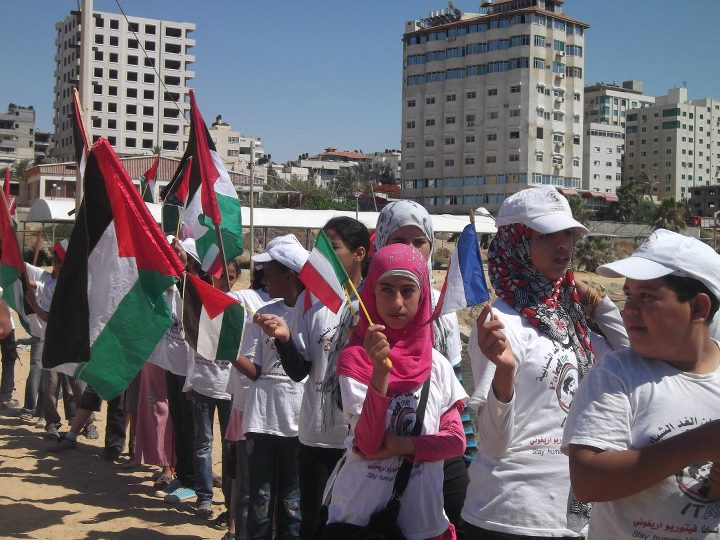
Palestinian children in Gaza rally in support of the Freedom Flotilla (Photo: Noor Harazeen)

An international flotilla of nine ships and hundreds of crew and passengers is a huge undertaking, in Gaza as much as anywhere. Mahmoud Elmadhoun knows this better than most. A member of Gaza’s Higher Government Committee, as well as the Governmental Committee for Breaking the Siege and Receiving Delegations (GCBS), which is tasked with welcoming solidarity missions to Gaza, he just finished hosting the Miles of Smiles convoy of 55 European dentists. Now he could face one of the most daunting challenges in the GCBS’ history: Freedom Flotilla – Stay Human.

“The main issue is whether the Israelis will let the Flotilla come,” Elmadhoun told me last Monday in his office in the Foreign Ministry. Their reception in Gaza, he assured me, was not a question. “We are ready to receive those people. Don’t worry; within 24 hours’ notice of their departure from Athens, everything will be in place.”

He quickly rattled off the GCBS’ responsibilities in the Flotilla effort. “Our main tasks are logistical: hotels, transportation, security, and of course activities,” he said. “Wherever they want to go in Gaza, they will be welcomed.”

Continue reading “Gaza mobilizes for Freedom Flotilla”

Khirbat Tuqu’ & the Silent World

It must have been late at night when this rare, short, late-night segment on Channel 10 sneaked by the editors:

Between Judea and Samaria & the West Bank

While I’m astonished that an Israeli mainstream news service would even address this story at all, let alone report in a considerably balanced manner; There are many very basic questions that this 2-and-a-half minute segment whizzes through, that I’d like to comment on.
Continue reading “Khirbat Tuqu’ & the Silent World”

Chase Madar: In defense of Bradley Manning

In this TomDispatch.com interview Civil rights attorney and PULSE contributor Chase Madar outlines the case against––and the defense on behalf of––the soldier who allegedly provided the documents for the latest WikiLeaks release as well as the now infamous “Collateral Murder” video, Private First Class Bradley Manning. Also, don’t miss Chase’s brilliant piece on Bradley Manning.

Of Niqabs, Monsters, and Decolonial Feminisms

By Huma Dar

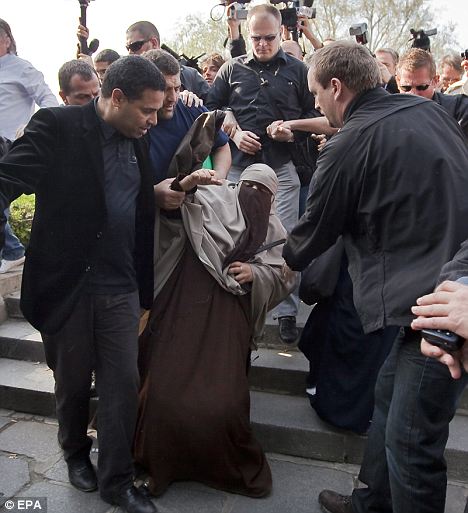
A woman in niqab being arrested in Paris, April 12, 2011, copyright EPA

Of Civilities and Dignities

On 22 June 2009, Nicolas Sarkozy, the French President, asserted that burqas (or the burqa-clad?) are “not welcome” in France, adding that “[i]n our country, we cannot accept that women be prisoners behind a screen, cut off from all social life, deprived of all identity” and that “the veils reduced dignity.” France’s Muslim minority is Western Europe’s largest Muslim minority, estimated at six-million-strong.  And this is just an approximation, as the French Republic implicitly claims to be post-race and post-religion via a prohibition on any census that would take into account the race or religion of its citizens. (This anxiety mirrors the brouhaha in Indian media àpropos the much-contested enumeration of OBCs or Other Backward Castes in the Indian census surveys of 2011, or the urgency to declare some spaces post-caste, post-feminist, and post-racist while casteism, patriarchy and racism continue unabated.)

Continue reading “Of Niqabs, Monsters, and Decolonial Feminisms”

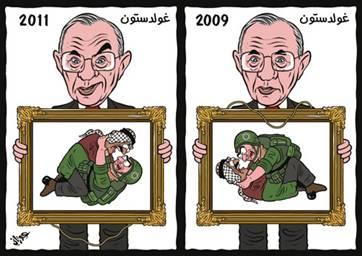
Open Letter to Justice Richard Goldstone

Reposted from the Coalition of Women for Peace website in response to Goldstone’s “reconsiderations” of the UN fact finding mission of the bloody incursion into Gaza.


April 5, 2011

Dear Justice Richard Goldstone,

The recent escalation in the Israeli army incursions into the Gaza strip is of grave concern to us at the Coalition of Women for Peace. The prospect of yet another flare out of large scale violence against civilians is alarming. Your recent comments on the Goldstone report are already interpreted by Israeli officials and the mainstream media channels as complete and full absolution of Israel’s military conduct in its entirety. Yet, the conclusions drawn from your statement with respect to Israel’s conduct during the Cast Lead military campaign and especially its aftermath are not backed by any new facts or findings. This seriously undermines the international, Israeli and Palestinian civil society struggle for accountability and against impunity from grave violations of human rights and humanitarian law.

Continue reading “Open Letter to Justice Richard Goldstone”

Right to intervene?

As Muammar Gaddafi strikes to crush rebel forces in Libya, Empire looks at the case for and against intervention.

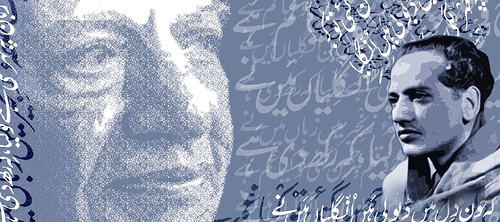
Thus Alone, and Always, Have People Resisted Tyranny: Remembering Faiz on his Birth Centenary

Today is the first birth centenary of Faiz Ahmed Faiz: one of South Asia’s most beloved radical Urdu poets. Today is also, just two days after Mubarak’s resignation as a result of the inspiring revolution in Umm al-Duniya, Mother of the World, Egypt; and almost a month after Tunisia’s courageous revolution. How ecstatic would Faiz have been today?!

by Huma Dar

Today is the first birth centenary of Faiz Ahmed Faiz: one of South Asia’s most beloved radical Urdu poets.  Today is also, just two days after Mubarak’s resignation as a result of the inspiring revolution in Umm al-Duniya, Mother of the World, Egypt; and almost a month after Tunisia’s courageous revolution.  How ecstatic would Faiz have been today?!  Faiz, who had lived in Beirut, in exile from Pakistan — when ruled by the US-bolstered military dictator, General Zia-ul Haq.  Faiz, who wrote a beautiful lullaby for a Palestinian child, and a poem for those who were martyred outside their beloved Palestine.  Faiz, whose poem commonly mis-titled, “Ham Dekhenge,” is a battle-song for people fighting for social justice from Sindh, Pakistan to Kashmir to Chhattisgarh, India.

The title of this particular poem of Faiz is in Arabic: “Wa Yabqaa Wajhu Rabbika.”  It is most often brushed aside as it does not fit the simplistic profile of the “avowed atheist” assigned to Faiz.  Being a socialist does not preclude belief in Islam, but this nuance is lost on many who cannot easily imagine Faiz being a Muslim, leave alone leading a prayer in the mosque of his ancestral village, especially given the subtle Islamophobia that pervades élite political and literary discourses, both within and without South Asia.  For some, even more difficult “to reconcile [is] the glowing tribute [that Faiz wrote] to Muhammad Ali Jinnah,” but this has to do with the rigorous demonology of Jinnah, the founder of Pakistan, in Indian historiography, and the hegemonic status of India and Indian academics, even those who vigorously critique nationalisms of all kinds, within South Asian Studies.

Continue reading “Thus Alone, and Always, Have People Resisted Tyranny: Remembering Faiz on his Birth Centenary”