One Citizen’s View

Two of our favorite people — Ralph Nader and Christopher Lydon — join in a typically stimulating conversation on Radio Open Source.

Ralph Nader on Main Street can still see the flatbed trucks hauling textile machinery out of his hometown in the 1950s, his high school years. The work of Winsted and New England mills was bound for the Carolinas and Georgia, then Mexico and Asia. In 1900 there’d been 100 factories and machine shops in Winsted, making useful things for the world — cloth to clocks. In Ralph’s boyhood, a factory worker could raise a family on one paycheck in a 6-room house with a 2% V.A. mortgage, and drive a second-hand car. Then as now the green hills of northwest Connecticut were a breezy walk or bike ride away. “You could hear cows mooing one minute, and the milk would be in glass bottles on your doorstep a few hours later…”

Continue reading “One Citizen’s View”

A Scene from Pulp Fiction in Kashmir

PUMPKIN: Everybody be cool, this is an occupation!
YOLANDA: Any of you fucking pricks move, and I’ll execute every motherfucking last one of you!
JULES: So, tell me again about those killing-for-promotions there…

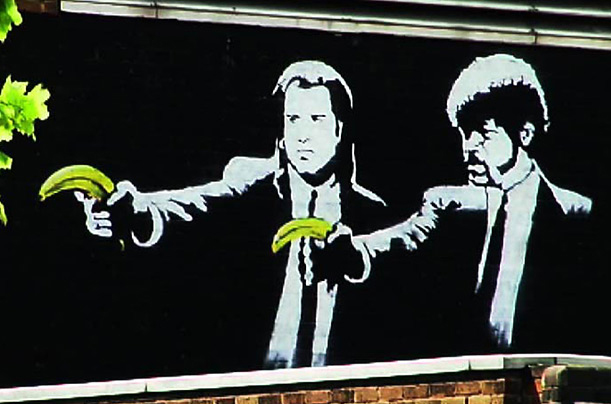
"Pulp Fiction Bananas" by Banksy, once near Old Street Tube Station, London, now whitewashed.  From http://www.toptenz.net/top-10-images-by-street-artist-banksy.php
"Pulp Fiction Bananas" by Banksy, once near Old Street Tube Station, London, now whitewashed.

PUMPKIN: Everybody be cool, this is an occupation!
YOLANDA: Any of you fucking pricks move, and I’ll execute every motherfucking last one of you!
JULES: So, tell me again about those killing-for-promotions there…
VINCENT: What do you want to know?
JULES: Killing is legal there, right?
VINCENT: Yeah, it is legal but it ain’t 100% legal. I mean you can’t walk into a house and start shooting right away. You’re only supposed to take those fucking pricks to certain designated places and blast off their fucking brains? You have to give them some name…
JUKES: Those are encounter sites?
VINCENT: Yeah, it breaks down like this: it’s legal to kill them, it’s legal to own it and, if you’re the occupier of the encounter site, it’s legal to bury them there. It’s legal to carry their bodies, but that doesn’t really matter ’cause — even if you got a truckload of them — if the cops stop you, it’s illegal for them to search you. Searching you is a right that the cops in Kashmir don’t have. Continue reading “A Scene from Pulp Fiction in Kashmir”

On the ‘Precision’ of Language: Why the Term ‘Genocide’ is So Wrong, or Who Can Use the Term

This essay is a response to the emerging discussions over the ‘appropriateness’ of the use of the word ‘genocide’ in the context of the Indian military occupation in Kashmir on PulseMedia and elsewhere on Facebook.

by Mohamad Junaid

[This essay is a response to the emerging discussions over the ‘appropriateness’ of the use of the word ‘genocide’ in the context of the Indian military occupation in Kashmir on PulseMedia and elsewhere on Facebook.]

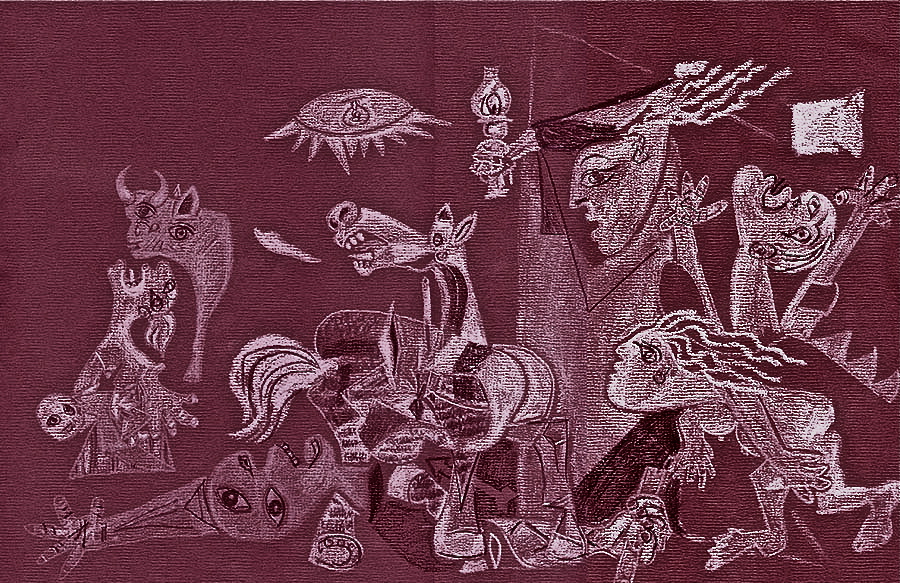
Homage to Picasso's Guernica (HD 2002)

But, which language? Which one language expresses all joyous, exhilarating, or traumatic experiences?

When Kashmiris are told to be precise in their language there are largely two positions involved: one, a sympathetic (if inadequate and self-censorious) one, which suggests that following ‘the convention’ will allow for legalistic interpretation and some form of retributive or ‘restorative’ justice. Often such a position traps itself in legal discourse, and by seeking to bottle people’s experiences into tight categories, fetishizes those categories, and in the end reduces the depth of traumatic experiences to mere data points on the grid of classification. This compliant and self-disciplining position forgets the origins of law in violence (and the inverse), and how ‘law’ serves to maintain ‘order’—which is, in other words, the systematized, legally endorsed structure of oppression. The peculiar claim to universalism (to create a universal system of law) that drives this position pays no heed to where, and for whom, these supposedly ‘universal’ categories of law are created, and what connection law has with power or ‘international’ law with the empire. Continue reading “On the ‘Precision’ of Language: Why the Term ‘Genocide’ is So Wrong, or Who Can Use the Term”

No Way to Honor Dr. King

by Medea Benjamin

The ceremonies for the new Martin Luther King Jr. Memorial in Washington DC were kicked off on August 24 at an event billed as Honoring Global Leaders for Peace. But some of those honored are a far cry from King’s beloved community of the poor and oppressed. The tribute to peacemakers, organized by the MLK National Memorial Foundation, was mostly a night applauding warmakers, corporate profiteers and co-opted musicians.

The night started out with great promise when MC Andrea Mitchell mentioned Dr. King’s brilliant anti-war speech Beyond Vietnam as a key to understanding the real Dr. King. And sure, there were a few wonderful moments—a song by Stevie Wonder, a speech about nonviolence by the South African Ambassador and a quick appearance by Jesse Jackson in which he managed to spit out a call to “study war no more.”

But most of the evening’s speakers and guests of honor had little to do with peacemaking. One of the dignitaries thanked at the start of the program was Israeli Ambassador Michael Oren, representing a country that uses $3 billion a year in precious U.S. tax dollars to commit war crimes against Palestinians.

Then came a parade of representatives of corporations that want to cleanse their image by being associated with Dr. King. The first was General Motors VP Eric Peterson. His company took billions from government coffers to keep it afloat, then showed its “generosity” by donating $10 million of our tax dollars to the memorial. Mr. Peterson gave a speech paying tribute to the company’s first black board member, Rev. Leon Sullivan. Peterson claimed that the Sullivan Principles, principles that established a social responsibility code for companies working in South Africa, helped abolish apartheid. The truth is that the Sullivan Principles ended up being a cover for U.S. corporations—like General Motors–to continue doing business in racist South Africa instead of respecting the international divestment campaign.

Continue reading “No Way to Honor Dr. King”

Political Fear

Sasha Lilley of the highly erudite Against the Grain interviews Corey Robin, author of the brilliant Fear: The History of A Political Idea. Also check out Robin’s superb essay on Hannah Arendt, and his commentary on Barack Obama’s recent capitulation on the debt deal.

Fear dominates our society. Fear of crime, fear of the poor, fear of foreign terrorists, to which we might add fear of our government and fear of our bosses. For some liberal thinkers, fear serves a purpose. It’s supposed to pull us all together so we can find some kind of social solidarity in an atomized, alienated world. Corey Robin discusses the problems with that notion and talks about the places where fear truly lurks in our society.

Representing the East, Viewing the West

Renowned anthropologist Laura Nader (sister of Ralph Nader) discusses how Arab/Muslim women perceived the west during their encounters in the past centuries.

Downloadprogram audio (mp3, 47.8 Mbytes)

Laura Nader

Edward Said spent much of his distinguished career combatting Western stereotypes of the Arab world. Laura Nader explains what Said meant by “Orientalism,” and describes what Arabs who visited the West in past centuries came to think of Western practices. Also, Adel Iskandar talks about the volume in which Laura Nader’s article about Said appears.

Adel Iskandar & Hakem Rustom, eds., Edward Said: A Legacy of Emancipation and Representation UC Press, 2010.

Dear Coen Brothers, It’s Nothing Personal (It’s all Political)

Ethan and Joel Coen recieve the $1M Dan David Prize on May 15th 2011 at Tel Aviv University. ~ Photo by REUTERS/Amir Cohen

On May 15th, while thousands of people were getting shot and gassed in the streets, the Coen Brothers (and many others) took a million dollars from Tel Aviv University, in the form of the Dan David Prize. I’m sure someone would have cared to protest, had  over 15 people not been killed and hundreds injured, during the Nakba Day commemoration demonstrations, that same day.

Update (17.5.11): 21 dead, and over 200 injured.

Continue reading “Dear Coen Brothers, It’s Nothing Personal (It’s all Political)”

The Social Democratic Manifesto

Tony Judt’s Ill Fares The Land: A Treatise On Our Present Discontents is an elegantly crafted elegy for the postwar consensus and a concise and erudite statement by a towering public intellectual of political wisdom accumulated over a lifetime of achivement. Its intended audience is ‘youths on both sides of Atlantic,’ who are too leery of civic engagement because of their disillusionment with politics and suspicion of government. Judt aims to invigorate their interest with challenging ideas and a practical project for political transformation. He offers no utopia, but an alternative that is ‘better than anything else to hand.’ He makes a case for social democracy, a form of government that can play an enhanced role without threatening liberties.

Judt begins with a diagnosis of the present malaise, a condition JK Galbraith described as ‘private wealth and public squalor.’ Judt finds something ‘profoundly wrong’ with an age which has made ‘a virtue out of the pursuit of material self-interest.’ Like Oscar Wilde’s cynics, he laments, ‘we know what things cost but have no idea of what they are worth.’ With ‘growth’ as the only index of progress, politicians have been able to claim success even as inequality has reached grotesque proportions. The decline began with Reagan and Thatcher’s assault on the welfare state, but has proceeded apace both in Britain and the US under successive Democratic and Labour governments. The result is a society marked by extreme inequality and broken communities. Judt draws on the work of Richard Wilkinson and Kate Pickett, authors of The Spirit Level, to show a correlation between the extreme inequality of the American and British society and its adverse consequences on health, crime, and social mobility.

Continue reading “The Social Democratic Manifesto”

Of Niqabs, Monsters, and Decolonial Feminisms

By Huma Dar

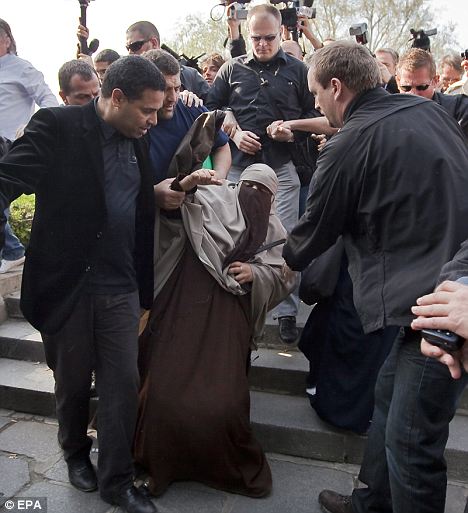
A woman in niqab being arrested in Paris, April 12, 2011, copyright EPA

Of Civilities and Dignities

On 22 June 2009, Nicolas Sarkozy, the French President, asserted that burqas (or the burqa-clad?) are “not welcome” in France, adding that “[i]n our country, we cannot accept that women be prisoners behind a screen, cut off from all social life, deprived of all identity” and that “the veils reduced dignity.” France’s Muslim minority is Western Europe’s largest Muslim minority, estimated at six-million-strong.  And this is just an approximation, as the French Republic implicitly claims to be post-race and post-religion via a prohibition on any census that would take into account the race or religion of its citizens. (This anxiety mirrors the brouhaha in Indian media àpropos the much-contested enumeration of OBCs or Other Backward Castes in the Indian census surveys of 2011, or the urgency to declare some spaces post-caste, post-feminist, and post-racist while casteism, patriarchy and racism continue unabated.)

Continue reading “Of Niqabs, Monsters, and Decolonial Feminisms”

Herbert Marcuse on the Frankfurt School

Herbert Marcuse gained world renown during the 1960s as a philosopher, social theorist and political activist; his most famous work is One-Dimensional Man, which had a strong influence on the New Left. Here he’s interviewed by Bryan Magee on the Frankfurt School.


Continue reading “Herbert Marcuse on the Frankfurt School”