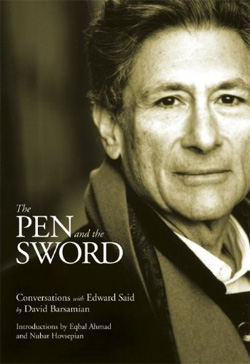
The Pen and the Sword

This review was originally published at the indispensable Electronic Intifada.

Edward Said was one of the great public intellectuals of the twentieth century – prolific, polymathic, principled, and always concerned to link theory to practice. Perhaps by virtue of his Palestinian identity, he was never an ivory tower intellectual. He never feared dirtying his hands in the messy, unwritten history of the present moment. Neither was he ever a committed member of a particular camp. Rather he offered a discomfiting, provocative, constantly critical voice. And against the postmodern grain of contemporary academia, his perspective was consistently moral, consistently worried about justice.

Said was primarily a historian of ideas. More precisely, he was interested in ‘discourse’, the stories a society tells itself and by which it (mis)understands itself and others. His landmark book “Orientalism” examined the Western narrative of empire in the Islamic Middle East, as constructed by Flaubert and Renan, Bernard Lewis and CNN. Said’s multi-disciplinary approach, his treatment of poetry, news coverage and colonial administration documents as aspects of one cultural continuum, was hugely influential in academia, helping to spawn a host of ‘postcolonial’ studies. Said’s “Culture and Imperialism” expanded the focus to include Western depictions of India, Africa, the Caribbean and Latin America, and the literary and political ‘replies’ of the colonised.
Continue reading “The Pen and the Sword”

The Price of Translating a Narrative and its Context (The King is Out: Part V)

Karan Johar falteringly attempts to fashion a cinematic alliance of sorts between African-Americans and South Asians — very unusual in the Bollywood context and more so for Karan Johar, himself — but fails to seize the radical politics embedded. One wishes that the spirit of this song was continuously re-thought, re-energized, re-contextualized, re-translated. A revolution that stops moving, stops “revolving,” is nothing but an aborted one.

by Huma Dar

[read Part I Part II Part III Part IV]


In an interesting twist, Karan Johar’s My Name is Khan displaces or translates (one original meaning of “translate” is to bear or carry across from one place to another) the convoluted and complex, determining context from India, with a specific genealogy, on to the US.  The post-9/11 circumstances provide some unfortunate resonances, yet much of the untranslated/untranslatable context results in the particular aporias of the filmic text.  Even beyond Mandira’s furious and irrational directive to Rizwan Khan, he has to go around saying his name is Khan and “he is not a terrorist” because in that originary terrain of imposed defensiveness there is not much space for a “Muslim name” (besides certain limited spheres), leave alone for “My Name is Khan, and I am an American.”  This latter, more “affirmative” alternative to the “apologetic” cinematic version, is proposed by Suad Abdul-Khabeer in her excellent critique of the film.

Continue reading “The Price of Translating a Narrative and its Context (The King is Out: Part V)”

Placating the gods of Citizenship: the Ritual Sacrifice (The King is Out: Part III)

The obligatory declaration of cinematic patriotism for Indian Muslims necessitates a continuous performance of “loyal citizenship” invariably through offering the sacrifice of a “disloyal” one. This leaves little space for critical engagement with the nation and the state.

by Huma Dar

[read Part I Part II]


King Khan and his divinity

The obligatory declaration of cinematic patriotism for Indian Muslims (discussed in Parts I and II earlier) necessitates a continuous performance of “loyal citizenship” invariably through offering the sacrifice of a “disloyal” one. This leaves little space for critical engagement with the nation, the state, and the unending wars.  An example of this ritual performance is the sequence in My Name is Khan where Rizwan Khan, played by Shahrukh Khan (SRK), reports the “doctor” in the Los Angeles Masjid to the FBI.  How do we know the “bad” doctor is an al-Qaeda member or a terrorist?  Dr. Faisal Rahman does indeed talk about his “blood boiling” at the oppression of the Muslim Ummah in Iraq, Afghanistan, Palestine, Chechnya, Kashmir et al and even exhorts the handful of audience in a completely open space inside the Masjid to “join him and do something.”  The details of that “something” are never revealed.

Continue reading “Placating the gods of Citizenship: the Ritual Sacrifice (The King is Out: Part III)”

Shahrukh Khan and the Pound of Flesh: the Cost of Stardom (The King is Out: Part II)

by Huma Dar

[read Part I]

Shahrukh Khan (SRK) has a long history of playing the fraught field (of the Indian context) with flawless diplomacy, perhaps even overplaying the field.  In early 2002, precisely during the days of the state-sponsored anti-Muslim pogroms in Indian Gujarat, the then Indian Prime Minister Atal Bihari Vajpayee, from BJP (a Hindu Nationalist party), released an MTV-esque album,Samvedna [Sensitivity]. Widely broadcast on Doordarshan, the State-owned television channel, as well as on Indian-American programs (at least in the San Francisco Bay Area), the video features Vajpayee reciting his Hindi poetry while Jagjit Singh, the ghazal singer, sings in tune.  The album is prefaced by the rhapsodizing words of Javed Akhtar — another famous Muslim from Bollywood, narrated by Amitabh Bachhan.

Continue reading “Shahrukh Khan and the Pound of Flesh: the Cost of Stardom (The King is Out: Part II)”

With Brothers Like This

This Memorial eve, culture in Israel took a turn to the right. Highly respected artist, Amir Bennayun, has written a song that can only described as messianic hateful state incitement and propaganda. Here it is in all its disgusting glory [lyrics below limited by my translation]:

I Am Your Brother

Continue reading “With Brothers Like This”

The King is Out, His Name is Khan: Long Live the King (Part I)

My Name is Khan, although narratively based mostly in the USA, has to be theorized within and around the framework of Bollywood; the Urdu-Hindi film history, and its transnational circuits of production, distribution, and consumption; Shahrukh Khan’s star narrative, and the determining context of the Indian political scene along with that in the US and its “war on/of terror.”

by Huma Dar


The Defacing of Khan: It's Not Easy Being Muslim in Mumbai or in Newark

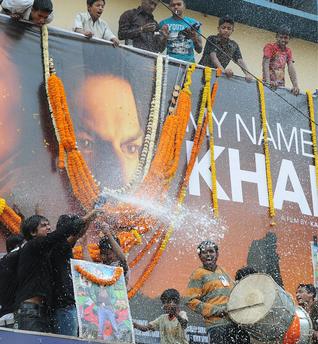
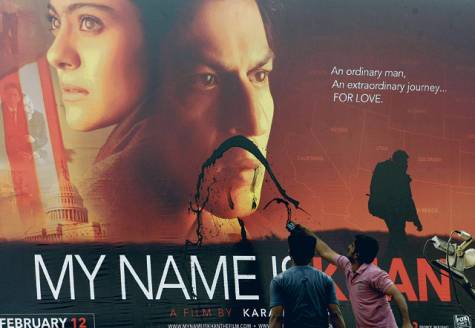
My Name is Khan, although narratively based mostly in the USA, has to be understood and theorized within and around the framework of Bollywood; the Urdu-Hindi film history and its transnational circuits of production, distribution, and consumption; Shahrukh Khan’s star narrative, and the determining context of the Indian political scene along with that in the US and its “War on/of Terror.”  Even prior to the Indian Partition in 1947, most Muslim artists had what Sa’adat Hasan Manto (1912-1955) mockingly called “shuddified” or Hinduized names – Dilip Kumar for Yusuf Khan, Madhubala for Mumtaz Begum Jahan Dehlavi (1933-1969), Meena Kumari for Mahjabeen Bano (1932-1972), or the more ambivalent (non-halal) Johnny Walker for Badruddin Jamaluddin Qazi (1923-2003) and Nargis for Fatima Rashid (1929-1981).  At the contemporary moment, the biggest stars of the Urdu-Hindi film industry in India are Khans: Shahrukh, Salman, Aamir, Saif Ali et al.  It might therefore be tempting to conclude that the Bombay film industry is indeed a level playing field.  The Khans are all Muslims, at least nominally.  Cinematically, they enact, with a few notable exceptions, Hindu characters.  Culturally, the vigorous fanzines of Bollywood idolize them as comfortably suave denizens of metropolitan Bombay[Mumbai] with understated or unexpressed Muslimness — their Hindu wives, girlfriends, or mothers facilitating this imagined assimilation or passing.  Of course, for regular, non-filmi (“film-related” in Urdu-Hindi) Muslim men, this assimilation through marriage to Hindu women is generally frowned upon and can have potentially fatal consequences.

My ruminations on My Name is Khan, like a typical Urdu-Hindi film, lengthy and replete with intermissions, are an entryway into not just the film as cinematic text, but also its complex and rich transnational contexts that must be read in tandem.  In a series of six thematic posts, with this as the first, I will expand on:

(i) The (B)Onus of Muslimness in Bollywood

(ii) Shahrukh Khan and the Pound of Flesh: the Cost of Stardom

(iii) Placating the gods of Citizenship: the Ritual Sacrifice

(iv) A Suitable Boy, “Decent” People, and Names that Pass

(v) The Price of Translating a Narrative and its Context

(vi) Outing the Muslimness, Finally: Some Viewing (and Hearing) Pleasures

Continue reading “The King is Out, His Name is Khan: Long Live the King (Part I)”

Sut Jhally on US Culture and Media

Sut Jhally

I have used several Media Education Foundation films in my classes and have found them to be an excellent resource for teaching. Jhally also has some perceptive comments on US media coverage of the Israel-Palestine conflict.

Sut Jhally is Professor of Communication at the University of Massachusetts at Amherst and Founder and Executive Director of the Media Education Foundation (MEF). He is one of the world’s leading scholars looking at the role played by advertising and popular culture in the processes of social control and identity construction. The author of numerous books and articles on media(including The Codes of Advertising and Enlightened Racism) he is also an award-winning teacher (a recipient of the Distinguished Teaching Award at the University of Massachusetts, where the student newspaper has also voted him “Best professor”). In addition, he has been awarded the Distinguished Outreach Award, and was selected to deliver a Distinguished Faculty Lecture in 2007.

Oprah’s Neoliberal Empire

Following on from last week’s discussion about the tyranny of positive thinking here is Janice Peck, author of the excellent The Age of Oprah: The Making of a Cultural Icon for the Neoliberal Era speaks about the place of Oprah Winfrey’s media enterprise in the last quarter century of U.S. culture and politics. The first interview was conducted by Bruce Dixon of Black Agenda Report, the latter by Bob McChesney of Media Matters. (Update: The first mp3 appears to have vanished from the internet. I have reproduced a transcript of Dixon’s interview with Peck below).

(Also don’t miss the excellent piece, ‘The selling of “Precious”‘ by Ishmael Reed.)

Janice Peck  Associate Professor at the University of Colorado, her research interests include critical theory, the relationship of media and society, the social meanings and political implications of mediated popular culture, communication history and theories of media and culture. She has also authored a book on the history and politics of religious television in the U.S.,The Gods of Televangelism: The Crisis of Meaning and the Appeal of Religious Television (1993).  She has published articles and book chapters on the theoretical and intellectual history of cultural studies, issues in media theory, the family and television, TV talk shows, Oprah’s Book Club and issues of literacy, religion and advertising, and representations of race in media.

Continue reading “Oprah’s Neoliberal Empire”

The Conquest of Cool II

Douglas Rushkoff was once an enthusiast of the revolutionary potential of cyberculture. During the ’90s the increasing conglomeration of the internet business led him to temper his enthusiasm. But I think his prophecies had more substance than he was given credit for. The internet truly came into its own with Web 2.0 technologies and from blogging to Twitter, its true democratizing potential is only now being recognized. It has already succeeded to a certain degree in holding MSM accountable, though it hasn’t quite levelled the playing field as some optimists like to imagine.

Like Neil Postman, however, an important aspect of Ruskhkoff’s work has been the effect of media and advertising on culture. Every other year I teach an undergraduate course in Globalization and Resistance in which I show students this excellent documentary which Rushkoff made for PBS’s Frontline. It illustrates the ersatz nature of alternative culture, the process of its manufacture, in a manner than leaves many of them flabbergasted. It also illustrates the feedback loop through which businesses steal from youth the fruits of their creativity, stamp it with their label, mass produce it, and then sell it to everyone else until it has lost its ‘cool’ — much as Thomas Frank argued in The Conquest of Cool. As the culture degenerates, the ideal female and male types are reduced to the ‘midriff’ and the ‘mook’. (According to the BBC, two-thirds of all teenage females in the UK aspire to be models). Youths, as Rushkoff shows in The Merchants of Cool, have become one of corporate America’s largest sources of revenue.

The Conquest of Cool I

When is dissent hip? This is the subject of the following discussion hosted by the excellent Your Call Radio. Participants include Douglas Haddow of Adbusters, whose article, ‘Hipster: The Dead End of Western Civilization‘, generated one of the longest running debates in the magazines history (the article presently records more than four thousand responses on the Adbusters website). Also participating are  Dan Sinker of Punk Planet, and journalist and hip-hop historian Davey D. They discuss: What is the relationship today between pop-culture, counterculture and dissent? What is the counterculture that sells media now? And can activists reclaim the counterculture that now permeates the mainstream?

The discussion is also joined later by Ishmael Reed and Thomas Frank, author of the splendid work The Conquest of Cool. In the book Frank (who also authored the classic What’s the Matter with Kansas? and edits The Baffler) shows that the advertising industry did not just co-opt the ’60s counterculture movement, in many respects it anticipated, indeed created, it. The instant-gratification individualism and the perpetual pursuit of uniqueness were the perfect compliments to capitalism’s manufacturing of needs to fuel the consumption on which it thrives. If capitalism had built planned obsolescence into its products,  the counterculture’s very idea of rebellion was premised on  ‘standing apart’. As soon as a new product was in the hands of more than one, it had lost its uniqueness, pushing the rebel to search for a new ticket to cool. Rebellion which seeks expression in merchandise manufactures its own needs, and the engines of capital obligingly hum along. Franks gives the example of the Volkswagen Beetle ads, which were all designed as a critique of mass culture. To own a Beetle, then, was to stand apart.  And the process continues as I’ll show in this series of three posts.