Of Niqabs, Monsters, and Decolonial Feminisms

By Huma Dar

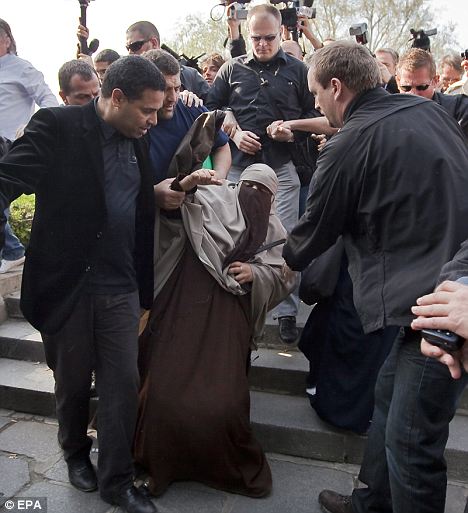
A woman in niqab being arrested in Paris, April 12, 2011, copyright EPA

Of Civilities and Dignities

On 22 June 2009, Nicolas Sarkozy, the French President, asserted that burqas (or the burqa-clad?) are “not welcome” in France, adding that “[i]n our country, we cannot accept that women be prisoners behind a screen, cut off from all social life, deprived of all identity” and that “the veils reduced dignity.” France’s Muslim minority is Western Europe’s largest Muslim minority, estimated at six-million-strong.  And this is just an approximation, as the French Republic implicitly claims to be post-race and post-religion via a prohibition on any census that would take into account the race or religion of its citizens. (This anxiety mirrors the brouhaha in Indian media àpropos the much-contested enumeration of OBCs or Other Backward Castes in the Indian census surveys of 2011, or the urgency to declare some spaces post-caste, post-feminist, and post-racist while casteism, patriarchy and racism continue unabated.)

Continue reading “Of Niqabs, Monsters, and Decolonial Feminisms”
A Call from Home

By Majid Maqbool

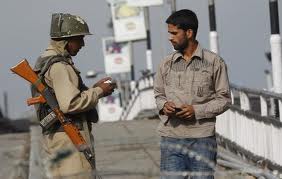
Checking a Kashmiri Youth’s ID Card

“Card chukha seath thavaan?”

(Do you carry the ID card with you?)

Mother worries over frequent phone calls

Away from home, home enters questions

‘Identity’ printed on a piece of paper

cuts through her voice; a discomforting lullaby:

“Card gase hamashe seath thavun”

(always carry the ID card with you)

Home leaves a permanent imprint…

On scattered notes, stamped on memories

At home, mother would tiptoe after me

At the door, before endless blessings, she always asked –

That question mothers have for their sons –

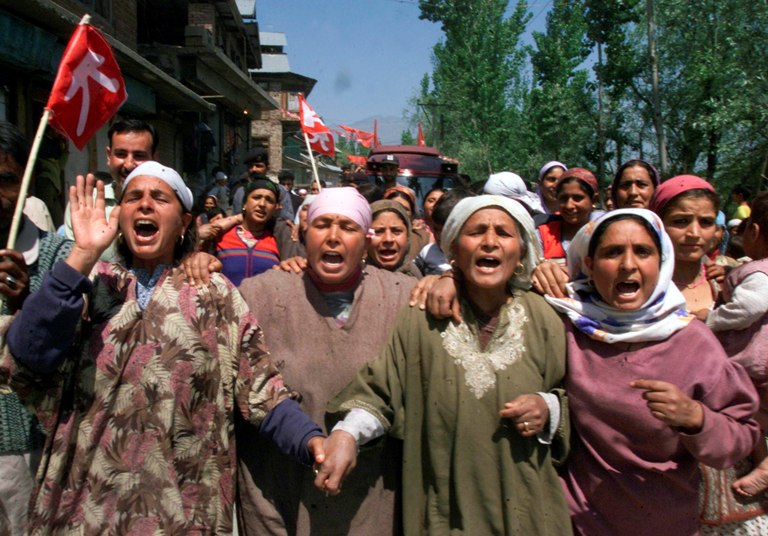
Protesting Kashmiri Women al (Yawar Nazir, IMOW)

“Card tultha seath?”

(are you carrying your ID card?)

From Delhi now, your question settles on my unrest

Identity – detached from the card – hangs heavy

This is not Kashmir, mother

“Toete gase card seath thavun…”

(Still you must carry the card with you…)

The line dropped on this insistence

I kept redialing, to rest her concerns,

her unfinished questions, unanswered

Hello..helloo… mother

Can you hear me?

I left the card at home, mother

In the back pocket of my worn-out jeans

Interrogating Identity in Kashmir

Find: a fading photograph, scrutinized edges

And no trace of those unrecognized questions

forever inked on my memory

For troops to question my absence

The proof I left behind is not enough

That frisked ID card remains

like a festering wound, pocketed pain

I carry everywhere


Majid Maqbool is a young journalist/writer from Kashmir.  Some of his writings can be found on his blog maqboolvoice.blogspot.com.

Protests against EU-India ‘Free Trade’ Deal

Activists fear a free trade agreement could risk lives that depend on affordable drugs.

India is one of the world’s largest producers of generic drugs, but a proposed Free Trade Agreement with the European Union could curb the supply of affordable drugs to millions of people. Many fear that multinational pharmaceutical companies will be the only ones allowed to produce and sell them. The proposed deal will affect millions of HIV positive patients in poor countries, who depend on generic drugs for their survival.

Al Jazeera’s Prerna Suri reports from New Delhi.

An Élite Not Unlike Ours! Who’d Have Guessed?!

By Huma Dar

Rakhshanda Jalil writes in The Hindu, 27 February 2011, about “that elusive connect with India when she was least expecting it” on a visit to Karachi, Pakistan.  The title of her piece is “A city not unlike home.”

I am always amused when Indians are surprised and taken aback by Pakistanis (whether in Karachi or Lahore or elsewhere) who “speak Urdu and English with almost equal aplomb” or by their “silk sarees and natty blazers” or by their possible cosmopolitanism!!! (Class is class, unfortunately, and the élite exhibit their privileges in similar ways all over the region!)  Does it not, if just remotely, smack of the loaded “praise”: “Gee! Obama is so articulate!” — also known as “the racism of lowered expectation”?  Why would Indians expect otherwise from their class-affiliates on the other side of the border?  Or is it that Bollywood’s Pakistan-bashing fantasies are actually swallowed uncritically — hook, line, and sinker —  even (or perhaps especially) by the educated Indians, eliciting “fears about Kalashnikov-toting Taliban and marauding Muhajirs.”

And by the way, Pakistanis are not all “tall, well-built, good-looking people,” especially under the normative definition of “good-looking” in South Asia (fair-skinned or with a “wheatish complexion”) — thank god for the latter!  Sadly, the former two ascriptions, of course, too easily go awry given malnutrition due to poverty. Continue reading “An Élite Not Unlike Ours! Who’d Have Guessed?!”

Pakistan: A Deficit of Dignity

M. Shahid Alam

Pakistan’s rulers and ruling elites may well be thinking that the wave of people’s indignation that started in Tunisia and is now working its way through Egypt, Jordan and Yemen will never reach them. Perhaps, they are telling each other, ‘We are safe: we are a democracy.’

The Arabs who are pouring into the streets of Tunisia, Egypt, Jordan and Yemen are not protesting only against their dictatorships. Simultaneously, they are also protesting against governments that have sold their dignity and bartered the honor of their country. Nearly, all the Arab rulers are self-castrated eunuchs in the courts of foreign powers, who have turned their own countries into police states, and who jail, maim, torture and kill their own people to please their masters.

The Arabs are venting their anger against elites who have stymied their energies by turning their societies into prisons. In complicity with foreign powers, these elites have ruled by fear, blocking the forward movement of their people because this movement collides with the imperialist ambitions of Israel and the United States.

It is true that Pakistan has had ‘elected’ governments alternating with military dictatorships. Increasingly, however, these governments, whether civilian or military, have differed little from each other. The priority for both is to keep their power and US-doled perks by doing the bidding of the United States and Israel.

Starting in the early 1990s, Pakistan hurriedly embraced the neoliberal paradigm that emanated from Washington. Hastily, successive ministers of finance and privatization – all of them IMF appointees – went about dismantling Pakistan’s industries, selling off for a song its state-owned enterprises, and empowering Pakistan’s elites to engage in unchecked consumerism.

Continue reading “Pakistan: A Deficit of Dignity”

Bhopal 26 years later

by Saffi Ullah Ahmad

Editor’s Note: For backround on the Bhopal disaster click here.

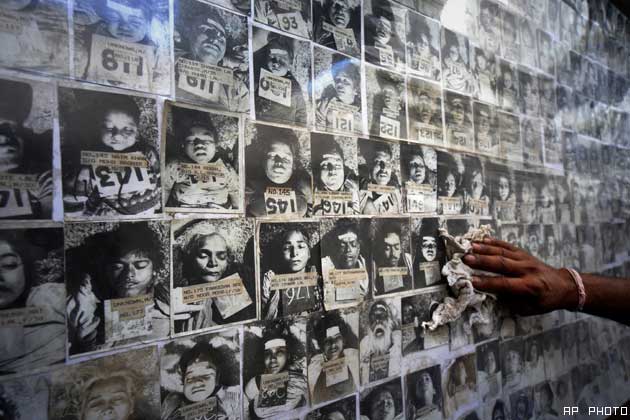
Friday marks the 26th anniversary of the world’s worst industrial catastrophe, the Bhopal Gas Disaster, which brought to light in the most horrific of ways the darker side of economic globalisation. The disaster saw the lives of hundreds of thousands of impoverished Indians destroyed as negligence on the part of a US multinational led to the escape of over 40 tons of ultra-hazardous toxic gasses from a poorly built pesticide factory, laying waste on an entire city.

Although estimates vary, the current death toll is thought to be 25,000, and those seriously injured number well over 100,000. These numbers are still rising due to the thousands of tons of abandoned chemicals continuously polluting the Bhopali environment (with increasing concentrations in the soil and drinking water), and gas-affected survivors giving birth to children with serious genetic malformations.

To date, justice has evaded Bhopal victims and their families, who continue to suffer with a vast range of crippling disabilities as well as psychological trauma. The multinational behind all this — Union Carbide Corporation, now owned by the Dow Chemical Company — continues to exploit the inadequate framework of the Indian legal system and has been aided by indifference and at times probable collusion by the central government which dubiously insists it has always acted in the best interest of the victims.

Continue reading “Bhopal 26 years later”

Manufacturing Consent and Violence: Azadi, Arundhati, Hindutva Terror, and Indian Media

by Huma Dar

At a groundbreaking seminar, ‘Azadi: The Only Way,’ organized by the Committee for the Release of Political Prisoners (CRPP) in New Delhi, India, on October 21st, 2010, the minutes record that Arundhati Roy, the prize-winning author of The God of Small Things, asserted that

[Kashmir] has never been an integral part of India and the Indian government recognised it as a disputed territory and took it to the UN on its own accord. In 1947 we were told that India became a sovereign democracy. But it became a country as per the imagination of its colonizer, and continued to be a colonizer even after the British left the country. Indian state forcibly or deceitfully annexed the North-East, Goa, Junagarh, Telangana, etc… the Indian state has waged a protracted war against the people which it calls its own. Who are the people it has waged war against? The people of North-East, Kashmir, Punjab, etc. This is an upper caste Hindu state waging a continuing struggle against the people. Continue reading “Manufacturing Consent and Violence: Azadi, Arundhati, Hindutva Terror, and Indian Media”

They can’t buy her silence

by Tariq Ali

Arundhati Roy

Arundhati Roy is both loathed and feared by the Indian elite. Loathed because she speaks her mind. Feared because her voice reaches the world outside India and damages the myths perpetrated by New Delhi regardless of which party holds power. She often annoys the official Indian Left because she writes and speaks of events for which they are either responsible or of which they dare not speak. Roy will not allow her life to be subjugated by lies. She never affects a courage or contempt she does not feel. Her campaigns against injustice are undertaken with no view to either fame or profit. Hence the respect awarded her by the poor, ordinary citizens, who know the truth but are not allowed a voice in the public sphere. The authorities can’t buy her silence. One of the few voices in India who has spoken loudly against the continuing Indian atrocities in Kashmir, she is now being threatened. If she doesn’t shut up they’ll charge her with sedition, aping their colonial masters of yesteryear. Her response to those who would charge and imprison her is a model of clarity, conviction and refusal to compromise.

Editor’s note: Also see Democracy Now’s interview with Arundhati Roy. This post first appeared on the London Review Blog.

Arundhati Roy Responds to Threat of Arrest for Sedition

Pity the nation that has to silence its writers for speaking their minds. Pity the nation that needs to jail those who ask for justice.

Arundhati Roy

Kashmir, Oct. 26—I write this from Srinagar, Kashmir. This morning’s papers say that I may be arrested on charges of sedition for what I have said at recent public meetings on Kashmir. I said what millions of people here say every day. I said what I, as well as other commentators have written and said for years. Anybody who cares to read the transcripts of my speeches will see that they were fundamentally a call for justice. I spoke about justice for the people of Kashmir who live under one of the most brutal military occupations in the world; for Kashmiri Pandits who live out the tragedy of having been driven out of their homeland; for Dalit soldiers killed in Kashmir whose graves I visited on garbage heaps in their villages in Cuddalore; for the Indian poor who pay the price of this occupation in material ways and who are now learning to live in the terror of what is becoming a police state.

Yesterday I traveled to Shopian, the apple-town in South Kashmir which had remained closed for 47 days last year in protest against the brutal rape and murder of Asiya and Nilofer, the young women whose bodies were found in a shallow stream near their homes and whose murderers have still not been brought to justice. I met Shakeel, who is Nilofer’s husband and Asiya’s brother. We sat in a circle of people crazed with grief and anger who had lost hope that they would ever get insaf-justice-from India, and now believed that Azadi-freedom-was their only hope. I met young stone pelters who had been shot through their eyes. I traveled with a young man who told me how three of his friends, teenagers in Anantnag district, had been taken into custody and had their finger-nails pulled out as punishment for throwing stones.

Continue reading “Arundhati Roy Responds to Threat of Arrest for Sedition”

Guinea pig nation: Pharmas use people as drug test fodder in India?

Remember The Constant Gardener? John le Carre’s superb novel, later filmed by Fernando Meirelles, was about Western pharmaceutical giants using Africans as guinea pigs for testing drugs before they are introduced into markets. Here it is in reality:

The world’s pharmaceutical giants stand accused of using people in India as guinea pigs for their new medical products – sometimes even without their consent. And Human rights groups say those who do know what’s happening, often don’t get a full explanation of the dangers they face.