 The inimitable Mr. Fish.
Julian Assange: Wanted!
The inimitable Mr. Fish.
The inimitable Mr. Fish.
by Huma Dar
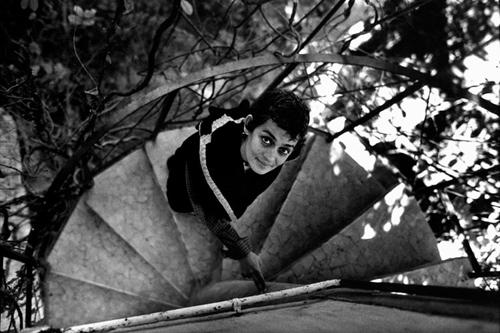
At a groundbreaking seminar, ‘Azadi: The Only Way,’ organized by the Committee for the Release of Political Prisoners (CRPP) in New Delhi, India, on October 21st, 2010, the minutes record that Arundhati Roy, the prize-winning author of The God of Small Things, asserted that
[Kashmir] has never been an integral part of India and the Indian government recognised it as a disputed territory and took it to the UN on its own accord. In 1947 we were told that India became a sovereign democracy. But it became a country as per the imagination of its colonizer, and continued to be a colonizer even after the British left the country. Indian state forcibly or deceitfully annexed the North-East, Goa, Junagarh, Telangana, etc… the Indian state has waged a protracted war against the people which it calls its own. Who are the people it has waged war against? The people of North-East, Kashmir, Punjab, etc. This is an upper caste Hindu state waging a continuing struggle against the people. Continue reading “Manufacturing Consent and Violence: Azadi, Arundhati, Hindutva Terror, and Indian Media”
In November, 76 Tamil refugees escaped Sri Lanka on a rusty freighter. They arrived in Victoria, where they were met by Royal Canadian Mounted Police (RCMP) and Canadian Border Services Agency (CBSA) officials, who promptly jailed them for three months on allegations of terrorism. It would be fully half a year before the CBSA would admit that it had never had any evidence… In 2008, the federal and provincial governments were forced to issue apologies for the Komagata Maru. Now, two years later, if those words are to mean anything, we cannot afford to repeat history: let them stay.
by Fathima Cader
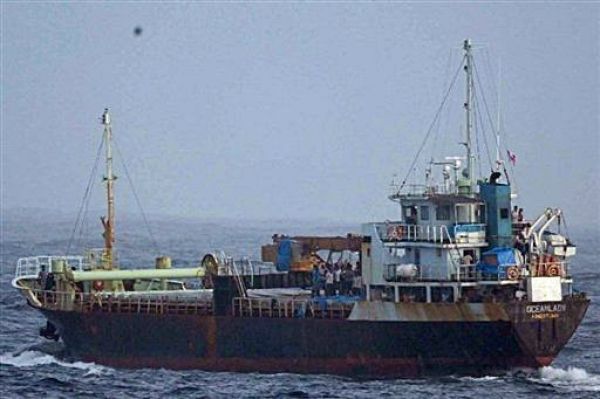
They’re at it again.
In November, 76 Tamil refugees escaped Sri Lanka on a rusty freighter. They arrived in Victoria, where they were met by Royal Canadian Mounted Police (RCMP) and Canadian Border Services Agency (CBSA) officials, who promptly jailed them for three months on allegations of terrorism. It would be fully half a year before the CBSA would admit that it had never had any evidence.
By then, however, it was too late: anti-Tamil and anti-refugee hysteria had spread like wildfire. Now, mere weeks after that most tepid of mea culpas from the CBSA, the hysteria greeting the Tamil MV Sun Sea passengers is worse. As with the Ocean Lady, these migrants will be detained in Maple Ridge jails before their refugee claims are considered. The Conservatives have begun to create new rules to treat refugees who arrive by boat differently from others. Meanwhile, Paul Fromm, the infamous neo-Nazi, has been receiving uncritical coverage in mainstream media with his demands that the migrants be sent back.
As the paranoia grows ever more heightened, it becomes increasingly important that we resist it. The universal rights of safety and mobility must be upheld, not only for the Sun Sea migrants, but for all people fleeing violence.
Continue reading “Rocking the Boat: A Brief History of Anti-Migrant Hysteria in Canada”
In annexing Kashmir, Indian leaders put aside their progressive anti-colonialism, and pursued a policy that stood in direct confrontation with the goals of struggling Kashmiris. Nehru’s professed derision for princes and despots proved facile in Kashmir in this first real test of his commitment to anti-colonialism and democratic values. His decision to urge the discredited and runaway Dogra ruler to sign the imperial Instrument of Accession, and then accept it, was a defeat for the oppressed Kashmiris who had, with great sacrifices, forced the Dogra ruler out. By recognizing the authority of the Dogra ruler, Indian sovereignty over Kashmir simply replaced the sovereignty enshrined in the Dogra maharaja. But along with that sovereignty, India inherited Dogra rule’s illegitimacy as well.
by Mohamad Junaid
(First published in Greater Kashmir on August 5, 2010)
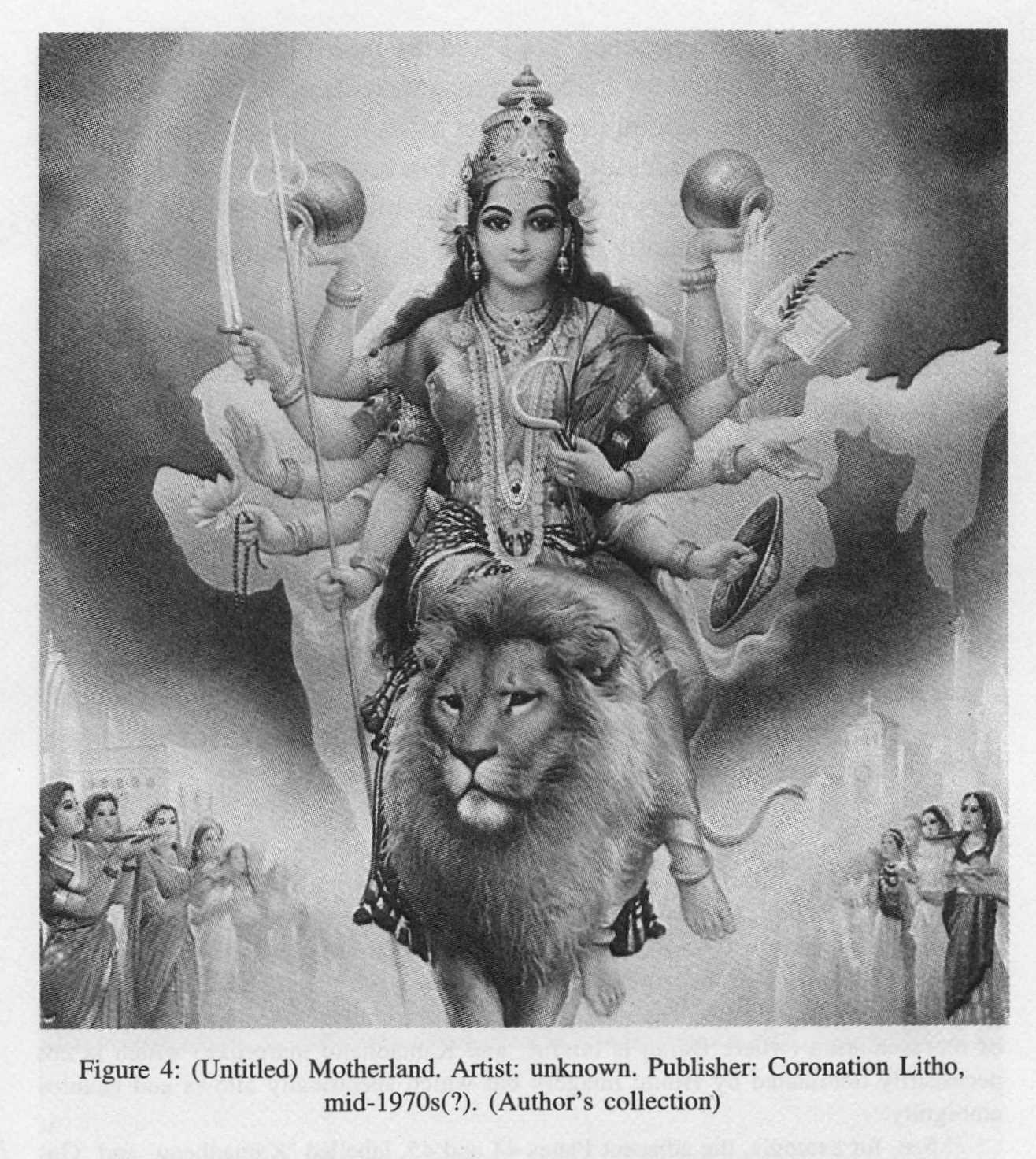
On 26 January 1992, Murli Manohar Joshi, the leader of the Hindu nationalist Bharatiya Janata Party, after travelling by road all the way from the southern tip of India, was airlifted from Jammu to the heart of Srinagar where he half-raised the Indian flag near historic Lal Chowk. All of Kashmir was put under severe curfew, and the army was given shoot-at-sight orders. Throughout the day soldiers shot dead more than a dozen Kashmiris in the streets of Srinagar. Over the previous two years, the Indian government had unleashed a reign of terror on the people, with massacre upon massacre of unarmed protestors dotting Kashmir’s timeline. Joshi’s Ekta Yatra (Unity March), protected and provided of full support by the Indian government, was an important reminder of the nature of the Indian state and the relationship it sought with the people of Kashmir. The event was designed to put on display the majoritarian character of Indian nationhood, and line up power of the state behind it to send barely coded messages to audiences in India and in Kashmir.
Continue reading “Kashmir: Trapped Within Hindu Nationalist Imagination”
Here is a video of yesterday’s action in Burlington, VT, my home state. The second speaker is Yonatan Shapiro, a former IDF pilot who was in the same squadron that conducted the atrocious raid on the Mavi Mamara.
The activists took their message beyond the streets. They walked into a department store and the Ben & Jerry’s Ice Cream store. I’m sure you’re all familiar with Ben & Jerry’s. Given Ben & Jerry’s economic and social justice activism, I’m hoping this will wake them (and all Vermonters) up to the realities of the Israeli occupation of Palestine. Another rally will take place tomorrow. I’ll update this post when I get new information.
The call for academic and cultural boycott is clearly a way to encourage civil society to play a broader political role—that is why it has the support of wide sections of Palestinian civil society. One of the most significant questions that call poses to us is simply this: How could those of us who oppose apartheid, occupation, and colonialism not support such a call?
Dear Amitav Ghosh,
We wish to express our deep disappointment in your decision to accept the Dan David prize, administered by Tel Aviv University and to be awarded by the President of Israel. As a writer whose work has dwelled consistently on histories of colonialism and displacement, your refusal to take stance on the colonial question in the case of Israel and the occupation of Palestine has provoked deep dismay, frustration, and puzzlement among readers and fans of your work around the world. Many admired your principled stand, and respected your decision not to accept the Commonwealth Writers Prize in rejection of the colonialist framework it represented.
Continue reading “Boycott Israel? Amitav Ghosh & the Dan David Prize”
Canadian documentarian Morvary Samare’s brave new film, Ghosts, premiered last month at the Human Rights Film Festival in Montreal. The film reveals the stories of three Canadian-Arab men who were detained and tortured in Syria and Egypt for months and years only to later be released without charges. The film raises a number of important questions concerning the use of torture and the role of the Canadian government in these cases. As Samare notes, while the case of another Canadian citizen detained and tortured in Syria, Maher Arar, received enormous attention in the media, the cases of the three men featured in Ghost – Abdullah Almalki, Muayyed Nureddin and Ahmad Abou El-Maati – received none at all. Recent reports have revealed that although the Canadian government was aware that these men were detained and possibly being tortured, officials did little or nothing to question the validity of their detention. Instead, the government maintained that all of information pertaining to their cases concerned national security and as such, were state secrets.
Here’s a link to a recent CTV interview with Morvary Samare, the producer and director of the film (as well as one of the founders of RamzMedia):
Karan Johar falteringly attempts to fashion a cinematic alliance of sorts between African-Americans and South Asians — very unusual in the Bollywood context and more so for Karan Johar, himself — but fails to seize the radical politics embedded. One wishes that the spirit of this song was continuously re-thought, re-energized, re-contextualized, re-translated. A revolution that stops moving, stops “revolving,” is nothing but an aborted one.
by Huma Dar
[read Part I Part II Part III Part IV]
In an interesting twist, Karan Johar’s My Name is Khan displaces or translates (one original meaning of “translate” is to bear or carry across from one place to another) the convoluted and complex, determining context from India, with a specific genealogy, on to the US. The post-9/11 circumstances provide some unfortunate resonances, yet much of the untranslated/untranslatable context results in the particular aporias of the filmic text. Even beyond Mandira’s furious and irrational directive to Rizwan Khan, he has to go around saying his name is Khan and “he is not a terrorist” because in that originary terrain of imposed defensiveness there is not much space for a “Muslim name” (besides certain limited spheres), leave alone for “My Name is Khan, and I am an American.” This latter, more “affirmative” alternative to the “apologetic” cinematic version, is proposed by Suad Abdul-Khabeer in her excellent critique of the film.
Continue reading “The Price of Translating a Narrative and its Context (The King is Out: Part V)”
The obligatory declaration of cinematic patriotism for Indian Muslims necessitates a continuous performance of “loyal citizenship” invariably through offering the sacrifice of a “disloyal” one. This leaves little space for critical engagement with the nation and the state.
by Huma Dar
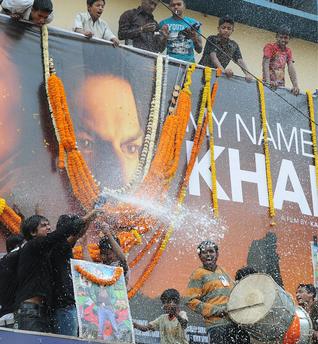
The obligatory declaration of cinematic patriotism for Indian Muslims (discussed in Parts I and II earlier) necessitates a continuous performance of “loyal citizenship” invariably through offering the sacrifice of a “disloyal” one. This leaves little space for critical engagement with the nation, the state, and the unending wars. An example of this ritual performance is the sequence in My Name is Khan where Rizwan Khan, played by Shahrukh Khan (SRK), reports the “doctor” in the Los Angeles Masjid to the FBI. How do we know the “bad” doctor is an al-Qaeda member or a terrorist? Dr. Faisal Rahman does indeed talk about his “blood boiling” at the oppression of the Muslim Ummah in Iraq, Afghanistan, Palestine, Chechnya, Kashmir et al and even exhorts the handful of audience in a completely open space inside the Masjid to “join him and do something.” The details of that “something” are never revealed.

From the Popular Struggle Coordination Committee website:
Dear Friends and Supporters,
It has been two months now since I was handcuffed, blindfolded and taken from my home. Today news has reached Ofer Military Prison that the apartheid wall on Bil’in’s land will finally be moved and construction has begun on the new route. This will return half of the land that was stolen from our village. For those of us in Ofer , imprisoned for our protest against the wall, this victory makes the suffering of being here easier to bear. After actively resisting the theft of our land by the Israeli apartheid wall and settlements every week for five years now, we long to be standing along side our brothers and sisters to mark this victory and the fifth anniversary of our struggle.
Ofer is an Israeli military base inside the occupied territories that serves as a prison and military court. The prison is a collection of tents enclosed by razor wire and an electrical fence, each unit containing four tents, 22 prisoners per tent. Now, in winter, wind and rain comes in through cracks in the tent and we don’t have sufficient blankets, clothes, and other basic necessities.
Continue reading “In Captivity: A Letter from Abdallah Abu Rahma”
 P U L S E