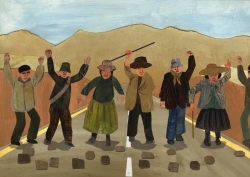
Showdown in Peru: Indigenous communities kick out Canadian mining company
September 17, 2011 § 1 Comment
by Benjamin Dangl
This article appeared at The Dominion.
Earlier this spring, an anti-mining Indigenous movement in Peru successfully ousted a Canadian mining company from their territory. “In spite of government repression, if the people decide to bring the fight to the bitter end, it is possible to resist the pressure of mining and oil companies,” Peruvian activist and journalist Yasser Gómez told The Dominion.
The David and Goliath scenario of this anti-mining uprising highlights the vast economic inequality that has beset Peru. The country’s economy has been booming for the past decade, with a seven per cent growth expected this year—one of the highest growth rates internationally. Sixty-five per cent of the country’s export income comes from the mining industry, and investors are expected to spend over $40 billion in the next 10 years on mining operations.
Yet this growth has not benefited a large percentage of the population. The poverty rate in Peru is just over 31 per cent; in the countryside, two in three people live under the poverty line. Today, there are over 200 communities organized against mining across Peru.
To the Last Drop
June 23, 2011 § 1 Comment
From Al Jazeera‘s excellent Witness series:
The small town of Fort Chipewyan in northern Alberta is facing the consequences of being the first to witness the impact of the Tar Sands project, which may be the tipping point for oil development in Canada. The local community has experienced a spike in cancer cases and dire studies have revealed the true consequences of “dirty oil”.
Gripped in a Faustian pact with the American energy consumer, the Canadian government is doing everything it can to protect the dirtiest oil project ever known. In the following account, filmmaker Tom Radford describes witnessing a David and Goliath struggle.
Below the fold you can also watch Dirty Oil, the 2009 documentary on the Alberta tar sands directed by Leslie Iwerks.
Of Niqabs, Monsters, and Decolonial Feminisms
April 15, 2011 § 13 Comments
By Huma Dar
Of Civilities and Dignities
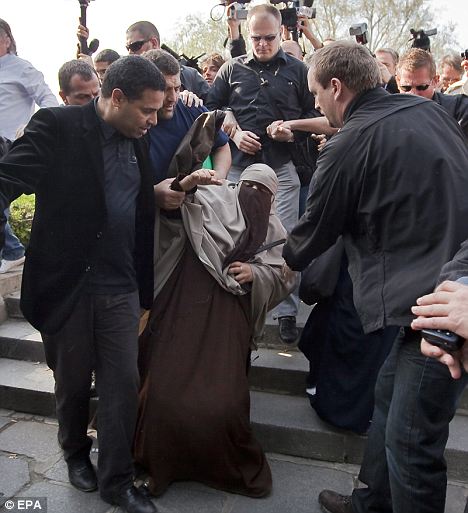
On 22 June 2009, Nicolas Sarkozy, the French President, asserted that burqas (or the burqa-clad?) are “not welcome” in France, adding that “[i]n our country, we cannot accept that women be prisoners behind a screen, cut off from all social life, deprived of all identity” and that “the veils reduced dignity.” France’s Muslim minority is Western Europe’s largest Muslim minority, estimated at six-million-strong. And this is just an approximation, as the French Republic implicitly claims to be post-race and post-religion via a prohibition on any census that would take into account the race or religion of its citizens. (This anxiety mirrors the brouhaha in Indian media àpropos the much-contested enumeration of OBCs or Other Backward Castes in the Indian census surveys of 2011, or the urgency to declare some spaces post-caste, post-feminist, and post-racist while casteism, patriarchy and racism continue unabated.)
Stephen Harper’s Sermon on the Hill
December 25, 2010 § 8 Comments
Editor’s Note: This essay was written in response to Canadian Prime Minister Stephen Harper’s speech at the Ottawa Conference on Combating Antisemitism on November 8th.
by Terry Greenberg
Blessed art the war mongers
For they are hastening the Second Coming;
Blessed art the ethnic-cleansers
For they are fulfilling the prophecy;
Blessed art the soldiers of Zion
For they are doing God’s Work;
Blessed art the enemies of free speech
For they are silencing the Devil.
On Parliament Hill in Ottawa on November 8, 2010 the Prime Minister of Canada delivered a sermon on good and evil to an international gathering of supporters of Israel in which he clearly articulated his view that all support for Israel is “good” and all animosity toward Israel is “evil”. In true Bible-thumper style he offered no middle ground, denouncing this as “moral ambivalence”. It was clear in his preaching that he believed Israel was God’s Plan, and any opposition to Israel was the Devil’s work.
It should be terrifying to Canadians that their Prime Minister would have such a fundamentalist and extremist world view. If we want to understand our current government’s foreign policy and the danger it poses to Canada’s welfare, it would be worthwhile to examine our Prime Minister’s “Sermon on the Hill”. All Canadians should read it for themselves and shudder.
Harper’s speech was remarkable in a number of ways which are outlined below:
Death Squads versus Democracy
December 14, 2010 § Leave a Comment
by Prof. Michael Keefer

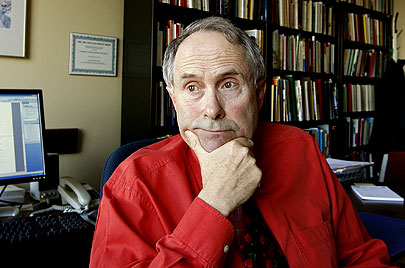
Right-wing Canadian pundit Tom Flanagan contemplating Julian Assange's assassination.
Tom Flanagan, University of Calgary political science professor, right-wing pundit, and mentor and former senior adviser to Prime Minister Harper, has earned himself more international media attention during the past week than even he may have an appetite for.
On November 30th, Flanagan spoke as one of the regular panelists on CBC Television’s national political analysis program, Power and Politics with Evan Solomon. Staring into the camera, while across the bottom of the television screen there appeared a banner reading “WIKILEAKS LATEST: New document mentions PM Stephen Harper,” Flanagan had this to say about Julian Assange, the founder and editor of Wikileaks:
Well, I think Assange should be assassinated, actually. I think Obama should put out a contract and maybe use a drone or something.
Canada-Israel: The other special relationship
December 3, 2010 § 1 Comment
Fault Lines with Avi Lewis looks at the Canadian Israel Lobby. Over the fold you’ll also find two excellent documentaries on the US and British Israel lobbies. They all have one thing in common: they were all produced by media institutions outside North America — Al Jazeera, VPRO, and Channel 4 respectively.
Seen as an honest-broker in the Israel-Palestinian conflict, Canada has become one of Israel’s most fervent supporters. Avi Lewis investigates.
Spend 4 days inside Guantánamo
October 5, 2010 § 1 Comment
YOU DON’T LIKE THE TRUTH – 4 days inside Guantánamo is a documentary based on security camera footage from the Guantánamo Bay prison.
This encounter between a team of Canadian intelligence agents and a child detainee [Omar Khadr] in Guantánamo has never before been seen. Based on seven hours of video footage recently declassified by the Canadian courts this documentary delves into the unfolding high-stakes game of cat and mouse between captor and captive over a four day period. Maintaining the surveillance camera style this film analyzes the political, legal and scientific aspects of a forced dialogue.
Rocking the Boat: A Brief History of Anti-Migrant Hysteria in Canada
August 19, 2010 § 2 Comments
by Fathima Cader

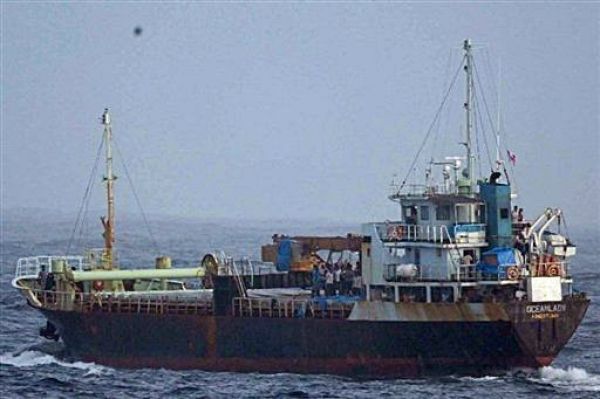
"MV Sun Sea" Uncredited Photo at: http://www.edynews.com/top-news/18-almost-500-sri-lankan-migrants-are-in-canadian-custody.html
They’re at it again.
In November, 76 Tamil refugees escaped Sri Lanka on a rusty freighter. They arrived in Victoria, where they were met by Royal Canadian Mounted Police (RCMP) and Canadian Border Services Agency (CBSA) officials, who promptly jailed them for three months on allegations of terrorism. It would be fully half a year before the CBSA would admit that it had never had any evidence.
By then, however, it was too late: anti-Tamil and anti-refugee hysteria had spread like wildfire. Now, mere weeks after that most tepid of mea culpas from the CBSA, the hysteria greeting the Tamil MV Sun Sea passengers is worse. As with the Ocean Lady, these migrants will be detained in Maple Ridge jails before their refugee claims are considered. The Conservatives have begun to create new rules to treat refugees who arrive by boat differently from others. Meanwhile, Paul Fromm, the infamous neo-Nazi, has been receiving uncritical coverage in mainstream media with his demands that the migrants be sent back.
As the paranoia grows ever more heightened, it becomes increasingly important that we resist it. The universal rights of safety and mobility must be upheld, not only for the Sun Sea migrants, but for all people fleeing violence.
Waiting for BP’s tarballs
June 22, 2010 § 1 Comment
NOVA SCOTIA—”BP has done ruined all those people’s lives down there,” said my friend Bill, a Nova Scotia lobsterman in his seventies, as we talked about the fate of Louisiana fishermen the other day. Many are Cajuns, descended from French Acadian settlers who once lived along this very coast, prior to their expulsion by the British in the 1750s.
Having worked on the sea all his life, Bill said sadly: “We ain’t seen nothing yet. I don’t care how you look at it, that oil is coming up here.” Remarking on swordfish and tuna, which winter and spawn in the Gulf but are caught by Canadian fishermen in the summer, he noted that ”fish swim, but that oil will kill every fish egg it touches.”
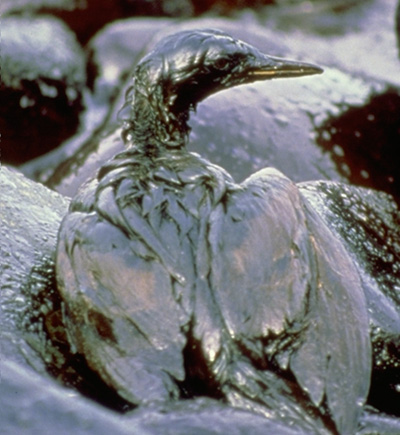
Although the focus of the environmental impacts of BP’s Deepwater Horizon oil spill has been primarily on the devastation of the coastal wildlife, marshes, and beaches of the Gulf Coast, the impacts will be felt all along the Atlantic coast, as well. With the spill, now in its third month, spewing oil into the ocean at the rate of at least 60,000 barrels a day, it’s clear BP CEO Tony Hayward’s claim that the environmental impact would be “very, very modest” could not be farther from the truth.