Of Niqabs, Monsters, and Decolonial Feminisms

By Huma Dar

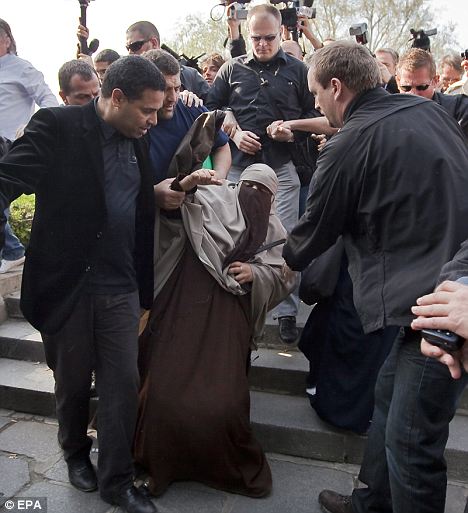
A woman in niqab being arrested in Paris, April 12, 2011, copyright EPA

Of Civilities and Dignities

On 22 June 2009, Nicolas Sarkozy, the French President, asserted that burqas (or the burqa-clad?) are “not welcome” in France, adding that “[i]n our country, we cannot accept that women be prisoners behind a screen, cut off from all social life, deprived of all identity” and that “the veils reduced dignity.” France’s Muslim minority is Western Europe’s largest Muslim minority, estimated at six-million-strong.  And this is just an approximation, as the French Republic implicitly claims to be post-race and post-religion via a prohibition on any census that would take into account the race or religion of its citizens. (This anxiety mirrors the brouhaha in Indian media àpropos the much-contested enumeration of OBCs or Other Backward Castes in the Indian census surveys of 2011, or the urgency to declare some spaces post-caste, post-feminist, and post-racist while casteism, patriarchy and racism continue unabated.)

Continue reading “Of Niqabs, Monsters, and Decolonial Feminisms”

CulturEscapes and the Moral Duty of BDS Today


The neutral Switzerland is about to host a yearly Culturescapes festival. Every year the festival focuses on a different country. This year- the most successful for cultural boycott, yet- it just had to play into Desmond Tutu’s hands and focus on Israel.

A Word about Culture

Culture is a word I’ve been hearing a lot lately. Israel’s Brand Israel campaign is focusing on PR apartheid; Hiding it’s atrocities as best it can, and highlighting it’s “advantages”:

In the Ministry of Foreign Affairs, 6 niches were identified in which Israel has a relative advantage… The 6 niches through which it is planned to promote Israel, in the world, are environment (with an emphases on desert agriculture); Science and technology (medicine, internet and hi-tech); Culture and art; Human variety and tradition; lifestyle and leisure culture; Tikun Olam [=Fixing the world] (support of populations of special needs).

Continue reading “CulturEscapes and the Moral Duty of BDS Today”

“O, God! Have mercy on me! Distracted, I whirl” — Rumi’s Gift

Not frivolously, around the alleys and bazaars, I whirl.
Lover’s temperament, I have — to have one glimpse of my Beloved, I whirl.

After Maulana Rumi (actual poet unknown)

Singing: Nusrat Fateh Ali Khan and Qawwaals

Translated by Huma Dar

Raqs al-Ruhani, al-Qahirah (Huma Dar 2005)
Naa Man Behooda Gird-e Koocha-o-Baazaar Mi Gardam (Huma Dar 2005)

نه من  بيهوده  گرد کوچه  و  بازار  می  گردم
مذاق عاشقی  دارم  پئ  ديدار  ميگردم

خدايا  رحم  کن  بر  من  پريشان وار  می  گردم
خطا کارم  گناھگارم  به  حال زار  می  گردم

شراب شوق  می نوشم  به  گرد يار  می  گردم
سخن مستانه  می گويم  ولے  هوشيار  می  گردم

گھےخندم  گھے گريم گھے افتم  گھے خيزم
مسيحا  در دلم  پيدا  و  من  بيمار  می گردم

بیا جانا  عنایت  کن  تو  مولانای رومی  را
غلام  شمس  تبریزم  قلندروار  می گردم

Continue reading ““O, God! Have mercy on me! Distracted, I whirl” — Rumi’s Gift”

Oliver Stone on South of the Border

Continue reading “Oliver Stone on South of the Border”

DAM: between bombs and beats

by Ben Schiller

We are living in Palestine. Our history, our culture, our everything is Palestinian. — Mahmoud Jreri of DAM

Photo: Marilyn Donahue

“I see myself as a fisherman,” says Suhell Nafar, a member of DAM, the leading Palestinian hip-hop group. “Today, I fished a few fish who didn’t know anything and now know a little thing. Maybe now when they see the TV news, they will think differently about it. Maybe they will go on the Internet and learn about it.”

Suhell was speaking at last weekend’s WOMAD music festival, minutes after DAM had given a passionate performance in front of a big crowd. “There were thousands of people at the concert screaming ‘Free Palestine’. Most of them have never heard about Palestine, and now they know something.”

Hip-hop has been one of the Palestinians’ most effective communication vehicles in recent years. While conventional messages are often drowned out, groups like DAM have been able to reach several new audiences at home and abroad, including the young. The group is not only popular among Palestinians on the West Bank and Gaza, but also in their native Israel, where they have a following among some Jewish-Israelis. Since forming in 1999, they’ve toured several times in Europe and the US, appeared in the Sundance-nominated film Slingshot Hip-Hop, and received exposure in US and European media, including on CNN and in Time.

Continue reading “DAM: between bombs and beats”

Peaches

by Arif Ayaz Parrey

Can I tell how much I love peaches?
Not ordinary ones
But those plucked from
The orchards along Jhelum

The ones in the basket before me
Are nebrim for sure
But they blush like a home-grown innocence
And hold as many juicy promises

I wonder what tree bore them
I wonder if it’s wise to ignore them

The tree of life
Has many buried roots

It is said that my only son
Was killed under the canopy
Of the branches of one such tree
By the army
Also known as the security forces
An old joke
What do they secure
These so-called security forces?
Not the people, not our lives, not our liberty
Not our sentiments, nor our emotions, not our sanity
Not our sons who are shot
Nor our daughters who are raped
Not the truth, not the facts, not humanity

Continue reading “Peaches”

Reel Bad Arabs Floating Overhead

One of the sillier lines deployed to take the wind out of a cultural boycott of apartheid Israel is ‘art is above politics.’ It’s not an argument, just a line. To see how far from an argument it is, just substitute Israel with something we all agree is unacceptable. Would it have been a good idea for an artist to travel to Auschwitz while the chimneys were pumping, not to witness but to entertain the Gestapo? What about singing for Stalin during collectivisation? Or dancing for Pol Pot as he filled Cambodia’s fields with corpses? O, but those were atrocities! They were criminals! Which brings us to the nub of it. Those false liberals and mercenaries who proclaim the nobility of their ‘engagement’ with Zionist colonialism believe that Zionist crimes are ok. The ethnic cleansing of Palestine, the caging of the refugees, the occupation of the West Bank and Gaza, the annexation of the Golan Heights and Jerusalem, the savage, repeated bombardments of Lebanon, the cheerleading for the destruction of Iraq – none of it matters much, because ‘art’ floats high above it.

Continue reading “Reel Bad Arabs Floating Overhead”

Demonstration in Burlington, Vermont, USA

Here is a video of yesterday’s action in Burlington, VT, my home state. The second speaker is Yonatan Shapiro, a former IDF pilot who was in the same squadron that conducted the atrocious raid on the Mavi Mamara.

The activists took their message beyond the streets. They walked into a department store and the Ben & Jerry’s Ice Cream store. I’m sure you’re all familiar with Ben & Jerry’s. Given Ben & Jerry’s economic and social justice activism, I’m hoping this will wake them (and all Vermonters) up to the realities of the Israeli occupation of Palestine.  Another rally will take place tomorrow.  I’ll update this post when I get new information.

The Price of Translating a Narrative and its Context (The King is Out: Part V)

Karan Johar falteringly attempts to fashion a cinematic alliance of sorts between African-Americans and South Asians — very unusual in the Bollywood context and more so for Karan Johar, himself — but fails to seize the radical politics embedded. One wishes that the spirit of this song was continuously re-thought, re-energized, re-contextualized, re-translated. A revolution that stops moving, stops “revolving,” is nothing but an aborted one.

by Huma Dar

[read Part I Part II Part III Part IV]


In an interesting twist, Karan Johar’s My Name is Khan displaces or translates (one original meaning of “translate” is to bear or carry across from one place to another) the convoluted and complex, determining context from India, with a specific genealogy, on to the US.  The post-9/11 circumstances provide some unfortunate resonances, yet much of the untranslated/untranslatable context results in the particular aporias of the filmic text.  Even beyond Mandira’s furious and irrational directive to Rizwan Khan, he has to go around saying his name is Khan and “he is not a terrorist” because in that originary terrain of imposed defensiveness there is not much space for a “Muslim name” (besides certain limited spheres), leave alone for “My Name is Khan, and I am an American.”  This latter, more “affirmative” alternative to the “apologetic” cinematic version, is proposed by Suad Abdul-Khabeer in her excellent critique of the film.

Continue reading “The Price of Translating a Narrative and its Context (The King is Out: Part V)”