The Eerie NGO Phenomenon in Kashmir

“Conflicts have always allowed very suitable ecosystems for Non Governmental Organisations or NGOs to flourish in. Embroiled with armed insurgency for about two decades now, Kashmir has attracted a plethora of organizations. But going by the numbers, the region seems to have become a heaven for NGO activity.”

By Parvaiz Bukhari

(This article was first published by The Honour Magazine, April 2010, (pg. 16-20).)
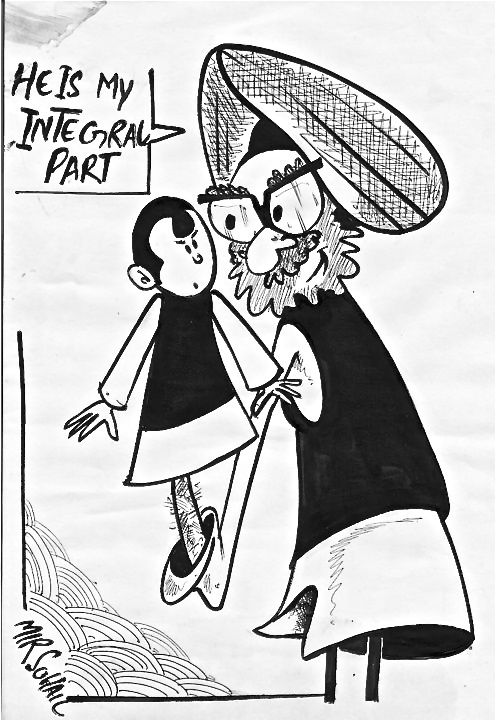
Kashmir as an Integral Part of India.  Cartoon by Mir Suhail Qadiri
Kashmir as an Integral Part of India. Cartoon by Mir Suhail Qadiri

Conflicts have always allowed very suitable ecosystems for Non Governmental Organisations or NGOs to flourish in. Embroiled with armed insurgency for about two decades now, Kashmir has attracted a plethora of organizations. But going by the numbers, the region seems to have become a heaven for NGO activity.

There is no central register for the NGOs operating here, no guidelines or any overt accountability. Various estimates put the figure of existing NGOs up to 16,000. Apart from the office of the Registrar of Societies, NGOs are registered for various non-profit activities as trusts and voluntary groups in the district courts. Besides, many NGOs from across the country operating in Kashmir are not registered here.

All you need is five persons and a draft of bylaws along with a declaration of supposed objectives that is then registered in any district court where no count is maintained.

Just what is this huge mass of NGOs doing and who are the people who run them? What is the real intent and incentive for this NGO boom in a region that is still considered business ‘unfriendly’? Where is the funding coming from? A superficial enquiry reveals a dizzying range of unclear activity bordering on subterfuge.

Government employees, close relatives of bureaucrats, politicians, well-off families and people who have been a part of counter insurgency think tanks, run a number of NGOs in the Valley. Kashmir Foundation for Peace and Developmental Studies (KFPDS) run by a former militant commander, Firdous Sayeed Baba alias Babar Badr, has been on the scene for many years now. Babar and four other former militant commanders were the first to enter into dialogue with New Delhi in 1995. He is also known to be very close to the former Intelligence Bureau (IB) chief A S Dullat, who for many years earlier and during NDA regime served as New Delhi’s point man on Kashmir affairs. Continue reading “The Eerie NGO Phenomenon in Kashmir”
More on “Haqeeqat-e-Kashmir”: India and Zubin Mehta’s Psyop Concert in Indian Occupied Kashmir

We appeal all sections of Kashmiri society to join the Haqeeqat-e-Kashmir event to express their solidarity with the resilience and suffering of people of Jammu and Kashmir.

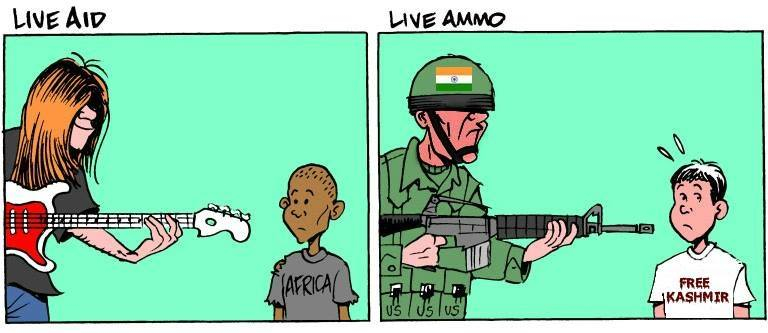
Live Aid, Live Ammo: India and Zubin Mehta's Psyop Concert in Kashmir
Live Aid, Live Ammo: India and Zubin Mehta’s Psyop Concert in Indian Occupied Kashmir

Organizing Committee, Haqeeqat-e-Kashmir

Press release, 5 September 2013

On 22 August 2013, the German Embassy, New Delhi, issued a press release that Zubin Mehta would be conducting an orchestra on 7 September 2013, at the Mughal Garden, Shalimar Bagh, in Srinagar, Jammu and Kashmir. On 26 August 2013, civil society members of Jammu and Kashmir – from lawyers and businessmen to poets and scholars – registered a strong protest against the proposed concert and concerns were communicated to the German Embassy and the people of Germany – from political representatives to artists and activists.

The people of Jammu and Kashmir take immense pride in our rich history of resisting oppression. We also have historically cultivated a sublime tradition in, and love for, music. Music – which appeals to the higher values of love, justice, dignity, and peace; which genuinely acknowledges the long-suffering, yet bravely resisting, Kashmiris; and which is performed for the actual public – is wholeheartedly welcome.

However, legitimizing an occupation via a musical concert is completely unacceptable. Art as propaganda, as abundantly documented in history, is put to horrific use across the world. Art as propaganda in Jammu and Kashmir is unacceptable. The Zubin Mehta concert is organized and controlled by Government of India and the German Embassy, with extensive corporate sponsorship. It serves to build on the State narrative that seeks to dilute the reality of Jammu and Kashmir and peoples’ aspirations. It seeks to promote an image of a “peaceful” and “normal” Jammu and Kashmir. The pain, suffering, courage and bravery of the resistance will find no place in this concert. Indian State operations that seek to support the occupation must be resisted. To build this Statist narrative of Jammu and Kashmir, an estimated Rs.100 crores [INR 10 billion or USD 16 million] is reported to being spent, and invitations have been sent to corporate India (Tatas, Birlas, Ambanis, Bajajs, CII, FICCI..), the film world (Amitabh Bachchan, Rajinikanth, Katrina Kaif…) and sportsmen (Sachin Tendulkar, Boris Becker…). It is most condemnable that the Government of Germany has chosen to be party to the Indian States’ continued political machinations in Jammu and Kashmir. So far Indian army and various Indian institutions have been organizing psychological operations which are termed by Indian military as Sadbhavana Operation. We protest German government’s joining the efforts of Indian army. It appears an attempt by the Indian State to outsource its military psychological operations to the international community. Continue reading “More on “Haqeeqat-e-Kashmir”: India and Zubin Mehta’s Psyop Concert in Indian Occupied Kashmir”

Of Occupation, Resistance and Music: An Appeal

We submit that it is incumbent upon the people of Germany to put pressure on the German Embassy to immediately recognize the reality, the horrifying context, within which this proposed concert is to take place, issue a statement that accepts the disputed nature of Jammu and Kashmir, and recognizes the pain and legitimate political and legal struggle of its people. Crucially, pressure must be put on the German Embassy to withdraw its support to the concert.

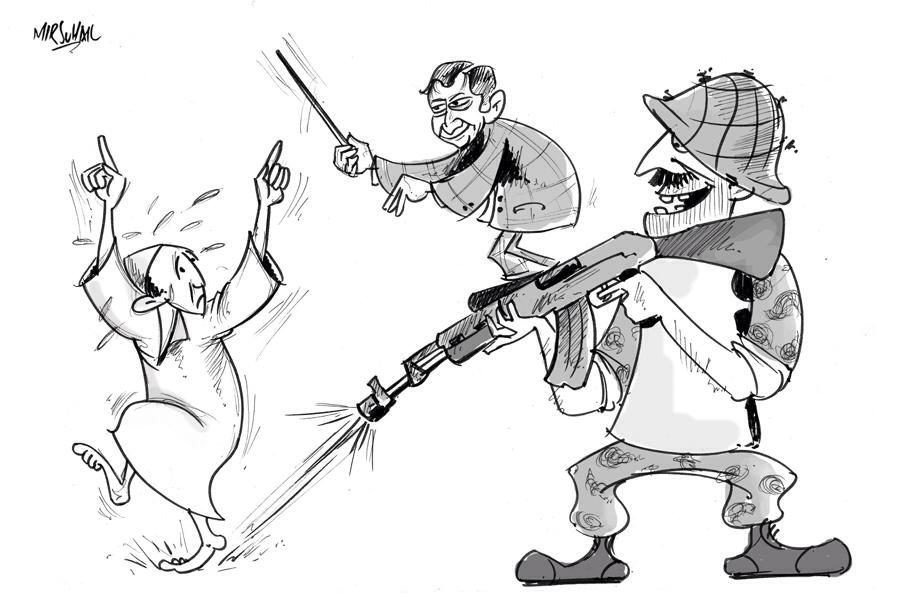
"Zubin Mehta, Indian Army, and Kashmir" by Mir Suhail Qadiri
“Zubin Mehta, Indian Army, and Kashmir” by Mir Suhail Qadiri
September 2, 2013
To                                                                                                       
The People of Germany
(Political Representatives, Civil Society, Artists, Activists and Citizens)
 
Of Occupation, Resistance and Music: An Appeal
 
1.      On 22 August 2013, the German Embassy, New Delhi, issued a press release that Zubin Mehta would be conducting an orchestra on 7 September 2013, at the Mughal Garden, Shalimar Bagh, in Srinagar, Jammu and Kashmir.  The press release stated that the concert was “a wonderful cultural tribute to Kashmir,” and intended “to reach the hearts of the Kashmiris with a message of hope and encouragement.”  “The ‘Kashmir Concert’ is part of a broader engagement,” it further stated.
2.      On 26 August 2013, civil society members of Jammu and Kashmir – from lawyers and businessmen to poets and scholars – registered a strong protest against the proposed concert. To date, the German Embassy has failed to respond – privately or publicly – to this letter of protest.  Faced with this unforeseen and complete apathy from the German embassy, we believe it is incumbent upon us to reach out to the people of Germany to express our serious concerns with a concert that seeks not to entertain, but to subtly control the political message from Jammu and Kashmir, i.e. manipulate it into a message of “peace” and “normalcy” that ignores ground realities. For example, even as we write this appeal, Jammu and Kashmir Police are conducting door to door searches and identification exercises at the homes of the residents in and around the Shalimar neighborhood, the proposed venue of the concert.  Surely this exposes the rot at the core of the much-touted “peace” and “normalcy.”  
3.      The people of Jammu and Kashmir take immense pride in our rich history of resisting oppression. We also have historically cultivated a sublime tradition in, and love for, music. Music – which appeals to the higher truths of love, justice, dignity, and peace; which genuinely acknowledges the long-suffering, yet bravely resisting, Kashmiris; and which is performed for the actual public – is wholeheartedly welcome.
4.      However, legitimizing an occupation via a musical concert is completely unacceptable. Art as propaganda, as abundantly documented in history, is put to horrific use across the world. We are sure you will understand that we cannot welcome anything even remotely analogous in Jammu and Kashmir.  In a state of affairs where the poets and musicians of Jammu and Kashmir, such as Ghulam Nabi Sheikh, well-known Kashmiri national singer, Inayatullah Bhat, a guitar/harmonium player, and Ali Mohammad Shahbaz, a poet from Handwara, have themselves been victims of the violence of the Indian State, it is but obvious that there needs to be a political understanding of the uses and abuses of art.  Given this sordid context, which cannot be naïvely wished away, we must then ask this crucial question of the people of Germany, and the world citizenry at large: Should we, as people of conscience, support art which not only does not highlight the sufferings of an oppressed people, leave alone which offers balm to its pain, but instead which, through its setting within the particular landscape of power, actively serves to silence and obfuscate our appeals to the rest of humanity, and thus furthers oppressionContinue reading “Of Occupation, Resistance and Music: An Appeal”

Haqeeqat-e-Kashmir [The Reality of Kashmir]: A Journey of Counter-Memory

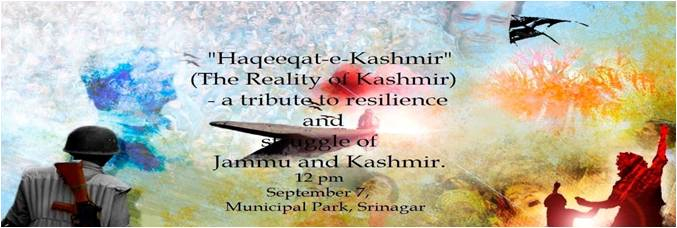
On Sept 7, we invite EVERYONE to come join us at noon, at the Municipal Park (near GPO), Srinagar, as we mark the “dark times” of the military occupation, and commemorate the luminosity of AZADI: the light of faith, of freedom, of our blood-soaked struggle for justice, dignity, and true peace. Luminosity that cuts through the deep darkness of the “dark times” and reflects the resilience of human spirit in all its grace.

Haqeeqat-e-Kashmir: The Reality of Kashmir

A Cultural Aesthetic Tribute to the Resilience and Struggle of the People of Jammu & Kashmir

“In the dark times
Will there also be singing?
Yes, there will also be singing.
About the dark times.”
~ Bertolt Brecht

On Sept 7, we invite EVERYONE — and not just a handpicked 1500 — to come join us at noon, at the Municipal Park (near GPO), Srinagar, as we mark the “dark times” of the military occupation, and commemorate the luminosity of AZADI: the light of faith, of freedom, of our blood-soaked struggle for justice, dignity, and true peace. Luminosity that cuts through the deep darkness of the “dark times” and reflects the resilience of human spirit in all its grace.

We invite EVERYONE to send in cultural aesthetic texts: poetry, paintings, photographs, multimedia, performance art, songs, et cetera on the ABOVE THEME to haqeeqatekashmir@gmail.com

Continue reading “Haqeeqat-e-Kashmir [The Reality of Kashmir]: A Journey of Counter-Memory”

Colonizing the Mind: Israel’s Assault on Palestinian Education

Yesterday, I stumbled across a title in Ma’an that shook me to the core:

Palestinian schools switch to Israeli curriculum in Jerusalem

To anyone who knows the Israeli curriculum, this is one of the most chilling statements anti-colonialists can imagine. The Israeli school curriculum is what allows millions of Israelis to enlist to the army, to cheer on as it slaughters Palestinians en-masse, and to be OK with being “a little bit fascist” .

I want to make a very important stop here, before we continue examining the article and the questions which it raised in my mind, so my readers, who didn’t grow up through Israel’s public school indoctrination, can get a basic idea of how it works. So sit back for 28 minutes and get to know the incredibly important research of Nurit Peled-Elhanan about the colonialist racist discourse in Israeli textbooks:

  Continue reading “Colonizing the Mind: Israel’s Assault on Palestinian Education”

Creative Community for Peace in Letter to Jose Feliciano: Healing with Music in Colonial Times, Building Bridges Over the Bodies of the Oppressed

Right: Jose Feliciano Left: Steve Schnur

Jose Feliciano is scheduled to perform in apartheid Israel on October 10, at Nokia Stadium. Already he’s being sent messages professing liberal language of equality and harmony for all, by that elite club for the endless cycle of war profiteering, whitewashing and violence, otherwise known as “Creative Community for Peace” (CCfP). Creative Community for Peace is a specialist in apartheid PR. They’re mere existence is about diverting attention from Israel’s systematic daily war crimes against the Palestinian population under its control, by abusing the word “Peace” and shooting the messenger- Boycott, Divestment and Sanctions activists (BDS), who connect the dots between Israel’s image of itself and the reality of its erasure of the Palestinian narrative and people.

Unfortunately, Jose Feliciano, for the time being, endorses the “Creative Community for Peace” statement that has been sent to him, and has posted it on the website. Continue reading “Creative Community for Peace in Letter to Jose Feliciano: Healing with Music in Colonial Times, Building Bridges Over the Bodies of the Oppressed”

Archaeology of Revolutionary Knowledge

My review of Pankaj Mishra’s From the Ruins of Empire which first appeared in Guernica.

As tsar Alexander III sat down for an evening’s entertainment at the St. Petersburg opera in late 1887, he little knew that the performance would be upstaged by one far more dramatic. Shortly after the curtains rose, a slender, goateed man with azure eyes, dressed in robe and turban, got up from a box nearby and proclaimed loudly: “I intend to say the evening prayer—Allah-u-Akbar!” The audience sat bemused and soldiers waited impatiently as the man proceeded unperturbed with his evening prayers. His sole companion, the Russian-born intellectual Abdurreshid Ibrahim, squirmed in fear of his life.

Jamal ud-Din al-Afghani was determined to recruit Russian support in his campaign against the British. Having failed to secure an audience with the tsar, he had decided to use his daring as a calling card. The tsar’s curiosity was duly piqued and Afghani had his hearing.

This could be a scene out of Tolstoy or Lermontov; but so extraordinary a figure was Afghani (1838-97) that inserting him into fiction would have compromised verisimilitude. So, renowned essayist and novelist Pankaj Mishra has opted for the genres of historical essay and intellectual biography to profile the lives of Afghani and other equally remarkable figures in From the Ruins of Empire: The intellectuals who remade Asia.

The book is a refreshing break from lachrymose histories of the East’s victimhood and laments about its past glories. It concerns a group of intellectuals who responded to the threat of western dominance with vigour and imagination. Together they engendered the intellectual currents that have shaped the last century of the region’s history. Continue reading “Archaeology of Revolutionary Knowledge”

Israel 2012, The Question of a Nation: What Does Culture Have to Do with Politics? (Part 2)

Earlier this week, I found a message in my inbox by an Israeli, who’s a Jazz musician, who’s paying gig was canceled because of a successful BDS movement campaign to get Swedish Jazzist, Andreas Öberg, to cancel his gig in the Eilat Red Sea Jazz Festival. Usually, the extent of my response, when I get unsolicited mail from angry Israelis, is to take a screenshot and add it to my “Love Letters” albums on my Facebook profile. Call it an artistic form of exhibiting political repression, racism and sexism, if you will (but what does culture have to do with politics, I wonder…). This time, however, since we’re not talking about your typical angry Red Hot Chili Peppers fan, but someone who has lost a paying gig. I think it merits a response (even though, as I will argue below, I am actually not the address for cultural worker grievances).

You Don’t Know Me and I Don’t Know You

Continue reading “Israel 2012, The Question of a Nation: What Does Culture Have to Do with Politics? (Part 2)”

Red Hot Chiling Silence

Red Hot Chili Peppers’ drummer, Chad Smith, professing a liberal language of equality and harmony for all.

You book some tour, receive some award, get an event invitation. “They love me! They really love me!” you think. Or maybe “Woah, cool! I always wanted to go to Murmansk!” All of a sudden, out of nowhere, you start getting letters from Arizona: “Dude, we’re trying to have a picket line here, you’re seriously treading on our turf! Boycott racism!” Panicked, you call your agent: “But I just wanted to make music!” Your agent, being payed to be in contact with the corporeal world tells you how it is: “We’ll have to loose some revenue, but let’s donate this concert’s proceeds to these people’s organizations!”, better yet “let’s buy activists off with free tickets!” Without much debate, you happily pack your bags and head off in your private airplane to the Congo. After all, what do you know about politics?

Continue reading “Red Hot Chiling Silence”

Boycotting the White City: Good for Tel Avivians

rev·o·lu·tion noun \ˌre-və-ˈlü-shən\

2
a : a sudden, radical, or complete change
b : a fundamental change in political organization; especially : the overthrow or renunciation of one government or ruler and the substitution of another by the governed
c : activity or movement designed to effect fundamental changes in the socioeconomic situation
d : a fundamental change in the way of thinking about or visualizing something : a change of paradigm <the Copernican revolution>
e : a changeover in use or preference especially in technology <the computer revolution> <the foreign car revolution>

~ Merriam Webster Dictionary

Almost a year ago a wave of massive popular protests began within the state of Israel. Though my initial criticisms still stands, I’d like to add that over the past year, at least in the south of Tel Aviv, there’s a constant learning about egalitarian politics, co-ops and community projects. People are changing and that can’t be a bad thing. Still, on the Palestinian liberation front there’s little change. The protests have remained Jewish-centered and protesters are still hostile to the mere mention of Arabs (Palestinians are people from another country, of course).

Dr. White City and Mr. Tel Aviv

Continue reading “Boycotting the White City: Good for Tel Avivians”