Of Niqabs, Monsters, and Decolonial Feminisms

By Huma Dar

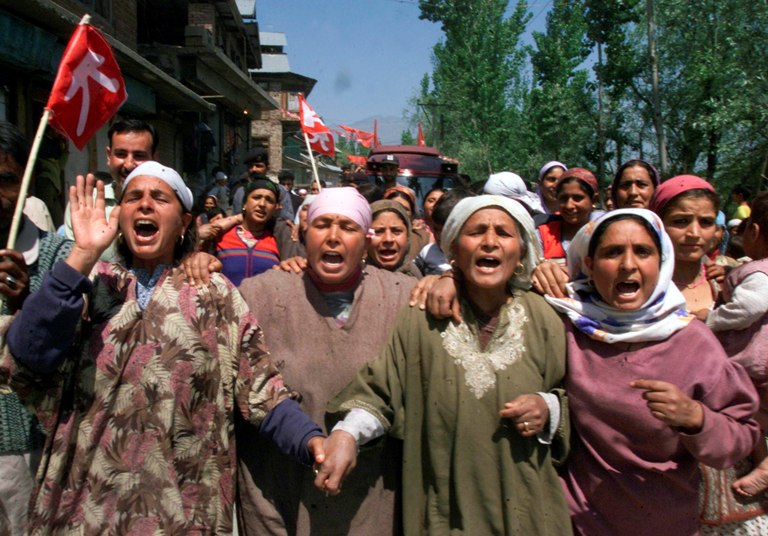
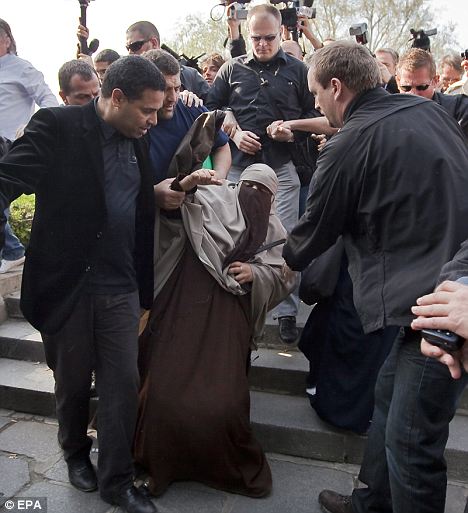
A woman in niqab being arrested in Paris, April 12, 2011, copyright EPA

Of Civilities and Dignities

On 22 June 2009, Nicolas Sarkozy, the French President, asserted that burqas (or the burqa-clad?) are “not welcome” in France, adding that “[i]n our country, we cannot accept that women be prisoners behind a screen, cut off from all social life, deprived of all identity” and that “the veils reduced dignity.” France’s Muslim minority is Western Europe’s largest Muslim minority, estimated at six-million-strong.  And this is just an approximation, as the French Republic implicitly claims to be post-race and post-religion via a prohibition on any census that would take into account the race or religion of its citizens. (This anxiety mirrors the brouhaha in Indian media àpropos the much-contested enumeration of OBCs or Other Backward Castes in the Indian census surveys of 2011, or the urgency to declare some spaces post-caste, post-feminist, and post-racist while casteism, patriarchy and racism continue unabated.)

Continue reading “Of Niqabs, Monsters, and Decolonial Feminisms”
A Call from Home

By Majid Maqbool

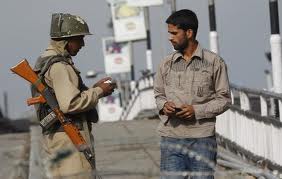
Checking a Kashmiri Youth’s ID Card

“Card chukha seath thavaan?”

(Do you carry the ID card with you?)

Mother worries over frequent phone calls

Away from home, home enters questions

‘Identity’ printed on a piece of paper

cuts through her voice; a discomforting lullaby:

“Card gase hamashe seath thavun”

(always carry the ID card with you)

Home leaves a permanent imprint…

On scattered notes, stamped on memories

At home, mother would tiptoe after me

At the door, before endless blessings, she always asked –

That question mothers have for their sons –

Protesting Kashmiri Women al (Yawar Nazir, IMOW)

“Card tultha seath?”

(are you carrying your ID card?)

From Delhi now, your question settles on my unrest

Identity – detached from the card – hangs heavy

This is not Kashmir, mother

“Toete gase card seath thavun…”

(Still you must carry the card with you…)

The line dropped on this insistence

I kept redialing, to rest her concerns,

her unfinished questions, unanswered

Hello..helloo… mother

Can you hear me?

I left the card at home, mother

In the back pocket of my worn-out jeans

Interrogating Identity in Kashmir

Find: a fading photograph, scrutinized edges

And no trace of those unrecognized questions

forever inked on my memory

For troops to question my absence

The proof I left behind is not enough

That frisked ID card remains

like a festering wound, pocketed pain

I carry everywhere


Majid Maqbool is a young journalist/writer from Kashmir.  Some of his writings can be found on his blog maqboolvoice.blogspot.com.

CulturEscapes and the Moral Duty of BDS Today


The neutral Switzerland is about to host a yearly Culturescapes festival. Every year the festival focuses on a different country. This year- the most successful for cultural boycott, yet- it just had to play into Desmond Tutu’s hands and focus on Israel.

A Word about Culture

Culture is a word I’ve been hearing a lot lately. Israel’s Brand Israel campaign is focusing on PR apartheid; Hiding it’s atrocities as best it can, and highlighting it’s “advantages”:

In the Ministry of Foreign Affairs, 6 niches were identified in which Israel has a relative advantage… The 6 niches through which it is planned to promote Israel, in the world, are environment (with an emphases on desert agriculture); Science and technology (medicine, internet and hi-tech); Culture and art; Human variety and tradition; lifestyle and leisure culture; Tikun Olam [=Fixing the world] (support of populations of special needs).

Continue reading “CulturEscapes and the Moral Duty of BDS Today”

Pakistan: A Deficit of Dignity

M. Shahid Alam

Pakistan’s rulers and ruling elites may well be thinking that the wave of people’s indignation that started in Tunisia and is now working its way through Egypt, Jordan and Yemen will never reach them. Perhaps, they are telling each other, ‘We are safe: we are a democracy.’

The Arabs who are pouring into the streets of Tunisia, Egypt, Jordan and Yemen are not protesting only against their dictatorships. Simultaneously, they are also protesting against governments that have sold their dignity and bartered the honor of their country. Nearly, all the Arab rulers are self-castrated eunuchs in the courts of foreign powers, who have turned their own countries into police states, and who jail, maim, torture and kill their own people to please their masters.

The Arabs are venting their anger against elites who have stymied their energies by turning their societies into prisons. In complicity with foreign powers, these elites have ruled by fear, blocking the forward movement of their people because this movement collides with the imperialist ambitions of Israel and the United States.

It is true that Pakistan has had ‘elected’ governments alternating with military dictatorships. Increasingly, however, these governments, whether civilian or military, have differed little from each other. The priority for both is to keep their power and US-doled perks by doing the bidding of the United States and Israel.

Starting in the early 1990s, Pakistan hurriedly embraced the neoliberal paradigm that emanated from Washington. Hastily, successive ministers of finance and privatization – all of them IMF appointees – went about dismantling Pakistan’s industries, selling off for a song its state-owned enterprises, and empowering Pakistan’s elites to engage in unchecked consumerism.

Continue reading “Pakistan: A Deficit of Dignity”

People Power in the Middle East

M. Shahid Alam

From his weekly perch at CNN, Fareed Zakaria, speculated last Sunday (or the Sunday before) whether George Bush could take credit for the events that were unfolding in Tunisia, whether this was the late fruit of the neoconservative project to bring ‘democracy’ to the Middle East.

It is quite extraordinary watching Zakaria – a Muslim born and raised in India, and scion of a leading political family – mimic with such facility the language of America’s ruling classes, and show scarce a trace of empathy for the world’s oppressed, despite his propinquity to them by reason of history and geography. He does have a bias for India, but here too he only shows a concern for India’s strategic interests, not the interests of its subjugated classes, minorities and ethnicities. This I offer only as an aside about how easy it is for members of the upper classes in countries like India, Pakistan or Egypt to slip into an American skin whenever that dissimulation offers greater personal advantages.

As a cover for deepening US control over the Middle East – here is the latest civilizing mission for you – the neoconservatives in the Bush administration argued that the Islamic world produces ‘terrorists’ because it lives under autocracies. To solve the ‘terrorist’ problem, therefore, the US would have to bring democracy to the Middle East. This demagoguery only reveals the bankruptcy of America’s political class. It is a shame when the President of the United States and his neoconservative puppet-masters peddle such absurdities without being greeted by squeals of laughter – and shouted down as hypocritical, as farcical.

Who has been the leading ally and sponsor these past decades of nearly all the despotisms in the Middle East – those of royal pedigree and others seeking to become royalties?

Regardless, the real plan of United States failed miserably. It was dispatched to its grave by a people’s resistance in Iraq, Afghanistan and Pakistan.

Continue reading “People Power in the Middle East”

Is Pakistan’s ‘Monkey Show’ Coming Apart?

M. Shahid Alam

For too long now, the government of Pakistan – at its highest levels – has looked like a monkey show staged by the United States of America.

The USA picks the mercenaries from Pakistan’s wealthy and corrupt elites who are eager to play the part of the monkey. Once in office, they act upon cues that are called by the US plenipotentiary in Islamabad or elsewhere. The monkey master says, Give us transit rights; the monkey obliges. He says, Join our war against Afghanistan; the monkey obliges again. He says, We will bomb your people, you take the blame; the monkey obliges again. The monkey never disappoints.

All that the monkey master has to do to keep this monkey show going is to toss a few peanuts to the monkeys in the show for every act well-performed.

Of course, in order to try to fool the Pakistanis, the monkey master complains periodically that the monkey is not “doing enough.” The monkey replies that the master is not “giving enough” – peanuts, that is.

How long is this monkey show going to go on?

How long will Pakistanis stand for this humiliation?

Continue reading “Is Pakistan’s ‘Monkey Show’ Coming Apart?”

Zionism: Two Deficits

M. Shahid Alam

We do not fit the general pattern of humanity…”

David Ben-Gurion

…only God could have created a people so special as the Jewish people.

Gideon Levy

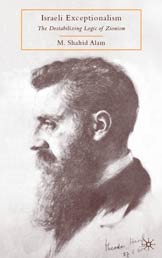
The fecundity of the Zionist project in producing claims of exceptionalism is not in doubt. Anyone who scans the voluminous Zionist literature will be suitably impressed by its repeated resort to claims of Jewish and Israeli exceptionalism. There is scarcely any aspect of Israeli or Jewish history that has not been embellished with some claim to uniqueness.

Israeli exceptionalism has many uses. It defends, obscures, explains away the ‘abnormal’ character of the Zionist nationalist project. When the Irish sought national liberation, their goal was straightforward. They wanted to regain national control over their lives and their country from a foreign power. No one had to convince the Irish that they are descended from the gods; that they possessed a unique essence which set them apart from all other peoples; or that their history, religion, race, language, morality or culture set them above their colonial masters. Occasionally, driven by exuberance or hubris, nationalists have advanced exceptionalist claims, but the success of their movement has not depended on their acceptance. The Irish claimed sovereignty because they knew that they are a nation with their own territory. In order to create their own state, they did not have to establish that they are exceptional.

The Zionists confronted two handicaps that Irish nationalists did not face. The diverse and scattered Jewish communities of Europe – and even more so, the world – did not constitute a single people. Instead, the Jews of the world were loosely united by their religious heritage, but they shared their languages, cultures and genes with their neighboring communities. Moreover, no Jewish community had its own country, a substantial and contiguous territory where it formed a majority of the population. Despite these twin Jewish deficits – the absence of a nation and a national territory – the Zionists were determined to ‘liberate’ the Jews of Europe and endow them with their own state.

The Zionists would remedy the first deficit by denying its existence. They knew that the Jews were not a nation, but it would be unwise to begin their ‘nationalist’ movement with the admission that a Jewish nation did not yet exist. They also did not think that this deficit was a serious hindrance to their movement. With help from anti-Semites, whose attacks had been growing in recent decades, the Zionists were convinced that they could quickly convince enough frightened Jews that they are a nation. Instead of constructing a nationalism based on a common religion, however, the Zionists chose to cultivate a racial basis for Jewish nationalism. They embraced the anti-Semitic accusation that Jews of Europe are an alien race, not Germans or Russians, descended from the ancient Hebrews.

Continue reading “Zionism: Two Deficits”

Zionist Dialectics: Past and Future

Excerpted from Israeli Exceptionalism (Palgrave: 2009).

by M. Shahid Alam

My God! Is this the end? Is this the goal for which our fathers
have striven and for whose sake all generations have suffered?
Is this the dream of a return to Zion which our people have
dreamt for centuries: that we now come to Zion to stain its soil
with innocent blood?”

Ahad Ha’am, 1921

This study has employed a dialectical framework for analyzing the destabilizing logic of Zionism. We have examined this logic as it has unfolded through time, driven by the vision of an exclusionary colonialism, drawing into its circuit – aligned with it and against it – nations, peoples, forces, and civilizations whose actions and interactions impinge on the trajectory of Zionism, and, in turn, who are changed by this trajectory.

It would be a bit simplistic to examine the field of interactions among the different actors in this historic drama on the essentialist assumption that these actors and their interests are unchanging. Instead, we need to explore the complex ways in which the Zionists have worked – and, often have succeeded – to alter the behavior of the other political actors in this drama: and, how, in turn, the Zionists respond to these changes. Most importantly, we need to explore all the ways in which the Zionists have succeeded in mobilizing the resources of the United States and other Western powers to serve their specific objectives.

Continue reading “Zionist Dialectics: Past and Future”

The Life of Frantz Fanon

A dramatisation of the life of French psychiatrist and revolutionary political writer Frantz Fanon, author of Black Skin, White Mask.

Part One of Five

Continue reading “The Life of Frantz Fanon”

Kashmir: Trapped Within Hindu Nationalist Imagination

In annexing Kashmir, Indian leaders put aside their progressive anti-colonialism, and pursued a policy that stood in direct confrontation with the goals of struggling Kashmiris. Nehru’s professed derision for princes and despots proved facile in Kashmir in this first real test of his commitment to anti-colonialism and democratic values. His decision to urge the discredited and runaway Dogra ruler to sign the imperial Instrument of Accession, and then accept it, was a defeat for the oppressed Kashmiris who had, with great sacrifices, forced the Dogra ruler out. By recognizing the authority of the Dogra ruler, Indian sovereignty over Kashmir simply replaced the sovereignty enshrined in the Dogra maharaja. But along with that sovereignty, India inherited Dogra rule’s illegitimacy as well.

by Mohamad Junaid

(First published in Greater Kashmir on August 5, 2010)

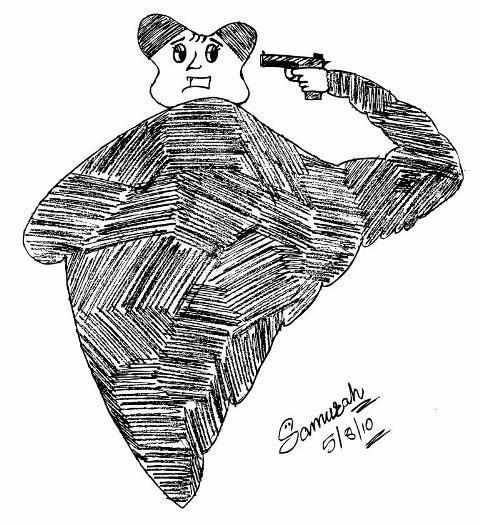
Untitled by Samurah Kashmiri, August 5, 2010
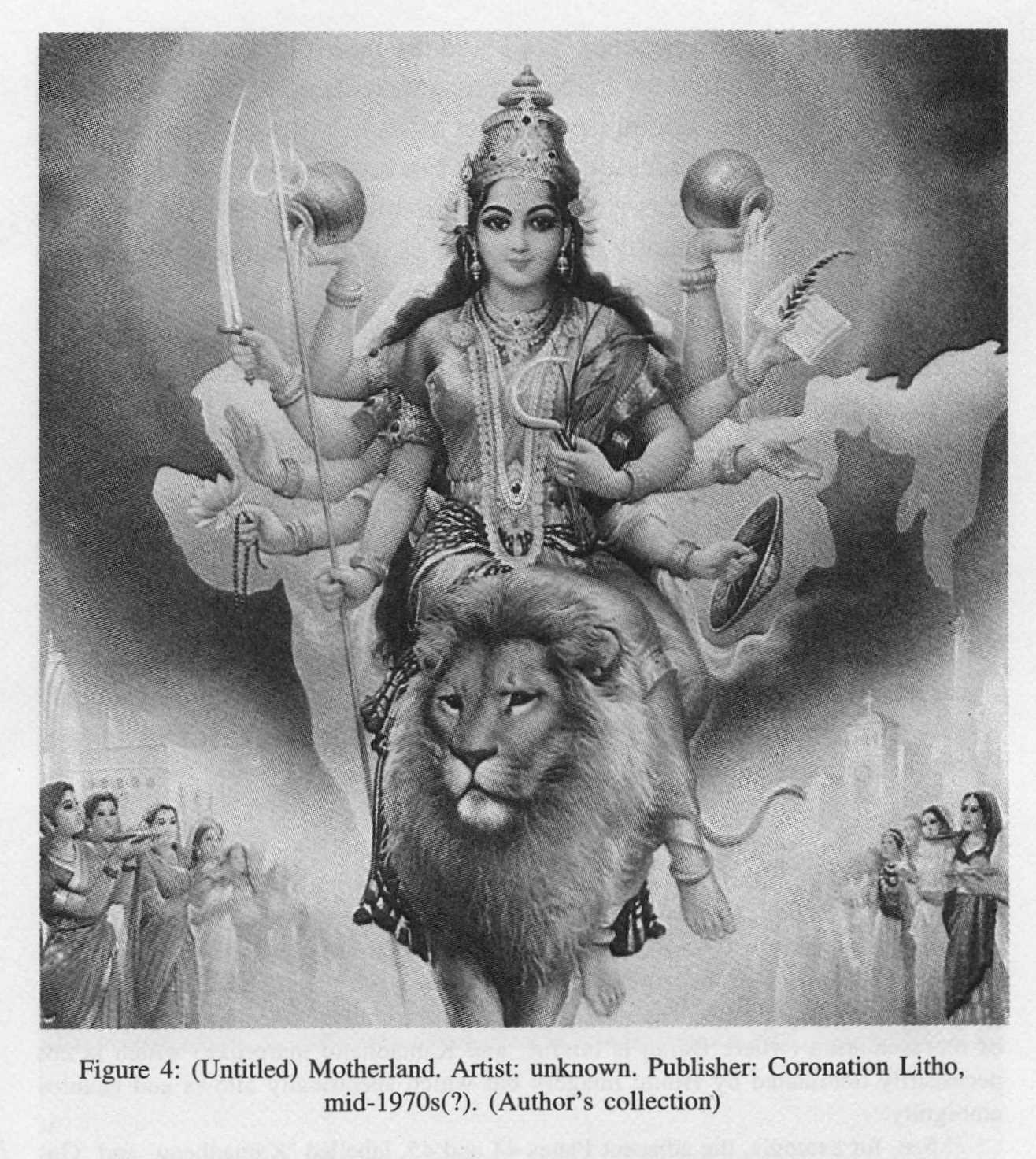
Bharat Mata or Mother India

On 26 January 1992, Murli Manohar Joshi, the leader of the Hindu nationalist Bharatiya Janata Party, after travelling by road all the way from the southern tip of India, was airlifted from Jammu to the heart of Srinagar where he half-raised the Indian flag near historic Lal Chowk. All of Kashmir was put under severe curfew, and the army was given shoot-at-sight orders. Throughout the day soldiers shot dead more than a dozen Kashmiris in the streets of Srinagar. Over the previous two years, the Indian government had unleashed a reign of terror on the people, with massacre upon massacre of unarmed protestors dotting Kashmir’s timeline. Joshi’s Ekta Yatra (Unity March), protected and provided of full support by the Indian government, was an important reminder of the nature of the Indian state and the relationship it sought with the people of Kashmir. The event was designed to put on display the majoritarian character of Indian nationhood, and line up power of the state behind it to send barely coded messages to audiences in India and in Kashmir.

Continue reading “Kashmir: Trapped Within Hindu Nationalist Imagination”