Of Niqabs, Monsters, and Decolonial Feminisms

By Huma Dar

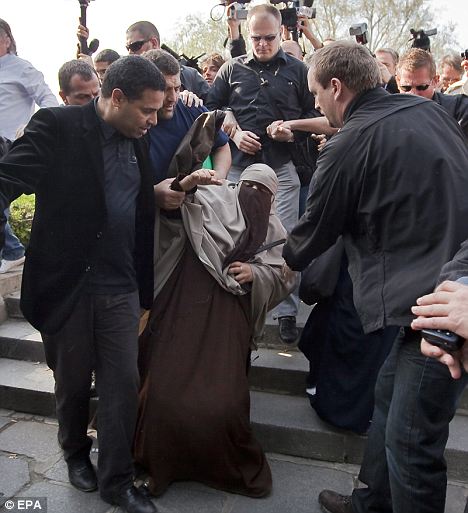
A woman in niqab being arrested in Paris, April 12, 2011, copyright EPA

Of Civilities and Dignities

On 22 June 2009, Nicolas Sarkozy, the French President, asserted that burqas (or the burqa-clad?) are “not welcome” in France, adding that “[i]n our country, we cannot accept that women be prisoners behind a screen, cut off from all social life, deprived of all identity” and that “the veils reduced dignity.” France’s Muslim minority is Western Europe’s largest Muslim minority, estimated at six-million-strong.  And this is just an approximation, as the French Republic implicitly claims to be post-race and post-religion via a prohibition on any census that would take into account the race or religion of its citizens. (This anxiety mirrors the brouhaha in Indian media àpropos the much-contested enumeration of OBCs or Other Backward Castes in the Indian census surveys of 2011, or the urgency to declare some spaces post-caste, post-feminist, and post-racist while casteism, patriarchy and racism continue unabated.)

Continue reading “Of Niqabs, Monsters, and Decolonial Feminisms”
An Élite Not Unlike Ours! Who’d Have Guessed?!

By Huma Dar

Rakhshanda Jalil writes in The Hindu, 27 February 2011, about “that elusive connect with India when she was least expecting it” on a visit to Karachi, Pakistan.  The title of her piece is “A city not unlike home.”

I am always amused when Indians are surprised and taken aback by Pakistanis (whether in Karachi or Lahore or elsewhere) who “speak Urdu and English with almost equal aplomb” or by their “silk sarees and natty blazers” or by their possible cosmopolitanism!!! (Class is class, unfortunately, and the élite exhibit their privileges in similar ways all over the region!)  Does it not, if just remotely, smack of the loaded “praise”: “Gee! Obama is so articulate!” — also known as “the racism of lowered expectation”?  Why would Indians expect otherwise from their class-affiliates on the other side of the border?  Or is it that Bollywood’s Pakistan-bashing fantasies are actually swallowed uncritically — hook, line, and sinker —  even (or perhaps especially) by the educated Indians, eliciting “fears about Kalashnikov-toting Taliban and marauding Muhajirs.”

And by the way, Pakistanis are not all “tall, well-built, good-looking people,” especially under the normative definition of “good-looking” in South Asia (fair-skinned or with a “wheatish complexion”) — thank god for the latter!  Sadly, the former two ascriptions, of course, too easily go awry given malnutrition due to poverty. Continue reading “An Élite Not Unlike Ours! Who’d Have Guessed?!”

Global food (in)justice

With more than one billion people around the world considered overweight, why are so many others still starving and struggling to fill their plates? And what can be done to make the global food system more equitable?

Riz Khan interviews the brilliant Raj Patel, author of Stuffed and Starved: The Hidden Battle for the World Food System and The Value of Nothing: How to Reshape Market Society and Redefine Democracy.

Manufacturing Consent and Violence: Azadi, Arundhati, Hindutva Terror, and Indian Media

by Huma Dar

At a groundbreaking seminar, ‘Azadi: The Only Way,’ organized by the Committee for the Release of Political Prisoners (CRPP) in New Delhi, India, on October 21st, 2010, the minutes record that Arundhati Roy, the prize-winning author of The God of Small Things, asserted that

[Kashmir] has never been an integral part of India and the Indian government recognised it as a disputed territory and took it to the UN on its own accord. In 1947 we were told that India became a sovereign democracy. But it became a country as per the imagination of its colonizer, and continued to be a colonizer even after the British left the country. Indian state forcibly or deceitfully annexed the North-East, Goa, Junagarh, Telangana, etc… the Indian state has waged a protracted war against the people which it calls its own. Who are the people it has waged war against? The people of North-East, Kashmir, Punjab, etc. This is an upper caste Hindu state waging a continuing struggle against the people. Continue reading “Manufacturing Consent and Violence: Azadi, Arundhati, Hindutva Terror, and Indian Media”

Feeling the Loyalty to the Jewish State of Israel

By Max Blumenthal and Joseph Dana

The Israeli Knesset is debating a bill proposed by David Rotem of the extreme right Yisrael Beiteinu party that would require all Israeli citizens to swear loyalty to Israel as a “Jewish and democratic state.” This bill is targeted at increasing pressure on the twenty percent of Israelis who are Palestinian citizens while forcing the ultra Orthodox Jewish minority who reject the legitimacy of any state not based on Jewish biblical law to accept Zionism. If passed in its proposed form, citizens unwilling to take the loyalty oath would be at risk of losing citizenship.

Continue reading “Feeling the Loyalty to the Jewish State of Israel”

Mozambique’s Food Riots – the True Face of Global Warming

Thirteen people were killed and hundreds wounded last week in Mozambique when police cracked down on a three-day protest over a 30 percent hike in the price of bread. The UN says the riots in Mozambique should be a wake-up call for governments that have ignored food security problems since the global food crisis of 2008, when countries around the world saw angry protests in the streets over the rising prices of basic food items. In this extremely informative interview on Democracy Now!, Raj Patel connects the dots between climate change, financial speculation, land grabs across Africa, food sovereignity and global hunger.

Also check out Johann Hari’s recent article on the “speculation-starvation-bubble” behind the 2008 global ‘food crisis’, below the fold.

Continue reading “Mozambique’s Food Riots – the True Face of Global Warming”

“Truth Alone Triumphs”: of David, Goliath, Stones, and Speech

“Azadi” is also the chant whose echoes swirl in the Kashmir Valley with greater resonance each day, from the minarets and playgrounds, boulevards and alleys, schools and courts, despite the crushing screeches of teargas and bullets of the Indian (in)security forces. It is “scriptured” into utterance by each breath of Kashmiri women, children, and men; calligraphed by their blood on their emerald valley; embroidered by their bones in Kashmiri Arabesque on worn cobblestones of the downtown; and papier-mâchéd in paisley tears on the blue of their beloved lakes.

by Huma Dar

“A Defiant Kashmiri woman being frisked by Indian Security Forces.” 2007. Uncredited photograph from a Kashmiri blogger


And the night’s sun there in Srinagar?  Guns shoot stars into the sky, the storm of constellations night after night, the infinite that rages on.  It was Id-uz-Zuha: a record of God’s inability, for even He must melt sometimes, to let Ishmael be executed by the hand of his father.  Srinagar was under curfew.  The identity pass may or may not have helped in the crackdown.  Son after son–never to return from the night of torture–was taken away.

… But the reports are true, and without song: mass rapes in the villages, towns left in cinders, neighborhoods torched.  “Power is hideous / like a barber’s hands.”  The rubble of downtown Srinagar stares at me from the Times.

… And that blesséd word with no meaning–who will utter it?  What is it?  Will the women pronounce it, as if scripturing the air, for the first time?  Or the last?

… What is the blesséd word?  Mandelstam gives no clue.  One day the Kashmiris will pronounce that word truly for the first time.  (Excerpt from Agha Shahid Ali’s “The Blesséd Word: A Prologue,” in The Country Without A Post Office,  1997: 16-17)

Continue reading ““Truth Alone Triumphs”: of David, Goliath, Stones, and Speech”

From “Islamist Watch” to Islamic Mimbar: the Politics of Hypocrisy

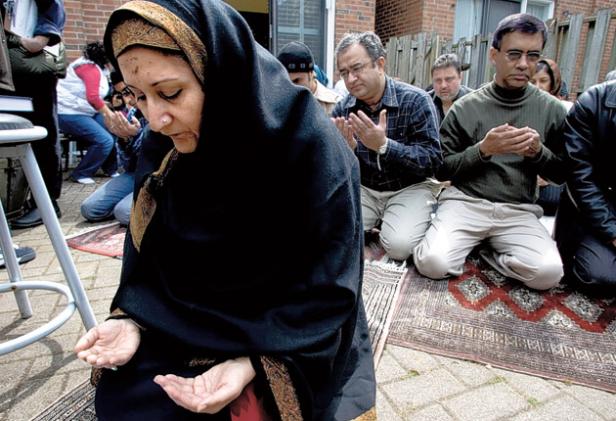
Raheel Raza leads a group of Muslims in prayer in Canada

By Huma Dar

On Thursday, June 10, 2010, Jerome Taylor, the Religious Affairs Correspondent of The Independent posted an article headlined, “First Woman to Lead Friday Prayers in UK.” Two-thirds of the way down this article, we find that:

“Ms Raza’s appearance in Oxford is a repeat of a similar prayer session in 2008 which was led by Amina Wadud, an American-born convert and Muslim feminist. But this is the first time a Muslim-born woman will lead a mixed prayer service in Britain.”

Continue reading “From “Islamist Watch” to Islamic Mimbar: the Politics of Hypocrisy”

Boycott Israel? Amitav Ghosh & the Dan David Prize

The call for academic and cultural boycott is clearly a way to encourage civil society to play a broader political role—that is why it has the support of wide sections of Palestinian civil society. One of the most significant questions that call poses to us is simply this: How could those of us who oppose apartheid, occupation, and colonialism not support such a call?

Dear Amitav Ghosh,

We wish to express our deep disappointment in your decision to accept the Dan David prize, administered by Tel Aviv University and to be awarded by the President of Israel. As a writer whose work has dwelled consistently on histories of colonialism and displacement, your refusal to take stance on the colonial question in the case of Israel and the occupation of Palestine has provoked deep dismay, frustration, and puzzlement among readers and fans of your work around the world. Many admired your principled stand, and respected your decision not to accept the Commonwealth Writers Prize in rejection of the colonialist framework it represented.

Continue reading “Boycott Israel? Amitav Ghosh & the Dan David Prize”

The Carnival at Novara and Unmasking of a Racist Regime

by Huma Dar

The police, in the northern Italian town of Novara, fined a 26-year-old Tunisian woman for wearing a black niqab; she was going to a mosque for the Friday prayers.  According to the New York Times she was fined about $650 under a regulation introduced in January 2010.  Apparently, Novara — a bastion of the xenophobic Northern League — “bans clothing in public that prevents identification by the police.”

Continue reading “The Carnival at Novara and Unmasking of a Racist Regime”