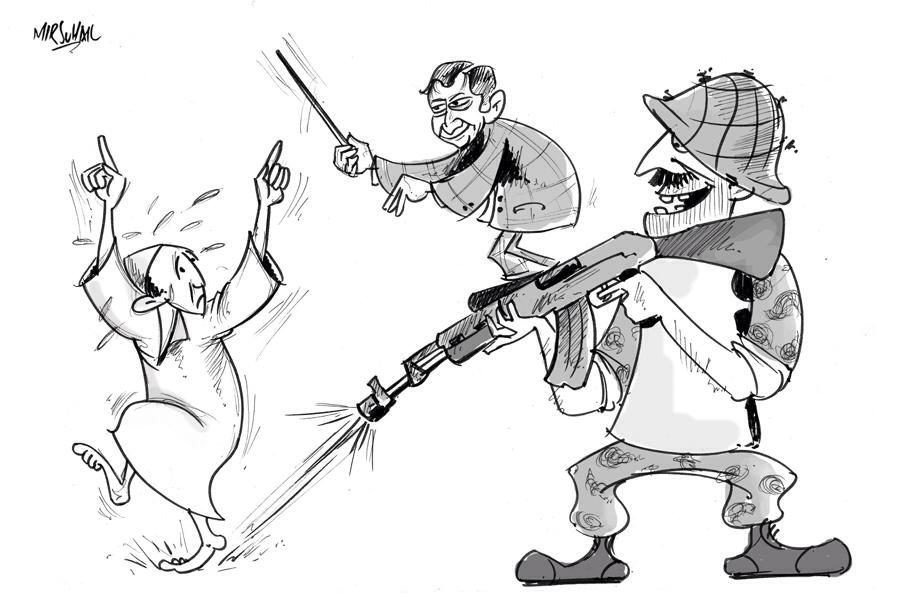
We submit that it is incumbent upon the people of Germany to put pressure on the German Embassy to immediately recognize the reality, the horrifying context, within which this proposed concert is to take place, issue a statement that accepts the disputed nature of Jammu and Kashmir, and recognizes the pain and legitimate political and legal struggle of its people. Crucially, pressure must be put on the German Embassy to withdraw its support to the concert.
“Zubin Mehta, Indian Army, and Kashmir” by Mir Suhail Qadiri
September 2, 2013
To
The People of Germany
(Political Representatives, Civil Society, Artists, Activists and Citizens)
Of Occupation, Resistance and Music: An Appeal
1. On 22 August 2013, the German Embassy, New Delhi, issued a press release that Zubin Mehta would be conducting an orchestra on 7 September 2013, at the Mughal Garden, Shalimar Bagh, in Srinagar, Jammu and Kashmir. The press release stated that the concert was “a wonderful cultural tribute to Kashmir,” and intended “to reach the hearts of the Kashmiris with a message of hope and encouragement.” “The ‘Kashmir Concert’ is part of a broader engagement,” it further stated.
2. On 26 August 2013, civil society members of Jammu and Kashmir – from lawyers and businessmen to poets and scholars – registered a strong protest against the proposed concert. To date, the German Embassy has failed to respond – privately or publicly – to this letter of protest. Faced with this unforeseen and complete apathy from the German embassy, we believe it is incumbent upon us to reach out to the people of Germany to express our serious concerns with a concert that seeks not to entertain, but to subtly control the political message from Jammu and Kashmir, i.e. manipulate it into a message of “peace” and “normalcy” that ignores ground realities. For example, even as we write this appeal, Jammu and Kashmir Police are conducting door to door searches and identification exercises at the homes of the residents in and around the Shalimar neighborhood, the proposed venue of the concert. Surely this exposes the rot at the core of the much-touted “peace” and “normalcy.”
3. The people of Jammu and Kashmir take immense pride in our rich history of resisting oppression. We also have historically cultivated a sublime tradition in, and love for, music. Music – which appeals to the higher truths of love, justice, dignity, and peace; which genuinely acknowledges the long-suffering, yet bravely resisting, Kashmiris; and which is performed for the actual public – is wholeheartedly welcome.
4. However, legitimizing an occupation via a musical concert is completely unacceptable. Art as propaganda, as abundantly documented in history, is put to horrific use across the world. We are sure you will understand that we cannot welcome anything even remotely analogous in Jammu and Kashmir. In a state of affairs where the poets and musicians of Jammu and Kashmir, such as Ghulam Nabi Sheikh, well-known Kashmiri national singer, Inayatullah Bhat, a guitar/harmonium player, and Ali Mohammad Shahbaz, a poet from Handwara, have themselves been victims of the violence of the Indian State, it is but obvious that there needs to be a political understanding of the uses and abuses of art. Given this sordid context, which cannot be naïvely wished away, we must then ask this crucial question of the people of Germany, and the world citizenry at large: Should we, as people of conscience, support art which not only does not highlight the sufferings of an oppressed people, leave alone which offers balm to its pain, but instead which, through its setting within the particular landscape of power, actively serves to silence and obfuscate our appeals to the rest of humanity, and thus furthers oppression? Continue reading “Of Occupation, Resistance and Music: An Appeal”
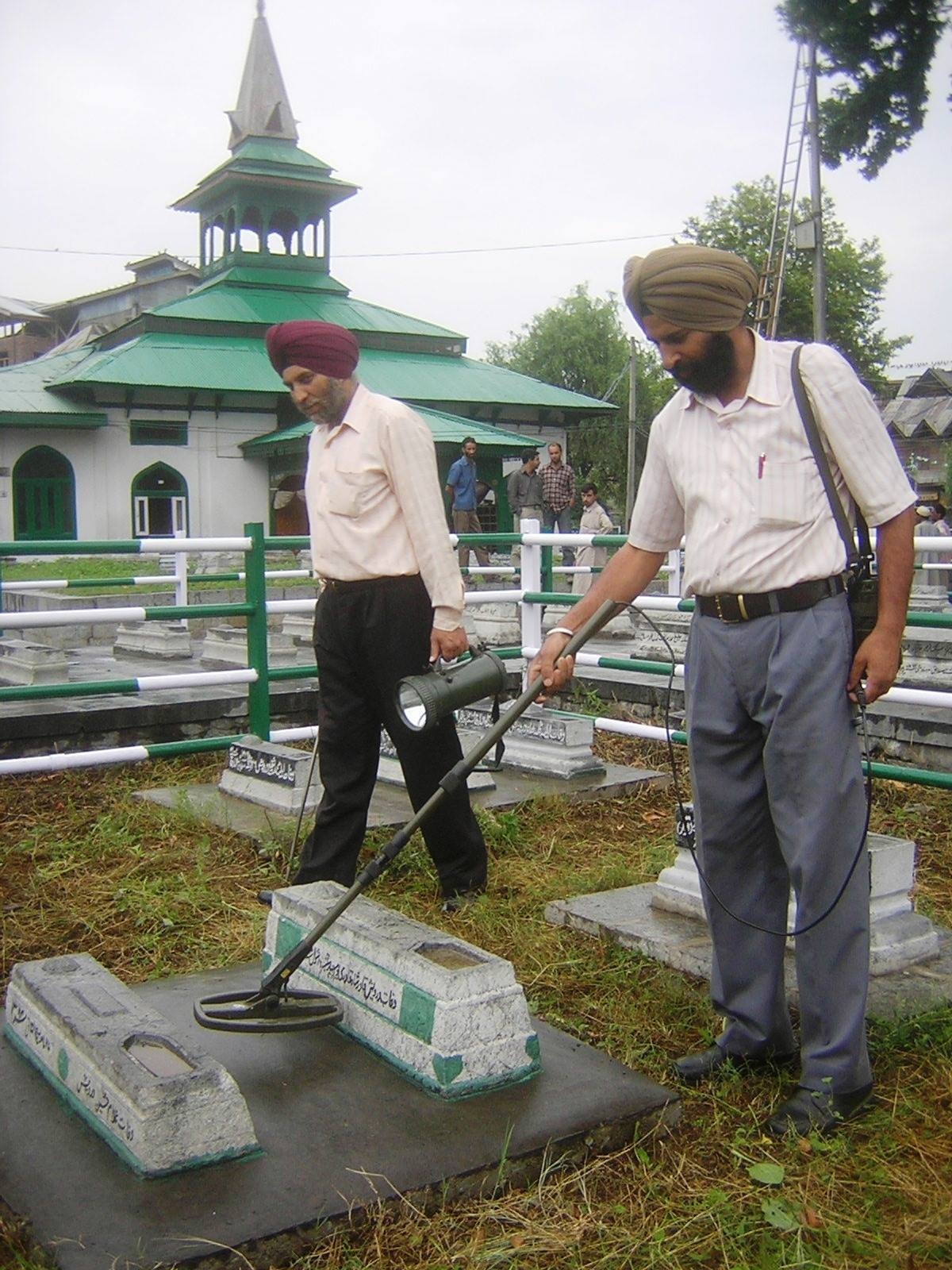
in conversation with the attached photograph by an anonymous photographer…
Frisking Ghosts: India Prepares for Martyrs’ Day in Kashmir, July 13, 2013. Photographer Unknown.
In my homeland
beloveds are planted as seeds singly, or in mass 23, 54, 77, 131… (each madness has its method — each massacre its algorithm) marked, unmarked, empty graves or those packed like sardines in football fields where children once played or open meadows where people once prayed.
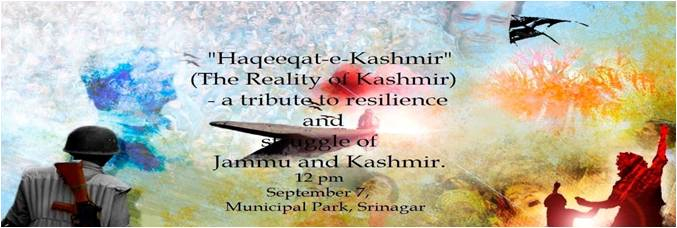
On Sept 7, we invite EVERYONE to come join us at noon, at the Municipal Park (near GPO), Srinagar, as we mark the “dark times” of the military occupation, and commemorate the luminosity of AZADI: the light of faith, of freedom, of our blood-soaked struggle for justice, dignity, and true peace. Luminosity that cuts through the deep darkness of the “dark times” and reflects the resilience of human spirit in all its grace.
Haqeeqat-e-Kashmir: The Reality of Kashmir
A Cultural Aesthetic Tribute to the Resilience and Struggle of the People of Jammu & Kashmir
“In the dark times
Will there also be singing?
Yes, there will also be singing.
About the dark times.”
~ Bertolt Brecht
On Sept 7, we invite EVERYONE — and not just a handpicked 1500 — to come join us at noon, at the Municipal Park (near GPO), Srinagar, as we mark the “dark times” of the military occupation, and commemorate the luminosity of AZADI: the light of faith, of freedom, of our blood-soaked struggle for justice, dignity, and true peace. Luminosity that cuts through the deep darkness of the “dark times” and reflects the resilience of human spirit in all its grace.
We invite EVERYONE to send in cultural aesthetic texts: poetry, paintings, photographs, multimedia, performance art, songs, et cetera on the ABOVE THEME to haqeeqatekashmir@gmail.com
Palestinian schools switch to Israeli curriculum in Jerusalem
To anyone who knows the Israeli curriculum, this is one of the most chilling statements anti-colonialists can imagine. The Israeli school curriculum is what allows millions of Israelis to enlist to the army, to cheer on as it slaughters Palestinians en-masse, and to be OK with being “a little bit fascist” .
I want to make a very important stop here, before we continue examining the article and the questions which it raised in my mind, so my readers, who didn’t grow up through Israel’s public school indoctrination, can get a basic idea of how it works. So sit back for 28 minutes and get to know the incredibly important research of Nurit Peled-Elhanan about the colonialist racist discourse in Israeli textbooks:
Earlier this week, I found a message in my inbox by an Israeli, who’s a Jazz musician, who’s paying gig was canceled because of a successful BDS movement campaign to get Swedish Jazzist, Andreas Öberg, to cancel his gig in the Eilat Red Sea Jazz Festival. Usually, the extent of my response, when I get unsolicited mail from angry Israelis, is to take a screenshot and add it to my “Love Letters” albums on my Facebook profile. Call it an artistic form of exhibiting political repression, racism and sexism, if you will (but what does culture have to do with politics, I wonder…). This time, however, since we’re not talking about your typical angry Red Hot Chili Peppers fan, but someone who has lost a paying gig. I think it merits a response (even though, as I will argue below, I am actually not the address for cultural worker grievances).
The interesting thing about Israel is that its government and registered citizens have a wonky spatial perception, which feeds off itself: In Israel, you’re not in the state, the state is in you. Due to this cyclical perception, along with the “standard” “nation branding” (a marketing lie on to itself, and that sick capitalist perception of a state- a geographic territory with obligations and responsibilities towards its respective inhabitants- as a product which is on the market for sale), known as Brand Israel, much of Israel’s propaganda is based on the blurring of the lines between the individual and the state (and army).
As a BDS activist, whose main focus is cultural boycott, I’ve come up against a very common Israeli claim (individuals, small business, and government officials) that “culture has nothing to do with politics”. Most commonly it comes in the form of a puzzled “rhetorical” question: “What does culture have to do with politics?!” As if asking this question closes the discussion, because it’s so obvious that art, music, books, films, theater and dance are a pure form of entertainment that has no intellectual, political, anthropological value. As if cultural products aren’t bought and sold as commodities and status indicators.
Shuki Weiss Promotion and Production Ltd. in the Service of the State of Israel
One of Israel’s favorite selling points, in its campaign to rebrand itself and divert attention from its ongoing theft of Palestinian land by means of ethnic cleansing, military control and apartheid policies, is its claim to world leadership in medicine. The problem with this line of apartheid PR is, of course, the failure to mention the control the state of Israel has over the Palestinian healthcare system.
Captive Economy, a new report by Who Profits investigates the involvement of Israeli and multinational pharmaceutical industries in the occupation of Palestinian land.
From Al Jazeera World: “This film tells the story of Arab and Palestinian captives who were detained in Israeli jails and how they had to adapt to a new life after their release. Upon release, the prisoners faced a number of difficulties adjusting to a new life of freedom, albeit within an occupied territory. They explain their mixed feelings to the change in society, and in the political landscape, which they experienced upon being released from the day-to-day monotony of prison life. Beyond The Walls contains beautifully-filmed interviews and novel graphics to provide a moving portrait of the interviewees and the emotions and feelings they are describing.”