Representing the East, Viewing the West

Renowned anthropologist Laura Nader (sister of Ralph Nader) discusses how Arab/Muslim women perceived the west during their encounters in the past centuries.

Downloadprogram audio (mp3, 47.8 Mbytes)

Laura Nader

Edward Said spent much of his distinguished career combatting Western stereotypes of the Arab world. Laura Nader explains what Said meant by “Orientalism,” and describes what Arabs who visited the West in past centuries came to think of Western practices. Also, Adel Iskandar talks about the volume in which Laura Nader’s article about Said appears.

Adel Iskandar & Hakem Rustom, eds., Edward Said: A Legacy of Emancipation and Representation UC Press, 2010.

eXing TEDx

TED is… TED is…. OK, I’m actually having a seriously hard time defining this… thing. And the site isn’t very helpful. So, as far as I can gather, TED was a conference in 1984, that brought together people from the Technology, Entertainment and Design industries for the Technology, Entertainment and Design industries people. It’s become a non-profit (owned by the Sapling Foundation), which holds double-annual conference, traditionally held in Long Beach and Palm Springs and Edinburgh, Scotland (but they’d rather say “Edinburgh, UK”, mind you). The goal of TED is to “spread great ideas”, they call those “ideas worth spreading”.

TEDx – The Image of a Perfectly Western World

Continue reading “eXing TEDx”

No Room for Jello!

Jello BiafraAnarchist and punker Jello Biafra and his band, The Guantanamo School of Medicine, are coming to perform in Israel. I’m not going to get into how is it that an anarchist tries to get elected for president of the American empire, I’ll just focus on the issue at hand.

Ironically enough, about a week before Jello made a really bad public statement (we’ll get to that in a moment), PACBI issued a clear cut statement to address all kinds of excuses that we’ve been hearing since the inception of the movement, seven years ago:

Continue reading “No Room for Jello!”

HotDocs and CoPro: Entertaining Palestinian Voices

CoPro and HotDocs

Since the second that I’ve realized that the only political action left for people who wish to see Palestinian rights realized is Boycott, Divestment and Sanctions, it’s been immediately clear that the Palestinian produce and services, and culture and narrative would have to be simultaneously promoted. This would prove to be tricky after 60 years of ongoing ethnic cleansing and simultaneous economic buildup. The systems that have formed in Israel for the benefit of the Palestinian population have often artificially separated the “social” from the “political” and created institutions that are unable and unwilling to truly improve Palestinian lives. Without political analysis, we are left with institutions that’s sole purpose is to serve as a fig leaf, depicting Israel as a state which promotes Palestinian social care and voices, when in fact, all they do is pat themselves on the back for boxing the Palestinian population into a perpetual state of dependence and forced gratitude.

Continue reading “HotDocs and CoPro: Entertaining Palestinian Voices”

The Dimensionality of Reading

Arnold Weinstein is one of the greatest teachers of literature, and I owe my own rediscovery of the pleasures of reading in good part to him. He always brings riveting insights to familiar works, but without the tedious blather of theory. Enjoy this fascinating discussion with Weinstein from Brown University’s excellent Radio Open Source with Christopher Lydon.

Of Niqabs, Monsters, and Decolonial Feminisms

By Huma Dar

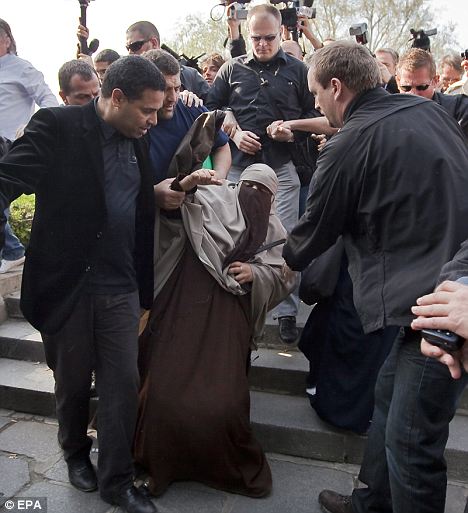
A woman in niqab being arrested in Paris, April 12, 2011, copyright EPA

Of Civilities and Dignities

On 22 June 2009, Nicolas Sarkozy, the French President, asserted that burqas (or the burqa-clad?) are “not welcome” in France, adding that “[i]n our country, we cannot accept that women be prisoners behind a screen, cut off from all social life, deprived of all identity” and that “the veils reduced dignity.” France’s Muslim minority is Western Europe’s largest Muslim minority, estimated at six-million-strong.  And this is just an approximation, as the French Republic implicitly claims to be post-race and post-religion via a prohibition on any census that would take into account the race or religion of its citizens. (This anxiety mirrors the brouhaha in Indian media àpropos the much-contested enumeration of OBCs or Other Backward Castes in the Indian census surveys of 2011, or the urgency to declare some spaces post-caste, post-feminist, and post-racist while casteism, patriarchy and racism continue unabated.)

Continue reading “Of Niqabs, Monsters, and Decolonial Feminisms”

CulturEscapes and the Moral Duty of BDS Today


The neutral Switzerland is about to host a yearly Culturescapes festival. Every year the festival focuses on a different country. This year- the most successful for cultural boycott, yet- it just had to play into Desmond Tutu’s hands and focus on Israel.

A Word about Culture

Culture is a word I’ve been hearing a lot lately. Israel’s Brand Israel campaign is focusing on PR apartheid; Hiding it’s atrocities as best it can, and highlighting it’s “advantages”:

In the Ministry of Foreign Affairs, 6 niches were identified in which Israel has a relative advantage… The 6 niches through which it is planned to promote Israel, in the world, are environment (with an emphases on desert agriculture); Science and technology (medicine, internet and hi-tech); Culture and art; Human variety and tradition; lifestyle and leisure culture; Tikun Olam [=Fixing the world] (support of populations of special needs).

Continue reading “CulturEscapes and the Moral Duty of BDS Today”

An Élite Not Unlike Ours! Who’d Have Guessed?!

By Huma Dar

Rakhshanda Jalil writes in The Hindu, 27 February 2011, about “that elusive connect with India when she was least expecting it” on a visit to Karachi, Pakistan.  The title of her piece is “A city not unlike home.”

I am always amused when Indians are surprised and taken aback by Pakistanis (whether in Karachi or Lahore or elsewhere) who “speak Urdu and English with almost equal aplomb” or by their “silk sarees and natty blazers” or by their possible cosmopolitanism!!! (Class is class, unfortunately, and the élite exhibit their privileges in similar ways all over the region!)  Does it not, if just remotely, smack of the loaded “praise”: “Gee! Obama is so articulate!” — also known as “the racism of lowered expectation”?  Why would Indians expect otherwise from their class-affiliates on the other side of the border?  Or is it that Bollywood’s Pakistan-bashing fantasies are actually swallowed uncritically — hook, line, and sinker —  even (or perhaps especially) by the educated Indians, eliciting “fears about Kalashnikov-toting Taliban and marauding Muhajirs.”

And by the way, Pakistanis are not all “tall, well-built, good-looking people,” especially under the normative definition of “good-looking” in South Asia (fair-skinned or with a “wheatish complexion”) — thank god for the latter!  Sadly, the former two ascriptions, of course, too easily go awry given malnutrition due to poverty. Continue reading “An Élite Not Unlike Ours! Who’d Have Guessed?!”

Pakistan: A Deficit of Dignity

M. Shahid Alam

Pakistan’s rulers and ruling elites may well be thinking that the wave of people’s indignation that started in Tunisia and is now working its way through Egypt, Jordan and Yemen will never reach them. Perhaps, they are telling each other, ‘We are safe: we are a democracy.’

The Arabs who are pouring into the streets of Tunisia, Egypt, Jordan and Yemen are not protesting only against their dictatorships. Simultaneously, they are also protesting against governments that have sold their dignity and bartered the honor of their country. Nearly, all the Arab rulers are self-castrated eunuchs in the courts of foreign powers, who have turned their own countries into police states, and who jail, maim, torture and kill their own people to please their masters.

The Arabs are venting their anger against elites who have stymied their energies by turning their societies into prisons. In complicity with foreign powers, these elites have ruled by fear, blocking the forward movement of their people because this movement collides with the imperialist ambitions of Israel and the United States.

It is true that Pakistan has had ‘elected’ governments alternating with military dictatorships. Increasingly, however, these governments, whether civilian or military, have differed little from each other. The priority for both is to keep their power and US-doled perks by doing the bidding of the United States and Israel.

Starting in the early 1990s, Pakistan hurriedly embraced the neoliberal paradigm that emanated from Washington. Hastily, successive ministers of finance and privatization – all of them IMF appointees – went about dismantling Pakistan’s industries, selling off for a song its state-owned enterprises, and empowering Pakistan’s elites to engage in unchecked consumerism.

Continue reading “Pakistan: A Deficit of Dignity”

Hollywood and the war machine

Empire examines the symbiotic relationship between the movie industry and the military-industrial complex.